A curated overview for businesses, universities and research centres
Among the streets of Brussels, the canals of Amsterdam, the squares of Berlin and the restless energy of Hamburg, some of the continent’s most strategic R&D calls are opening their doors this summer. A mosaic of opportunities that may seem scattered, yet is surprisingly coherent. It spans worlds that appear far apart: the depths of the blue economy, the tenacity of technology-driven SMEs, the subtlety of educational assessment and the boldness of deep tech startups. Here, distilled, is the map of what truly matters right now.
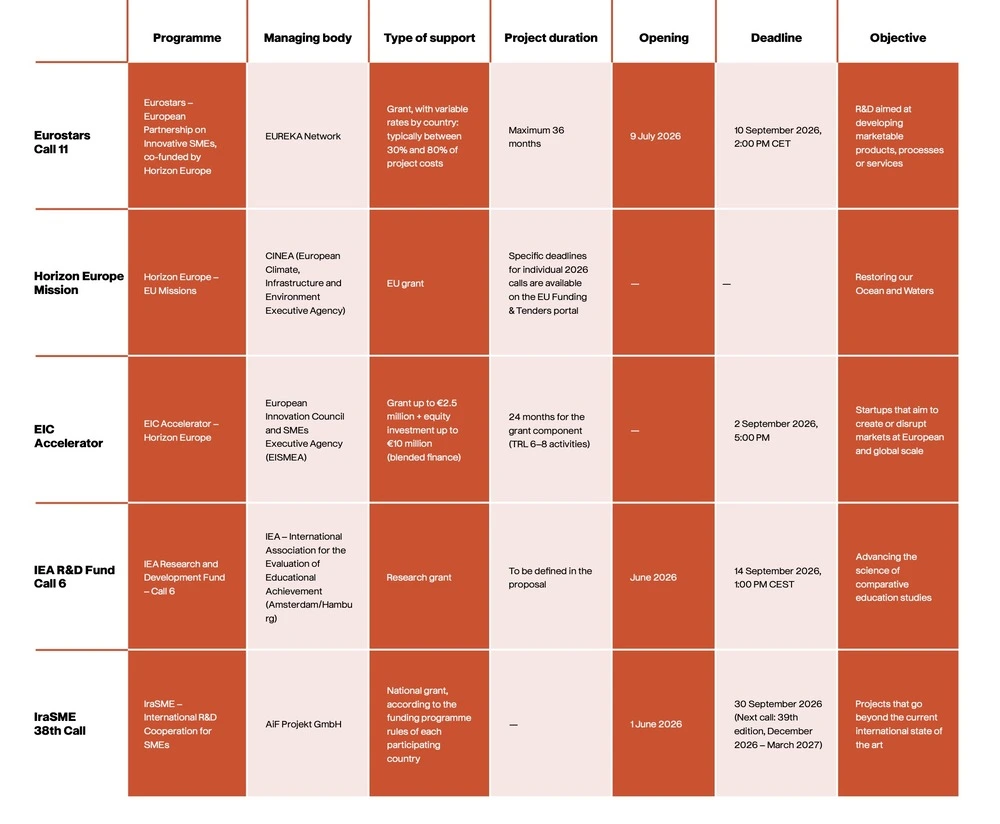
Eurostars Call 11. Innovating together, across borders
Eurostars is the instrument designed for innovative SMEs that want to do research beyond their national borders. The mechanism is simple in its architecture and ambitious in its reach: an international consortium – with at least two independent partners from at least two Eurostars countries, led by an SME – submits an R&D project on a centralised platform, while funding is disbursed by the national agencies of each participating country according to their own rules.
More than thirty-five countries are taking part in Call 11. These include all the major European states and non-EU partners such as Canada, South Korea, Singapore and South Africa. Italy alone currently has no national funds available for this window. Italian companies that wish to take part may do so through self-funding, or keep an eye out for any updates from their national contact point.
The programme imposes no thematic constraints. R&D in any sector is eligible for funding, provided it is aimed at developing marketable products, processes or services. The overarching conditions are that the project must have civil applications, that the SMEs from Eurostars countries must account for at least 50% of the total budget. No single partner or country may cover more than 70% of the project’s overall costs.
Applications are submitted through myeurekaproject.org. It is strongly advisable to contact your national or regional funding body in advance to verify fund availability and specific eligibility criteria.
Horizon Europe Mission: restoring our Ocean and Waters
In January 2026, the European Commission presented the new calls under the Horizon Europe Work Programme 2026/27 dedicated to EU Missions. A dedicated info day for the “Restore our Ocean and Waters by 2030” mission was held on 21 January. The 2026 calls for proposals — identified under the code HORIZON-MISS-2026-OCEAN — are now accessible through the Commission’s Funding & Tenders portal.
This Mission was born to respond to a silent but profound crisis. Pollution, warming and overexploitation are undermining the health of European and global aquatic ecosystems.. Brussels’ answer is both systemic and operational. The Mission is built around three axes. The first is the protection and restoration of marine and freshwater biodiversity, in line with the EU Biodiversity Strategy 2030. The second is the prevention and elimination of pollution, under the “Zero Pollution” Action Plan. The third looks to the decarbonisation and circularity of the sustainable blue economy.
On the territorial side, the Mission operates through thematic “lighthouses” across Europe’s major sea and river basins: Atlantic-Arctic, Mediterranean, Baltic-North Sea, and Danube-Black Sea. These spaces function as living labs where solutions are demonstrated, deployed and scaled. More than 1,000 organisations – including regions, cities, businesses and coastal communities – have already signed the Mission Charter, pledging concrete actions.
One of the Mission’s most innovative technical tools is the Digital Twin Ocean. It is a virtual representation of the ocean capable of integrating heterogeneous data, simulating future scenarios and supporting real-time marine governance decisions. Proposals may be submitted by transnational consortia composed of universities, research bodies, local authorities, SMEs and large companies. Specific deadlines for individual 2026 calls are available on the EU Funding & Tenders portal.
IEA R&D Fund – Call 6: education science
The IEA, the international association based in Amsterdam responsible for comparative education studies such as TIMSS and PIRLS, has opened the sixth edition of its research and development fund. This is an opportunity directed not only at internal researchers, but above all at those working in universities, research institutes and independent survey organisations who wish to contribute to improving the science behind major international learning assessments.
The call is thematically open, but the IEA highlights several areas of particular interest: questionnaire design and innovative response formats; improving the measurement of core constructs within IEA studies; the comparability of assessments across cycles. Also flagged are the measurement of socioeconomic status and imputation approaches; the use of technology to improve field operation procedures; and the handling of bias and non-response. Further areas include the application of machine learning and artificial intelligence to data analysis; the augmentation of collected data using external sources such as administrative or EMS data; data visualisation and tools for tracking and synthesising secondary analyses using IEA data.
The sixth edition introduces several changes from previous rounds: limitations on the use of generative AI in drafting proposals (permitted only for marginal support tasks, not for generating the core scientific content), budgets expressed in euros, and more detailed expectations regarding timelines, outputs and cooperation with the IEA. Proposals must be submitted via the IEA Opportunities Platform before the deadline.
Transnational R&D built for SMEs with IraSME – 38th Call
IraSME was born from a simple insight: small and medium-sized enterprises rarely have the resources to build international research partnerships on their own, but they often have a strong technical idea. The network brings together national agencies from different countries that co-fund transnational R&D projects submitted by consortia of at least two companies from at least two participating countries.
The 38th call involves Austria (FFG), Brazil (EMBRAPII), the Czech Republic (MPO), Flanders/Belgium (VLAIO), Germany (ZIM/AiF Projekt GmbH), Luxembourg (Luxinnovation), Türkiye (TÜBİTAK) and Wallonia/Belgium (SPW). Each partner receives funding from its own national agency according to domestic programme rules: this is therefore a parallel co-funding arrangement rather than a shared pool.
What does IraSME fund? Projects that go beyond the current international state of the art, involving technical or experimental development up to prototype level and carrying significant technical risks for all partners involved. A minimum consortium of two companies from two different countries is required (with exceptions for Austria and Switzerland). Applications are submitted by email to the network secretariat, accompanied by the IraSME application form, a draft consortium agreement and a Gantt chart. In parallel, each partner must submit an application to their national agency in accordance with local rules.
A free consultation service is available by email and phone; German applicants (ZIM) may submit a project outline up to six weeks before the deadline to receive non-binding preliminary feedback.
EIC Accelerator, the launchpad for startups
When Brussels wants to back a startup that could redefine an entire sector, it does so through the EIC Accelerator. It is the most ambitious instrument of the European Innovation Council: nearly €635 million deployed in 2026 to fund individual innovative companies with the potential to create or disrupt markets at European and global scale.
The mechanism is designed for those who already have something tangible in hand – technologies between TRL 6 and TRL 8, meaning prototyped, demonstrated or in the process of being validated – and who need patient capital that the market is not yet willing to provide on its own. The EIC’s response is a dual package: a grant component of up to €2.5 million, plus the possibility of a direct equity investment in the company of between €1 and €10 million, disbursed through the EIC Fund.
Application stages and 2026 deadlines
The selection process unfolds in three progressive stages. In the first, the company submits a twelve-page short proposal, a pitch deck and a three-minute video — a lean format designed to lower the barrier to entry. If it receives a “GO”, it proceeds to the full proposal stage, which requires a more detailed form, financial data, an FTO analysis and a further video pitch. The third stage is a face-to-face interview with the EIC Jury, the most selective step, which determines the actual awards.
For 2026, full proposal deadlines are scheduled approximately every two months: the next is 2 September, followed by 4 November. Those who do not reach the funding threshold but exceed the minimum score are awarded a Seal of Excellence – a mark of quality that opens doors to other public and private investors across Europe. Startups and SMEs from all EU member states and Horizon Europe-associated countries may apply. Submissions must be made as a single entity, not as a consortium.
Innovation is never a solitary act
Innovation is never a solitary act. It is a truth you can find beyond the deadlines and the forms, beyond the consortium requirements and the co-funding percentages. Whether international or local, deep tech or educational, every winning proposal will be, above all, a story of connections. Between companies that did not know each other, between science and policy, between an idea and its first real test.