

What is ozonized oil and why does quality matter?
Innovares has been studying and developing the method for the ozonization of vegetable oils, since 2006. In 2020, Innovares obtained ISO 22716:2007 quality certificate and started a process aimed at the chemical, physical, toxicological and eco-toxicological characterization of its ozonized sunflower seed oil (Ozonia 3000 Sunflower).
In 2022, Ozonia 3000 Sunflower was included into ECHA (European Chemical Agency) database and became the first world’s ozonized sunflower seed oil to be assigned a unique identification number (EC N.: 924-751-7) by the main authority regulating the production of chemicals to ensure their safe use in Europe. Innovares will always be ECHA Lead Registrant of ozonized sunflower seed oil.
Scientific literature attributes to ozone antimicrobial, antinflammatory and biostimulating properties, but, due to its instability and toxicity, its medical use presents critical issues. For topical uses, ozone gas can be substituted by ozonized oils [1].
How ozonized oils are formed
Ozonized oils are the reaction products between ozone and fatty acids. Ozonized oils do not contain ozone and do not release ozone. When O2/O3 gas mixture is insufflated into vegetable oils, ozone reacts with the double bonds of the unsaturated fatty acids with the synthesis of ozonides (Figure 1). Ozonides are organic compounds, stable at temperatures < 50 °C [2].
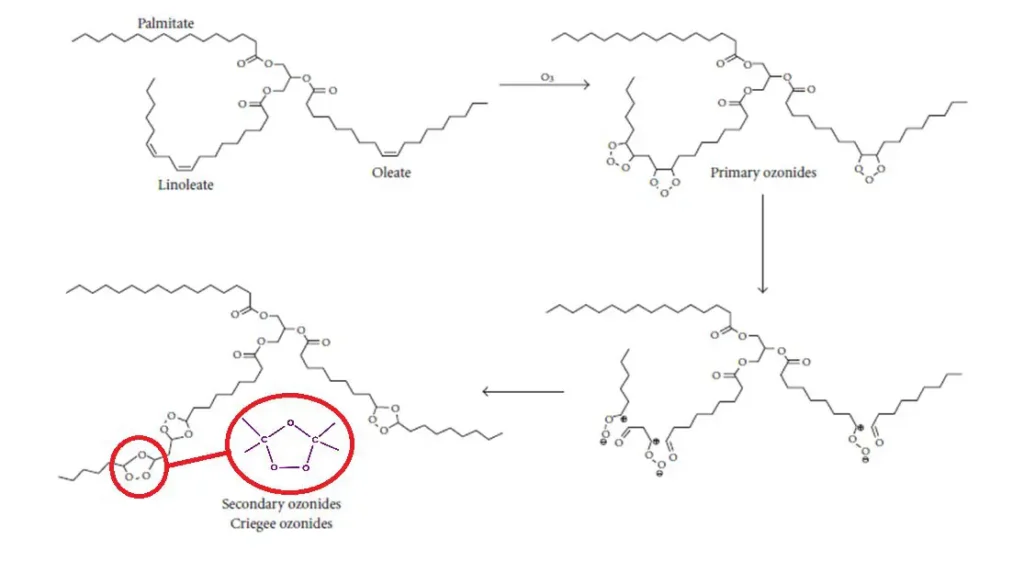
Figure 1: Representative chemical structures of ozonized derivatives which are formed by chemical reaction of ozone with unsaturated triglycerides. The primary ozonides are transient, unstable species which rearrange in the normal, secondary ozonides also known as Criegee ozonides [2].
When ozonized oils are applied to somatic tissues, in the presence of lipids and water, ozonides rapidely react with production of reactive oxygen species (ROS), such as free radicals, aldehydes and hydrogen peroxide, which, in turn, react with lipids to form lipoperoxides (LOPS). Both have antimicrobial activities.
On somatic tissues ROS and LOPS together generate a sort of eustress, to which cells respond by secreting antioxidant enzymes, antinflammatory interleukins and growth factors. Catalase enzyme breaks down hydrogen peroxide into water and oxygen, thereby promoting oxygenation of peripheral tissues. This mechanism contributes to restoration or maintenance of physiological normality (homeostasis).
The chemical mediators mentioned above are those secreted by human organisms in response to adverse conditions, so ozonized oil respects the patient’s physiology, since it doesn’t alter biological responses and its medical use is never contraindicated.
Choosing the right base oil: the role of unsaturated fatty acids
Vegetable oils are composed of triglycerides, with small amounts of di- and monoglycerides, where glycerol is esterified with fatty acids, which can be saturated, mono- (oleic acid) or polyunsaturated (linoleic acid and linolenic acid. This latter is present in negligible amounts). The greater the amount of unsaturated fatty acids, the greater the number of double bonds that can react with ozone, forming ozonides.
Among edible oils, sunflower seed oil has the highest degree of unsaturation (Table 1).
| VEGETABLE OIL | Oleic Acid (%) | Linoleic Acid (%) |
| Extra virgin olive oil | 70 – 83 | 5 – 10 |
| Olive oil | 63 – 80 | 8 – 15 |
| Sunflower seed oil | 28 – 35 | 55 – 70 |
| High-oleic Sunflower seed oil | 75 – 85 | 4 – 10 |
| Soybean oil | 20 – 30 | 50 – 65 |
| Coconut oil | 5 – 8 | 1 – 2 |
| Sesame oil | 34 – 45 | 37 – 48 |
| Palm oil | 13 – 16 | 2 – 3 |
Table 1 — Degree of unsaturation of selected vegetable oils, expressed as percentage of unsaturated fatty acids (data from Gemini AI).
The Innovares ozonization process: parameters, control, and safety
Ozonides are not the only oxidizing chemical species found in ozonized oils, aldehydes may also be present. Aldehydes derive from prolonged oxidation of fatty acids and phenolic compounds, naturally present in vegetable oils. Ozonization process consists of blowing an O2/O3 gas mixture into the oil, under stirring. Parameters that regulate the process are: ozone concentration, gas pressure, stirring speed, temperature and time [1]. When parameters are correctly set, ozone reacts with the double bonds of unsaturated fatty acids with production of ozonides, without increase in aldehydes, in particular short-chain aldehydes, which are toxic by-products (Table 3).
| ALDEHYDE | Raw sunflower seed oil (mg/kg) | Ozonized sunflower seed oil (mg/kg) |
| Formaldehyde | < 1 | < 1 |
| Acetaldehyde | 4 | 3 |
| Acrolein | 56 | 57 |
| Propanal | < 1 | < 1 |
| Crotonaldehyde | < 1 | < 1 |
| Butyraldehyde | < 1 | < 1 |
| Benzaldehyde + iso-valeraldehyde | 3 | 5 |
| Valeraldehyde | 2 | 3 |
| o-tolualdehyde | 1 | 6 |
| m-tolualdehyde | 1 | 3 |
| p-tolualdehyde | 28 | 40 |
| Hexanal | 30 | 35 |
| 2,5-dimethyl-benzaldehyde | 1 | 3 |
| Heptanal | 12 | 13 |
| Octanal | 14 | 30 |
| Nonenal | 62 | 70 |
| Nonanal | 107 | 125 |
Table 3 — Aldehyde analysis (mg/kg) comparing raw and ozonized sunflower seed oil (Ozonia 3000 Sunflower). Values remain stable, confirming safety of the ozonization process.
Fatty acid profile: raw vs. ozonized sunflower seed oil
Innovares ozonization method allows for the saturation of over 75% of the unsaturated fatty acids in the raw oil, with formation of stable ozonides (Table 2), keeping negligible aldehydes production (Table 3). Avoiding the formation of harmful by-products is essential to obtain an ozonized oil recognized by ECHA as non-toxic and non-hazardous by ingestion, as it is for Ozonia 3000 Sunflower.
The reported percentage currently represents the maximum limit for ozonized sunflower seed oil. Ozone attack on the double bonds leads to changes in lipid molecules, generating steric hindrance that progressively limits the availability of double bonds along ozonization. Unsaturated double bonds become increasingly difficult to be reached by ozone, as the ozonization process progresses.
| OXIDATIVE STATUS | Raw triglycerides fatty acid profile Relative % | Oxidized triglycerides fatty acid profile Relative % |
| Oxidized Fatty Acids (OH, OOH C18:1, C18:2, C18:3, Keto C18:1) | 0.28 | 14.11 |
| Oxidized Fatty Acids (Keto C18:2, C18:3) | 2.91 | 61.66 |
| Total of oxidized Fatty Acids | 3.19 | 75.77 |
| Conjugated Fatty Acids C18:3 | 20.85 | 0.99 |
| Conjugated Fatty Acids C18:2 (cis-trans, trans-cis) | 0.66 | 0.52 |
| Conjugated Fatty Acids C18:2 (trans-trans) | < 0.01 | 0.03 |
| Total of Conjugated Fatty Acids | 21.51 | 1.54 |
| Total of Natural Fatty Acids | 75.30 | 22.69 |
Table 2 — Fatty acid profile comparison between raw and ozonized sunflower seed oil (Ozonia 3000 Sunflower), showing the transformation of unsaturated into oxidized fatty acids.
The higher the concentration of ozonides, the greater the impact of the ozonized oil on the patient’s physiology. Ozonide concentration is the main parameter for establishing the quality of ozonized oil, but its determination is complex and expensive. The degree of ozonization is well described by the peroxide index (PI), which expresses the concentration of peroxide groups (-O-O-), calculated as meqO2/kg of ozonized oil. The chemical structure of the ozonide is characterized by the presence of a -O-O- bond (Figure 1).
Peroxide index estimates the stability of ozonized oils. When an oil with high PI comes into contact with air, it does not undergo changes since it has no double bonds that can be attacked by atmospheric oxygen.
When an ozonized oil with low PI comes into contact with air, oxygen can react with the unsaturated fatty acids (not saturated by the ozonization process) with formation of peroxyl radicals, which, in turn, react with the double bonds of unsaturated fatty acids (generating a chain reaction), with the production of allyl compounds and linear peroxides. Linear peroxides are more reactive than ozonides and reduce the stability of the ozonized oil. Ozonized oils with high PI can be stored under standard environmental conditions (1 atm pressure and 25 °C temperature) for very long periods.
Minimum PI thresholds for germicidal activity
As previously expressed, PI represents an estimate of the efficacy of the ozonized oil. Sunflower seed ozonized oil must have PI > 630 meqO2/kg, in order to show germicidal properties [3]. Innovares produces, stabilizes and standardizes ozonized sunflower (Ozonia 3000 Sunflower), sesame (Ozonia 3000 Sesame) and olive (Ozonia 1500 Olive) oils, having PI > 3000 meqO2/kg, PI ≥ 3000 meqO2/kg and PI ≥ 1500 meqO2/kg, respectively. The difference depends on the unsaturation degree of raw oils (Table 1). A PI value of at least 1500 meqO2/kg for olive oil is sufficiently high to guarantee long-term stability and shelf life.
Applications of ozonized oils: medicines, cosmetics, and medical devices
Onized oils are widely used as active ingredients in medicines, cosmetics and medical devices. Whether the source of the oil is, the quantity of the ozonized oil must always be reported. Even more important, is the declaration of quality of the ozonized oil.
Ozonized oil with high PI cannot be used as is (it would be excessively oxidizing), but in association with excipients, which are fundamental in favoring adaptation of ozonized oil-based formula to the condition to be treated. Only high-quality ozonized oils contribute to realize products that may represent a valid therapy, in the respect of the patient’s physiology.
References
1. Martinez-Sanchez G. Scientific rationale for the medical application of ozonized oils: an update. Ozone Therapy Global Journal 2021; 11(1):239–272.
2. Skalska K, Ledakowicz S, Perkowski J, Sencio B. Germicidal properties of ozonated sunflower oil. Ozone: Science & Engineering 2009; 31(3):232–237.
3. Travagli V, Zanardi I, Valacchi G, Bocci V. Ozone and ozonated oils in skin diseases: a review. Mediators of Inflammation 2010; Article ID 610418, 9 pages. doi:10.1155/2010/610418.