It reveals an ecological footprint that can be mitigated through design and a roadmap to embrace a new vision for digital sustainability
The data center sector finds itself in the midst of an unprecedented dichotomy. The exponential growth of computational demand requires increasingly powerful infrastructures, especially in the current global context, where the pervasive use of AI has now become widespread and is pushing data centers toward operational limits never reached before. However, responsibility toward environmental factors and sustainability represents an urgency that can no longer be ignored.
Beyond Power Usage Effectiveness
In this context, the joint white paper by Data4, a leading European operator in the data center market, and APL Data Center, a French engineering and sustainable design consulting company, has been published. The title: Measuring the environmental impact of data centers to take better decisions summarizes the essential nature of its content. This is not just a market report or a reporting exercise, but rather the first complete and scientifically rigorous Life Cycle Analysis (LCA) of a data center (specifically, a 5 MW one).
This is not the first document to analyze the environmental impact of data centers. The industry currently relies on PUE (Power Usage Effectiveness), an energy efficiency indicator, to evaluate the environmental effect/cost ratio of each product. However, PUE overlooks many aspects that generate an impact on the overall ecological footprint.
The Data4 and APL Data Center paper, instead, illustrates a new, more structured and comprehensive investigation paradigm, adopting the international ISO 14040/14044 standards (the framework principles for Life Cycle Assessment). It also examines every single impact, from the production of raw materials needed for building data centers, to the energy cost of their operation, up to final decommissioning. This approach is fundamental for the general awareness that the total environmental impact generated by a digital infrastructure comes not only from the electricity used during operation and the carbon dioxide produced, but from a whole series of consequences, material mobilizations, electrical impulses, and final waste produced.
The nature of Data Centers
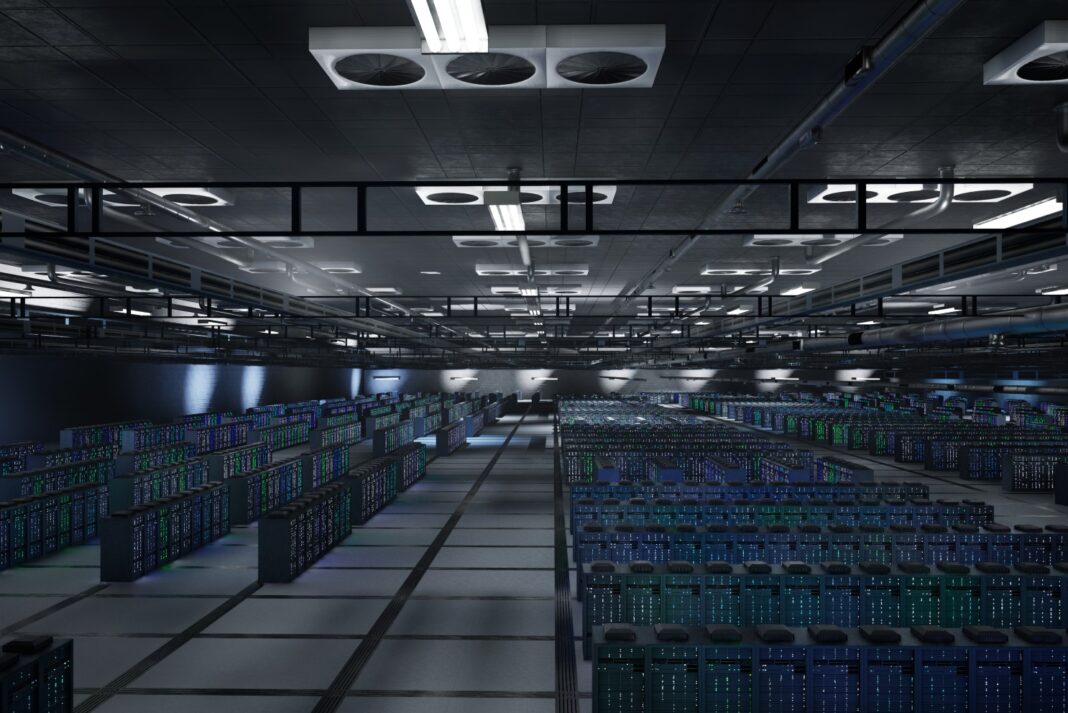
To better understand the magnitude of the impacts described in the analysis, it is necessary to understand the nature and functioning of a data center. It is not just many computers working in synergy, but a true physical-digital ecosystem, highly engineered and complex, where hardware, software, and firmware operate in symbiosis, together with power supply mechanisms and cooling systems that maintain their physiological balance. The heart/brain that manages and processes information, as well as the ability to scale, store, and transmit data, is the IT infrastructure, which can have different physical configurations depending on the required performance complexity.
The architecture behind data processing
Mainframes are the most complex data centers existing today. They are very high-performance systems, capable of handling billions of operations in real time, as currently happens with the most widely used AI. Alongside computing capacity, there are storage systems, which contain and preserve very large volumes of data, and low-latency processing units (those working in the background), until they are used for processing that same data. This entire system is interconnected among its components and with the network. This connectivity is guaranteed by a network backbone composed of routers and kilometers of optical fiber.
What has been described, which is the internal structure of the data center, operates continuously. Therefore, it requires an equally sophisticated physical support infrastructure. Uninterruptible Power Supplies (UPS) work in close contact with cooling systems. The former ensures a non-stop electrical supply, connected to local utilities and diesel generators that self-activate in case of emergency. The latter manage the immense heat generated by the electrical supply activity, therefore they are fundamental and extremely important for the proper maintenance of the entire ecosystem. Cooling systems therefore represent one of the main vectors of energy consumption. Today, for the most part, they vary from traditional direct expansion systems (i.e., releasing HFC refrigerant gas into the premises) and chilled water, to more innovative solutions, such as free-cooling, which exploits low-temperature outside air.
Measuring every smallest detail
Life Cycle Analysis works by meticulously breaking down every aspect of the object it examines, both its operation, its production, and its disposal. In summary, the resulting report breaks down total carbon dioxide emissions: the production of necessary equipment for data centers (predominantly steel and concrete) contributes 39%, the operational phase related to usage weighs 48%, and the remaining 13% is due to maintenance, transportation, and final disposal. Contrary to what one might assume, therefore, the greater physical carbon footprint is due to the first phase: procurement of materials, transportation, processing, and finally the construction of the equipment. Indeed, before production comes the extraction of raw materials and their transformation. The demand for mineral and metal resources required for the production of a data center is massive.
The solutions proposed by Data4 are based on the technical implementation of eco-design, such as mixing different cements to reduce the carbon footprint, using hollow-core slabs to reduce the amount of concrete (with savings of up to 50% of the current volume), and recycling metals to reduce dependence on primary extraction. For the operational phase, however, Data4 proposes Power Purchase Agreements (PPAs) which guarantee a constant supply of energy from renewable sources. It is impossible to do without electricity in any of the phases.
Water consumption, maintenance and circular economy
The water impact of a data center, at first analysis, seems very reduced (less than 0.1%). However, this refers to direct water consumption. The real impact is indirect, due 57% to electricity generation and 36% to mineral extraction. Data center maintenance generates an impact due to the ordinary and extraordinary operations that maintain its optimal functioning, such as technician visits, replacement of degraded components, and continuous monitoring. Data4 optimizes this phase through the Green Dashboard which, through data processing and visualization, allows its customers to make decisions to extend the useful life of hardware, reducing the need for new production. The final dismantling of parts to be replaced or entire components no longer in use is a crucial point in the discussion on the circular economy and waste management. Deconstructing systems requires careful advance planning to manage them best and, where possible, recycle them.
Microsoft also adopts new strategies
Data4 and APL Data Center are not the only ones moving in this direction. Microsoft, in the process of improving the transparency of its environmental impact, revealed in a document that 97% of its emissions are due to carbon from the supply chain. These are all the indirect emissions produced by the management, production, extraction, processing, transportation, and disposal of raw materials, mainly hardware components and semiconductors. They are particularly difficult to trace and measure in terms of impact, due to their complexity.
To overcome this problem, Microsoft developed CHEM (Cloud Hardware Emissions Methodology), an internal methodology also based on Life Cycle Analysis of components. The main purpose is to improve reporting and categorize which components have a greater carbon footprint. Data cataloging is the first step towards developing new solutions, impossible without a clear and complete quantitative picture of the problem. Microsoft has taken a further step forward: sharing the methodology they developed, and collaborating with various industry consortia, such as the Open Compute Project (OCP) or the Semiconductor Climate Consortium (SCC) to create standardized reports for the entire technology sector.
Towards the first Circular Bio-Data Center
After the publication of the paper, the two entities brought to attention various strategies and solutions to address the sustainability problem. The results of the white paper became the starting point for the Data4Good program, a company plan based on four pillars: environment, people, community, and governance. Their goal is to reduce emissions by 38% for each megawatt of installed infrastructure.
One of the most disruptive innovations is also the creation of the world’s first circular bio-data center. The project was launched in May 2025 in collaboration with the Paris-Saclay University Foundation on the Marcoussis campus in France. The heart of the innovation is the use of residual heat from servers (which is around 26-30°C), usually dissipated into the environment, channeled into modules to power the cultivation and growth of microalgae of the genus Chlorella. One of the most common ideas among the public regarding CO2 recovery to counteract air pollution is planting a large number of trees. There are hundreds of projects and entire companies based on this. However, in nature, this task is mostly due not to trees but to phytoplankton and algae. Chlorella has a CO2 absorption capacity up to 20 times higher than that of trees.

Circular economy opportunities for digital infrastructure
The project exploits this knowledge. The algae grown in these cultivations are used in various ways – biofuels, cosmetics, and nutraceutical products – entire supply chains that in turn generate employment opportunities and economic and territorial resources.
The cultivation of micro-algae using residual heat from servers is an excellent example of applying circular economy concepts, and the synergy between the digital and environmental components shows us that industrial symbiosis between digital infrastructure and the territory is possible.
All these projects offer a mirror of the current reality, but they are much more than that. They also establish a roadmap for the future, inviting all operators and entities in the sector to embrace a new vision for digital sustainability. The first step, as with everything, always begins with awareness. Going back is not possible, as confirmed by the growing investment in this type of infrastructure. This race runs alongside those seeking a way to make it possible in a world that is already presenting the environmental bill.