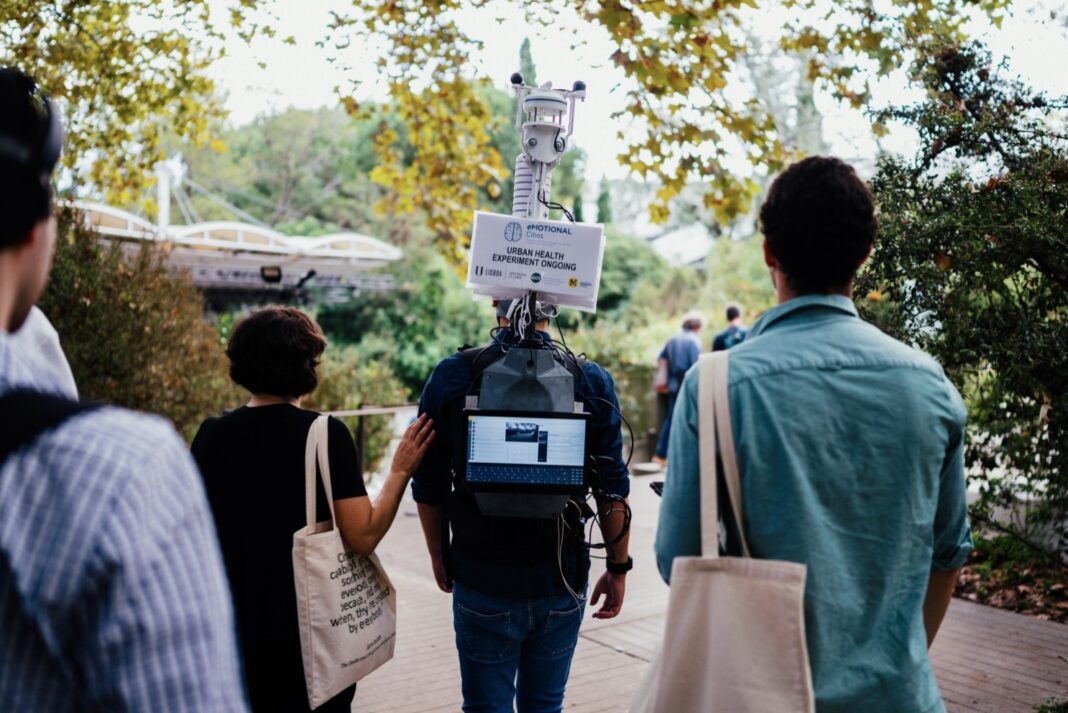
To understand how cities shape human emotions volunteer participants of this project were equipped with portable sensor kit
Cities are complex environments where physical, social, and environmental factors interact continuously with human perception, cognition, behaviour, and ultimately with people’s health and wellbeing. Urban residents are exposed daily to noise, air pollution, traffic, extreme microclimatic events, crowding, and, for the majority, limited access to green and blue spaces. At the same time, urban design can promote social interaction, soft mobility, physical activity, cognitive stimulation, and psychological restoration. Over the past decades, urban research has increasingly recognised that mental health and emotional wellbeing are fundamental components of sustainable development. However, despite growing awareness, decision-makers still lack robust, objective, and spatially explicit evidence on how specific urban environments influence emotions, stress, and cognitive performance, which causes them to hesitate to implement pro-health policies.
Traditional urban indicators often rely on socio-economic statistics, surveys, or environmental monitoring. While valuable, these approaches rarely capture the real-time emotional and physiological responses of citizens as they interact with urban spaces.
Study cities from a human-centred perspective
Advances in wearable technologies, mobile sensing, and geospatial analytics now make it possible to study cities from a human-centred perspective, linking environmental conditions to biological and psychological responses. Within this groundbreaking research context, the eMOTIONAL Cities project was designed to bridge urban planning, neuroscience, environmental psychology, and geospatial science. Its central ambition was to build evidence on how urban environments affect emotions, wellbeing, and behaviour, and how this knowledge can support healthier and more inclusive cities.
eMOTIONAL Cities – Mapping the cities through the senses of those who make them, was a European research and innovation project funded under the Horizon 2020 programme. The project ran from 2021 to 2025 and brought together a multidisciplinary consortium of universities, research centres, and innovation-oriented SME’s from several European countries. The consortium combined expertise in geography, urban planning, neuroscience, psychology, environmental science, data analytics, and digital technologies. The project was coordinated by the University of Lisbon, through the Institute of Geography and Spatial Planning, in collaboration with the Lisbon School of Medicine. The total budget amounted to approximately €5 million, funded by the European Union under Horizon 2020.
eMOTIONAL Cities focused on pilot studies in several European cities, such as Lisbon, London, Copenhagen, and East Lansing (Michigan, USA), selected to represent different urban forms, city genesis, climatic conditions, and socio-cultural contexts. These living laboratories allowed the project to test and validate its methods under real-world conditions.
Measure human responses to urban environments
The main objective of eMOTIONAL Cities was to develop an integrated theoretical and quantitative framework for assessing how urban environments influence emotional states, stress levels, and cognitive functioning. More specifically, the project aimed to:
- Measure emotional and physiological responses to urban environments in real time.
- Link these responses to environmental, spatial, and social characteristics.
- Identify urban features associated with positive and negative emotional experiences, i.e., the urban health determinants.
- Develop evidence-based indicators and metrics for urban health & wellbeing.
- Build a spatial open data infrastructure that stores curated, and harmonized georeferenced data produced under the project initiatives
- Translate scientific findings into practical tools for planners and policymakers.
By achieving these goals, the project sought to support urban policies that promote mental health, social inclusion, and general wellbeing.
A mixed-methods approach
eMOTIONAL Cities adopted a mixed-methods approach that combined quantitative measurements, qualitative assessments, and spatial data analysis.
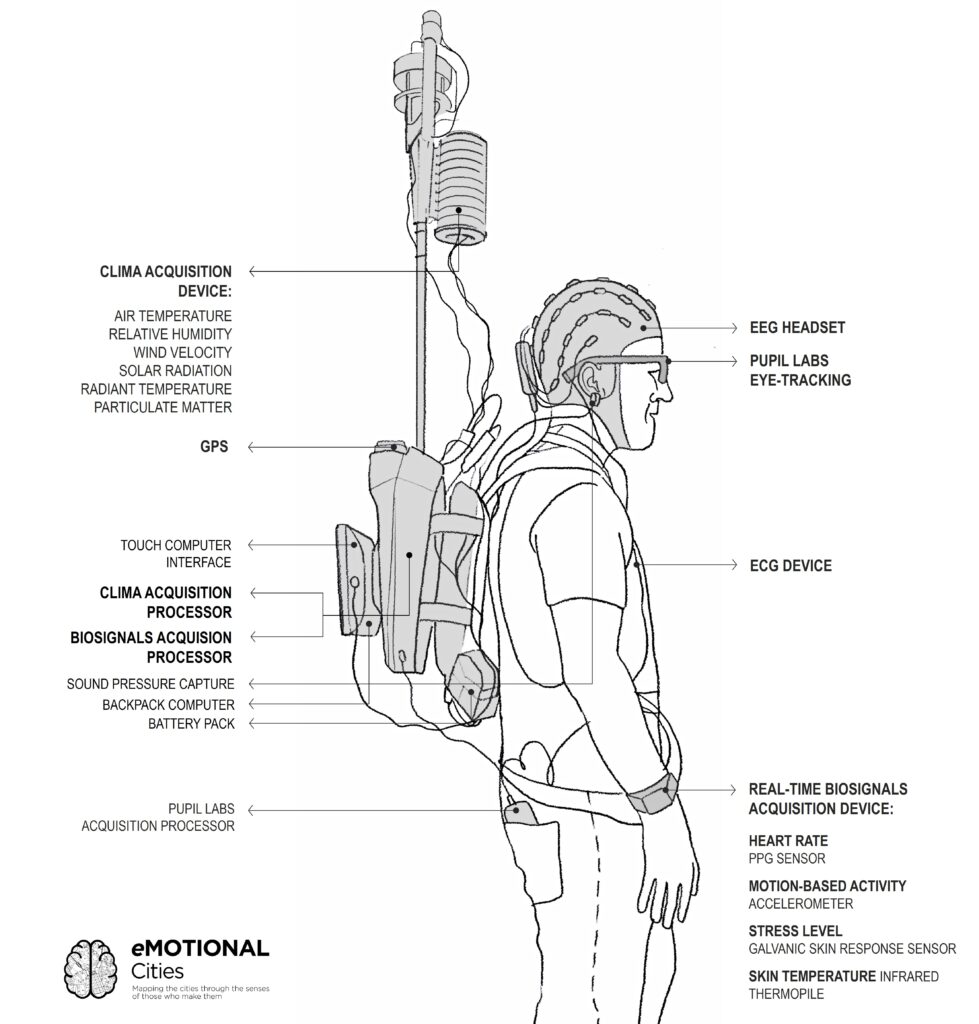
Wearable and Mobile Sensing – At the core of the methodology was the use of wearable environmental and biosensors and mobile devices. Volunteer participants were equipped with portable sensor kit, referred to as Multi-environment wearable data acquisition unit, distinguished as a Key Innovation by the European Union Innovation Radar, which included:
- A multisensory wristband for heart rate, skin conductance, and physical activity.
- Microclimate sensors for measuring air quality, noise, temperature, and humidity.
- Eye-tracking and GPS for geolocation and user interaction.
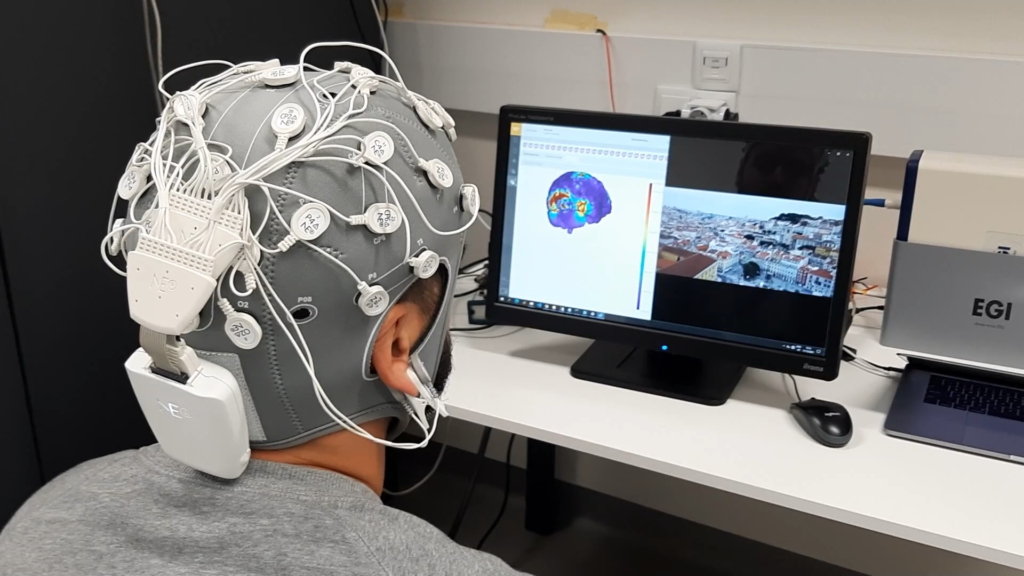
- Mobile EEG for brain responses to urban stimuli
Psychological and Perceptual Assessment – Physiological measurements were complemented by psychological questionnaires and short surveys administered before, during, and after field experiments. These instruments captured subjective perceptions, emotional states, stress levels, and cognitive fatigue. This triangulation between objective signals and self-reported experiences strengthened the interpretation of results.
Geospatial and Environmental Analysis – All collected data were integrated into a geospatial information system (GIS). This allowed researchers to map emotional responses and environmental exposures at high spatial resolution. Advanced spatial analytics were used to relate physiological indicators to urban morphology, land use, vegetation cover, traffic density, street vibrancy, façades complexity, and accessibility to services, amenities and green spaces. Remote sensing data, open urban datasets, sentiment analysis, and local monitoring networks were also incorporated to contextualise field measurements.
A participatory dimension
The project actively involved urban stakeholders, including municipal planners, architects and urban planners, public health professionals, and community representatives. Workshops and co-design sessions were organised to discuss findings and explore policy implications. This participatory dimension ensured that scientific outputs were aligned with real planning needs.
eMOTIONAL Cities generated one of the most comprehensive datasets linking urban environments to emotional and physiological responses in Europe.
The analyses revealed consistent patterns across cities:
- Green and blue spaces were associated with lower stress levels and more positive emotional states.
- High traffic intensity and noise correlated with increased physiological arousal and reported discomfort.
- Walkable environments with good visual permeability and moderate complexity promoted feelings of safety and engagement.
- Poor air quality and thermal discomfort negatively affected cognitive performance and mood.
- Low-cost urban interventions, e.g., more trees, less traffic, building façades clean of graffiti and well maintained, benches, were key to significantly improving navigation and orientation for people with mild cognitive impairment
- Noise and overcrowding prevent the regenerative effect of green spaces.
Importantly, the project showed that emotional responses are highly context-dependent. The same physical environment may be experienced differently depending on social conditions, personal characteristics, and previous experiences.
Development of urban wellbeing indicators
Based on the collected evidence, the project developed a set of urban health and wellbeing indicators combining environmental exposure, psychophysiological stress, and perceptual quality. These indicators provide a more nuanced assessment of urban quality than conventional metrics. They can be used to identify “emotional hotspots”, areas where negative experiences accumulate, as well as “restorative zones” that promote recovery and wellbeing.
eMOTIONAL Cities produced digital tools and visualisation platforms that allow policymakers to explore emotional and environmental data interactively. These tools support scenario analysis and help assess the potential impacts of urban interventions. Examples include dashboards integrating sensor data with maps, and planning support systems for evaluating street redesigns, placemaking, green infrastructure, or mobility changes.
Policy and societal impact
The project contributed to European policy debates on healthy cities, climate adaptation, and social cohesion. Its findings support the integration of mental health considerations into urban planning and environmental regulation. By demonstrating the feasibility of large-scale emotional sensing, eMOTIONAL Cities also paved the way for future research on citizen-centred digital twins and smart city platforms.
eMOTIONAL Cities has shown that emotions and wellbeing can be systematically measured, mapped, and analysed in urban environments. By combining neuroscience, geospatial intelligence, and participatory planning, the project offers a new paradigm for evidence-based urban design. Its legacy lies not only in scientific publications and datasets, but also in a methodological framework that can be replicated across Europe. As cities face increasing challenges related to climate change, ageing populations, and social inequalities, such human-centred approaches will be essential for building healthier, resilient, and inclusive urban futures.
References
- Torres Lahoz, L., Azevedo, C. L., Ancora, L., Morgado, P., Kotval, Z., Miranda, B., & Camara Pereira, F. (2026). Scenario discovery for urban planning: The case of green urbanism and the impact on stress. Futures, 175, 103727.
- Seraphim, A. P., Niu, H., Morgado, P., Miranda, B., & Silva, E. A. (2025). Mapping urban health policies: A scoping review of environmental, behavioural and socioeconomic determinants of health. Progress in Planning, 193, 100926.
- Niu, H., Seraphim, A. P., Morgado, P., Miranda, B., & Silva, E. A. (2025). Mapping urban emotion from geotagged social media data: Age, gender and spatial heterogeneity. Applied Geography, 185, 103768.
- Amaro, J., Ramusga, R., Bonifácio, A., Almeida, A., Frazão, J., Cruz, B. F., Erskine, A., Carvalho, F., Lopes, G., Chokhachian, A., Santucci, D., Morgado, P., & Miranda, B. (2025). Advancing mobile neuroscience: A novel wearable backpack for multi-sensor research in urban environments. Sensors, 25(23), 7163.
- https://zenodo.org/communities/emotional-cities/