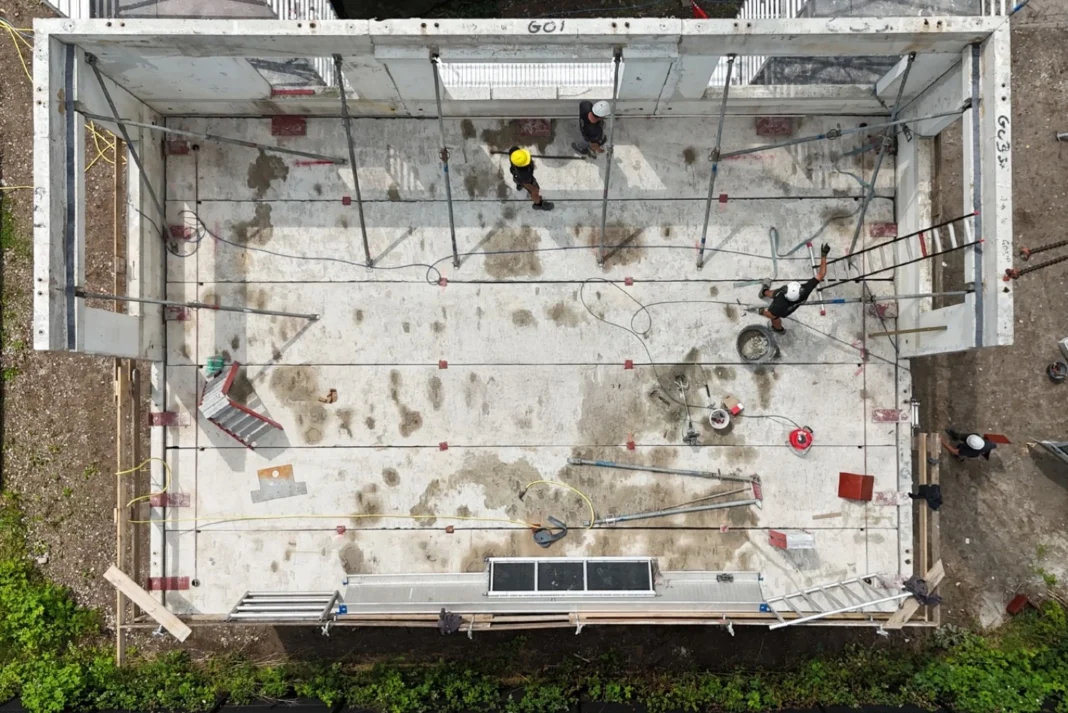
Reusing precast concrete: how the ReCreate project is proving that a building’s structure can move house
The construction sector is responsible for around 35 % of all waste generated in the European Union and a significant share of its greenhouse-gas emissions. Concrete, the most widely used construction material in the world, accounts for roughly 8% of global CO₂ emissions, largely through cement and reinforcement-steel production. Most of that carbon footprint is “locked in” the moment a structural element is cast and installed. At the building’s end of life, the conventional practice of demolition followed by crushing the rubble into low-grade aggregate for road sub-bases or new mixes irretrievably loses the energy and emissions embedded in shaping, reinforcing and curing each individual element.
The hierarchy of circularity in construction places the reuse of whole structural components well above recycling, because reuse preserves the geometry, reinforcement and embodied carbon of the original element. Precast reinforced-concrete components – hollow-core slabs (HCS), beams, columns and façade panels – are technically well suited to this approach. They are produced in a factory and dimensionally standardised, which in principle allows controlled deconstruction from a donor building and reassembly into a new structure. In practice, however, this approach faces several significant barriers. Buildings are not usually designed for deconstruction. Joints between elements were grouted and secured with rebar, original material-quality data is often incomplete or missing, and the regulatory and insurance frameworks for “second-hand” structural components are only now being established across the EU. These are precisely the barriers that the ReCreate project is set up to address.
A €12.5 million bet on second-life structures
ReCreate – Reusing precast concrete for a circular economy is a research and innovation action funded under the Horizon 2020 programme (call H2020-LOW-CARBON-CIRCULAR-INDUSTRIES-2020). The European Commission contribution totals EUR 12,494,045.02. The project started on 1 April 2021 with an original duration of 48 months. This was later extended to 66 months to accommodate the construction of the demonstration pilots, which were slowed by the downturn in the European construction sector. The project is scheduled to conclude in 2026. The project is coordinated by Tampere University (TAU) in Finland; the scientific coordinator is Professor Satu Huuhka. The consortium brings together 22 partners from five countries, organised into four geographic Country Clusters that lead the pilot projects:
• Finland — TAU, architectural studio Liike, structural engineering firm Ramboll Finland, precast manufacturer Consolis Parma. It also brings together contractor Skanska, deconstruction company Umacon and the City of Tampere.
• Sweden — KTH Royal Institute of Technology, the public housing operator Helsingborgshem and the precast manufacturer Strängbetong
• The Netherlands — Eindhoven University of Technology (TU/e), research organisation TNO, engineering consultants CSD. It also brings together precast manufacturer VBI, deconstruction and reuse company Lagemaat and structural engineers IMd.
• Germany — Brandenburg University of Technology Cottbus-Senftenberg (BTU), deconstruction company Ecosoil, structural engineer Ingenieurbüro Jähne. It also brings together the City of Hohenmölsen and digital partner Lohmann und Robinski.
The Croatia Green Building Council (CGBC) completes the consortium, leading communication, dissemination and the analysis of how the project’s outputs can be transferred and replicated beyond the four piloting countries.
Proof through pilots
ReCreate has defined six specific objectives: to demonstrate the value and profitability of reuse; to develop a scalable business model; to develop the technologies and digital tools needed to integrate the supply chain; to safeguard occupational and structural safety throughout the process; to demonstrate the wider potential and mitigate social and legal barriers; and to share knowledge through open access.
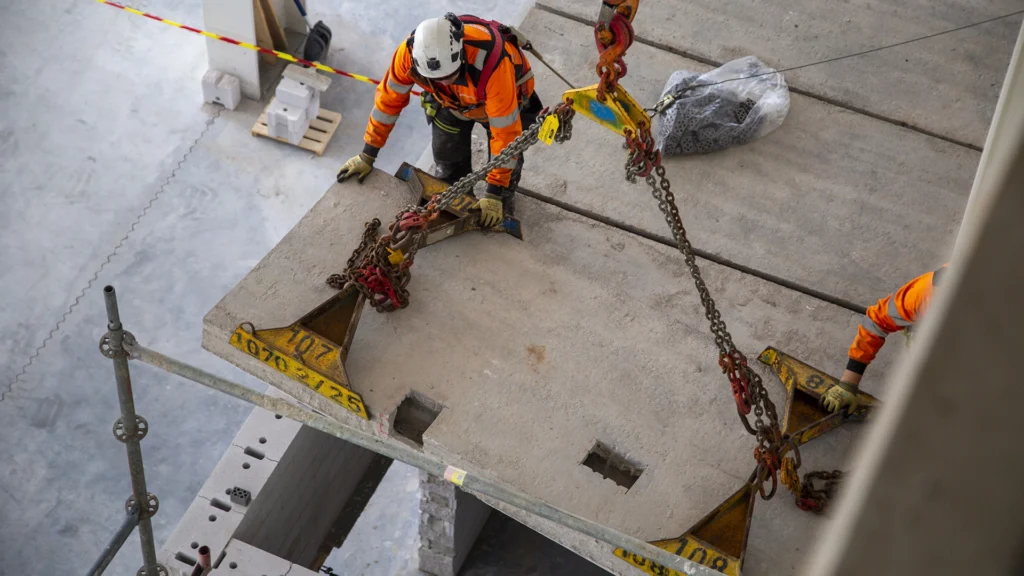
Methodologically, the project is organised into nine work packages and is built around the principle of “proof through pilots”. Each Country Cluster selects one or more donor buildings, from which precast components are reclaimed through controlled deconstruction. The elements are then assessed for quality, refurbished, recertified and reassembled into reuse pilots with a new function. Around this central pipeline, the project develops non-destructive diagnostic methods, including rebar mapping, ultrasonic testing and core-sample protocols. It also creates digital tools such as BIM-based pre-deconstruction audits, QR and RFID tracking, and an open database of reclaimed elements.
In addition, the project develops retrofit connectors for demountable joints. It also analyses business models, life-cycle environmental and economic impacts (LCA and LCC), and the legal and social dimensions of reuse.
Deconstruction done, reuse underway
All four planned pilot deconstructions have been completed. They involved a 1982 office building in Tampere (FI), a 1960s residential block and an industrial building in Helsingborg (SE), a 1987 administrative building in Arnhem (NL), and partial deconstruction of the upper floors of two 1980s panel housing blocks in Hohenmölsen and Großräschen (DE). Dozens of hollow-core slabs, façade panels, beams and columns have been salvaged, stored and refurbished for reassembly.
On the reuse side, the Swedish exhibition pavilion built for the H22 City Fair in Helsingborg was the first full pilot, completed in 2022. In Finland, three mini-pilots in Tampere have been completed. Together, they incorporated 86 reused hollow-core slabs, seven beams and 13 columns into residential and industrial buildings. The main Finnish pilot, a temporary exhibition building, begins construction in 2026. In the Netherlands, a full-scale two-storey mock-up structure in Heerde has been used to field-test the developed connections and tolerances; the main Dutch pilot, the Circulair Centre Netherlands, has received its building permit and is expected to start construction in 2026. In Germany, a temporary test building in Cottbus was erected and dismantled to validate the new retrofit connectors. Meanwhile, the planned reuse pilots are progressing through the permitting process. These include a youth centre in Hohenmölsen and a set of public-use buildings in Kolkwitz.
From project validation to commercial replication
Among the institutional results, particularly significant is the acceptance of the proposed quality-management and recertification procedure for reclaimed elements by the building inspection authorities in Tampere and Helsinki, Finland. This has opened the door to the first commercial replications outside the project. These include the Melkinlaituri housing project in Helsinki, where industrial partners applied the ReCreate methodology, and the Ter Haak office building in Amsterdam, where Lagemaat installed reclaimed precast components. The Swedish and Finnish teams are contributing to national standards for reused precast concrete elements (SiS/TK191 and RTT/TR 204). In Germany, meanwhile, the project is testing the applicability of Brandenburg’s existing technical guidance on the reuse of structural elements in other federal states.
The project’s life-cycle assessments of reclaimed hollow-core slabs indicate substantial CO₂ savings compared with new production, under one important condition: beyond approximately 720 km of road transport, the environmental benefit is exhausted. This makes regional supply chains a critical design parameter for both the ecological and the economic viability of reuse.
The consortium has also built an extensive open-knowledge base: open-access scientific articles, conference papers and four open datasets on the Zenodo repository, covering a pan-European historical material library for concrete and reinforcement, a database of digital models of reclaimed elements, and two datasets on non-destructive concrete diagnostics. The project has produced ReCreate Studio, a prototype Autodesk Revit plug-in. It allows architects and engineers to design new buildings around a database of available reclaimed elements. In September 2025, ReCreate co-organised the 2nd International Conference on Circularity in the Built Environment (CiBEn 2025) in Tampere. The event brought together around 140 international researchers, practitioners and policy-makers.
No longer “can it be done?” but “how to scale?”
In the project’s final phase, the Country Clusters are working toward having the main pilot buildings built. Forthcoming deliverables include a design manual for building with reclaimed components, a comparative LCA and LCC analysis across the value chain. They also include environmental product declarations (EPDs) for reused concrete components. A final transferability and replicability roadmap will target policy-makers, public clients and new market entrants. A final project conference is scheduled for 2026.
From technical feasibility to market adoption
Taken together, the results so far point to a single, central conclusion. The reuse of structural precast concrete is no longer a technical hypothesis. At its current scale, it is already becoming a practical solution, with the first commercial replications emerging where the right enabling conditions are in place. The remaining barriers are no longer about whether it can be done. They concern regulatory predictability, the availability of specialised diagnostic and logistics services, and the existence of regional supply chains. With pilots in four countries and an innovation pipeline –spanning from deconstruction equipment, through digital tools and structural connectors, to business ecosystems – ReCreate is laying the groundwork for the European construction sector to scale the shift from demolition to deconstruction-and-reuse over the coming decade.
REFERENCES
• Database of digital models of reclaimed precast elements: zenodo.org/records/16809738
• CiBEn 2025 conference proceedings (Tampere): doi.org/10.5281/zenodo.17092524
• Alkki, L., Aarikka-Stenroos, L., Jaakkola, E. & Pohls, E. L. (2025). How do
business-to-business actors experience circular solutions? Industrial
Marketing Management, 131, 181–195. https://doi.org/10.1016/j.indmarman.2025.10.012
• Räsänen, A., Laaksonen, A. & Lahdensivu, J. (2025). Sufficient number of core
samples and method to determine compressive strength of in-use and
reclaimed concrete elements. Structural Concrete. https://doi.org/10.1002/suco.70139
• Huuhka, S., Aarikka-Stenroos, L., Lahdensivu, J., Jonker-Hoffrén, P., Arnold, V.,
Stenberg, E., Blok, R., Gudmundsson, K., Teuffel, P. & Mettke, A. (2023).
Recreating the construction sector for circularity: Catalysing the reuse of
prefabricated concrete elements https://doi.org/10.4324/9781003267492-4