An integrated management framework for real-time operational awareness across the full mine-to-product chain
Funded under the Horizon Europe research and innovation programme, DINAMINE: Digital and Innovative Mine of the Future was launched to address one of the mining industry’s most urgent challenges: secure supply of critical raw materials needed for Europe’s green and digital transition while simultaneously reducing the environmental footprint, operational risks and inefficiencies traditionally associated with the industry.
Europe is accelerating the deployment of batteries, renewable energy systems, electrified transport and advanced manufacturing technologies. As a result, demand for minerals such as graphite, lithium and rare earth elements is increasing rapidly. Yet the mining sector faces mounting pressure to modernise. Many operations, particularly small and medium-sized mines, still rely on disconnected software systems, manual reporting procedures and fragmented operational workflows. Data exists, but often in isolated silos that prevent fast, informed decision-making.
DINAMINE’s response is ambitious but practical. It aims to create a connected digital ecosystem that integrates geology, drilling, processing, maintenance, environmental monitoring and operational planning into a single real-time management environment.
Launched in January 2023 under the Horizon Europe research and innovation programme, DINAMINE runs for 42 months. It brings together a multidisciplinary consortium including Norwegian Geotechnical Institute (NGI), Skaland Graphite (Norway), Felmica Minerais Industriais (Portugal), AMV (Norway), Worldsensing (Spain), SINTEF (Norway), Spectral Industries (the Netherlands), PNO Innovation (Italy), and National Institute of Chemistry (Slovenia). Together, the partners are developing and validating technologies intended not only for R&D demonstration, but for future commercial deployment across Europe’s mining sector.
From fragmented operations to intelligent mining
The mining industry has historically digitalised individual activities rather than the mining value chain as a whole. Geological models, drilling information, laboratory analyses, environmental measurements, maintenance records and production schedules are often managed separately, making it difficult to obtain a coherent operational picture.
The DINAMINE project’s core concept was designed specifically to overcome this fragmentation. At the core of the project are the Integrated Smart Mine Planning and Management system and the Mine Information Model. Together, they form the basis of DINAMINE’s integrated digital management framework. Rather than acting as a standalone mine-planning tool, the platform brings together sensor streams, geological data, geotechnical models, processing analytics, maintenance information, production scheduling and environmental indicators into a unified operational environment.
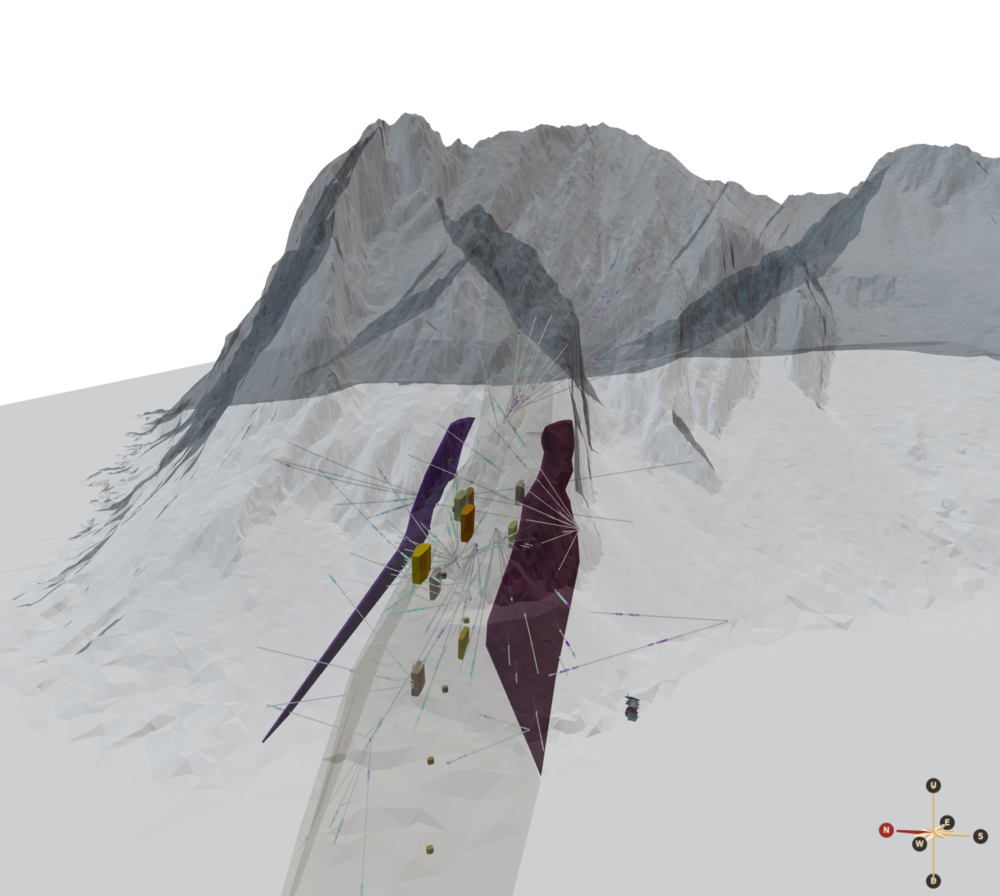
For mine operators, this creates something the industry needs: real-time operational awareness across the full mine-to-product chain. Through the addition of various modules, the DINAMINE system supports short- and long-term mine planning, predictive maintenance, environmental monitoring, financial forecasting and production optimisation. The information is available through web-based dashboards combining live and historical operational data. Operators can visualise live sensor data alongside historical trends and environmental performance indicators, enabling faster and more informed operational decisions.
Importantly, DINAMINE was developed with smaller mining operations in mind. Many advanced mining software ecosystems currently on the market are tailored primarily for large multinational operators with significant digital infrastructure and dedicated IT departments. DINAMINE instead focuses on modularity and interoperability, allowing mines to progressively adopt new technologies without replacing their existing systems.
Automated and optimised excavation
DINAMINE is also advancing automated drilling technologies that can significantly improve precision and efficiency in underground excavation, across both development and production mining.
Underground drilling remains one of the most technically demanding aspects of mining. Drilling precision directly influences blasting performance, ore recovery and downstream processing efficiency, while underground working conditions remain physically constrained and operationally complex.
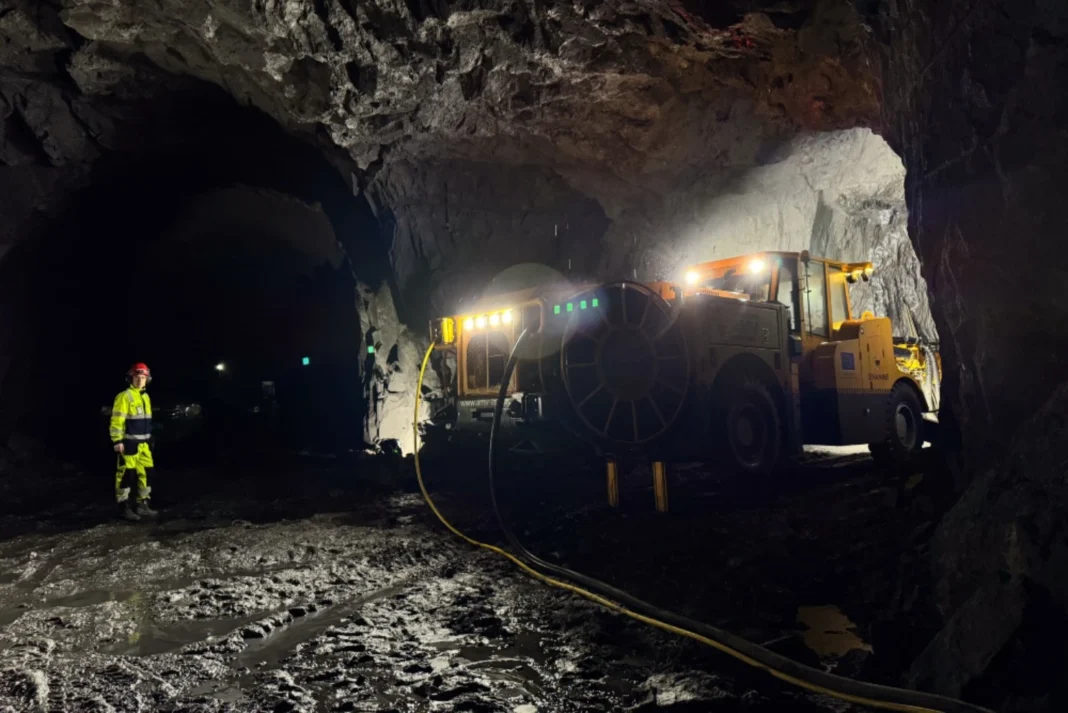
One of DINAMINE’s most visible innovations is its semi-automated drilling jumbo system developed by project partner AMV for underground mining operations. DINAMINE’s jumbo drill technology combines automated boom guidance, Measurement While Drilling technology, predictive maintenance. It is integrated with geological and geotechnical mapping systems in a single platform designed to improve both safety and operational efficiency.
Researchers within the project have developed a technology that designs drilling-and-blasting patterns tailored to the current tunnel or sublevel face. The technology accounts for over- and under-cuts, explosives consumption, and the required geometry relative to ore boundaries or planned tunnel profiles. The so-called Active-Dig system provides the optimised drilling pattern directly to the drilling jumbo’s local coordinate system. The rig’s automated drilling boom executes, drilling each hole at the specified location, length, and angle.
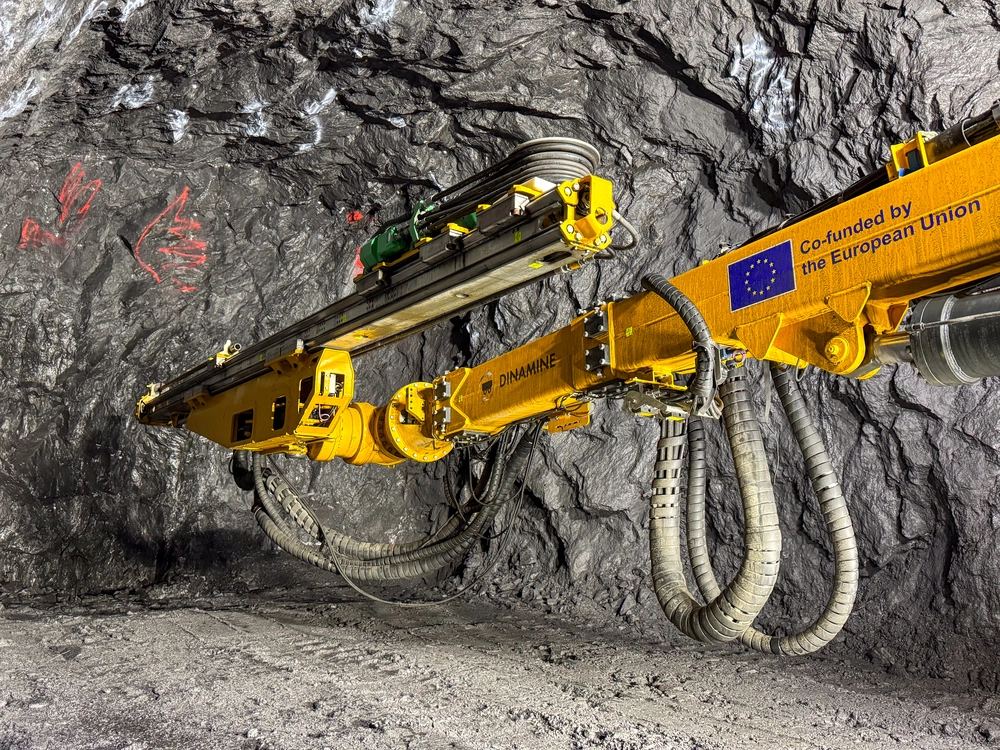
The implications are considerable. Drilling accuracy has a direct effect on blast outcomes. Precise borehole placement reduces overbreak, explosives consumption, ore dilution, and ore loss. It also improves fragmentation and lowering the risk of structural damage to surrounding rock. Conventional drilling practice, by contrast, depends heavily on manual setup, which is time-consuming and introduces variability, particularly in confined or hazardous underground headings.
Operational validation and predictive maintenance
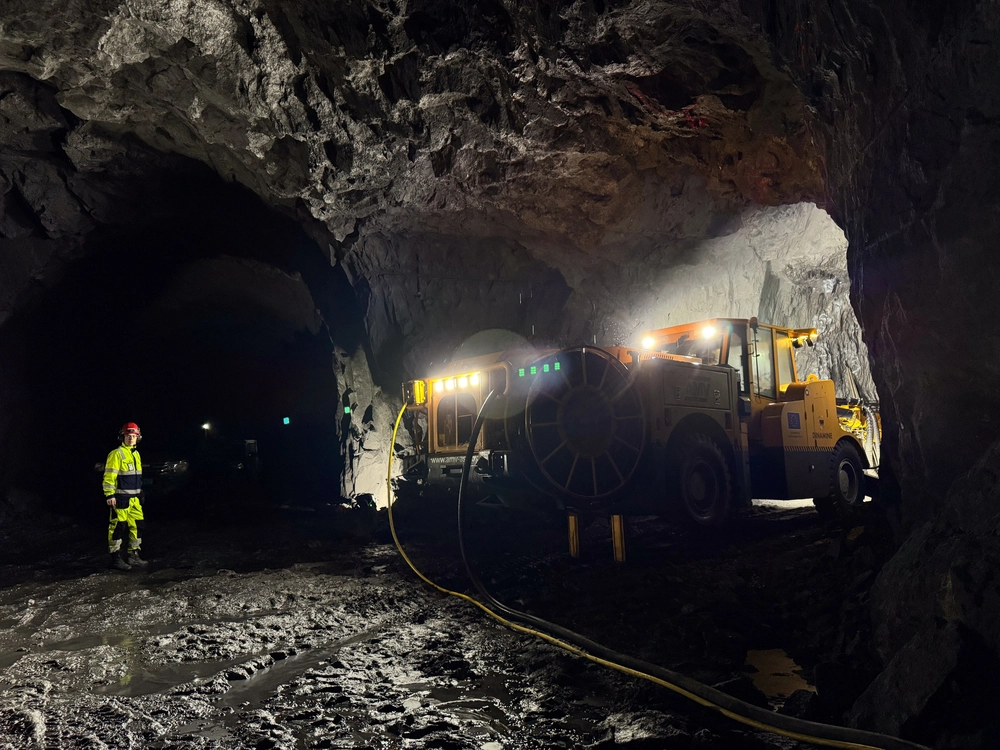
At the Skaland Graphite underground mine in Norway, the project has already demonstrated automated drilling campaigns under operational conditions. Drilling plans developed through the Active-Dig technology were successfully executed by the jumbo drill, demonstrating integration between digital mapping systems and underground drilling operations.
The significance extends beyond automation itself. Advanced underground automation systems have traditionally remained accessible mainly to large mining operators due to high capital requirements and infrastructure complexity. DINAMINE instead demonstrates a more scalable pathway toward intelligent underground operations suitable for small and medium-sized European mining operations.
The project has also initiated predictive maintenance experiments on the drill’s percussion unit. By analysing pressure and operational data collected during drilling campaigns, the system aims to identify equipment degradation before failures occur, helping reduce downtime and improve operational reliability.
Real-time environmental and process monitoring
If automation represents one side of mining’s future, environmental sustainability represents the other. The mining sector is increasingly expected not only to reduce emissions and resource consumption, but also to continuously document and quantify environmental performance. Traditionally, environmental reporting has been retrospective: data is collected, analysed and reported long after operational activities occur.
DINAMINE aims to shift that model toward real-time operational environmental and process monitoring. The project integrates hybrid real-time life cycle assessment and mineral processing methodologies directly into operational workflows. Sensor networks deployed at the pilot sites track operational and environmental parameters including energy use, water consumption and processing efficiency, while integrated analytics calculate environmental indicators dynamically rather than retrospectively.
Operators can identify operational hotspots more rapidly, evaluate how operational changes affect sustainability indicators and respond faster to inefficiencies. The system also integrates broader environmental indicators, providing a more holistic assessment of mining performance.
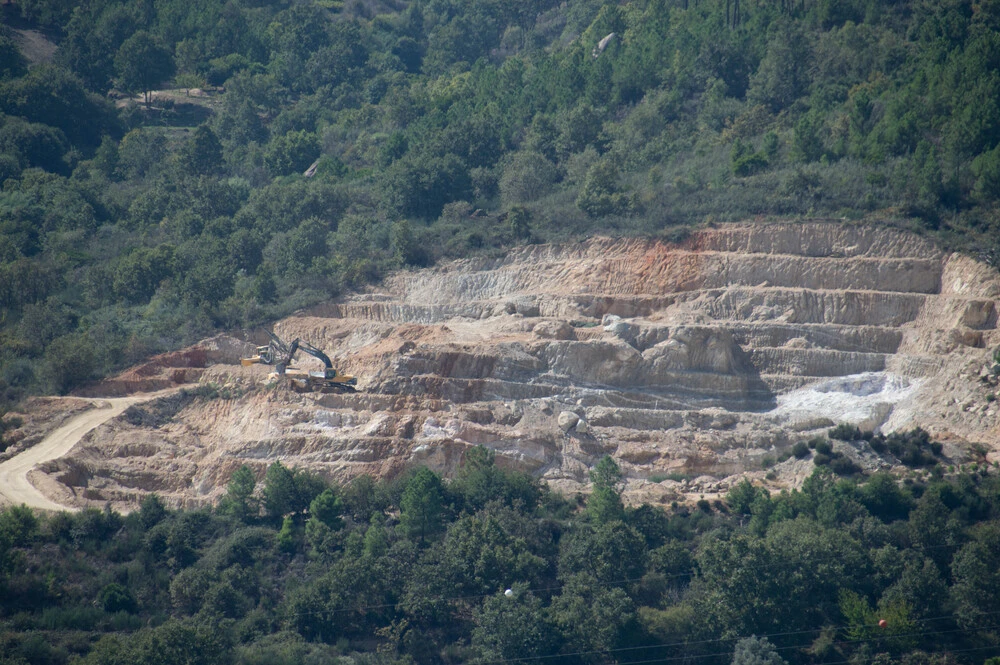
At the project pilot site in Portugal (Felmica Minerais Industriais), the DINAMINE team has deployed sensors that provide data for predictive-maintenance, mineral processing, and environmental-monitoring systems capable of tracking equipment vibration, oil pressure, temperature, power consumption, water usage, and mass movement. The project has also developed a low-cost vehicle tracking and monitoring technology.
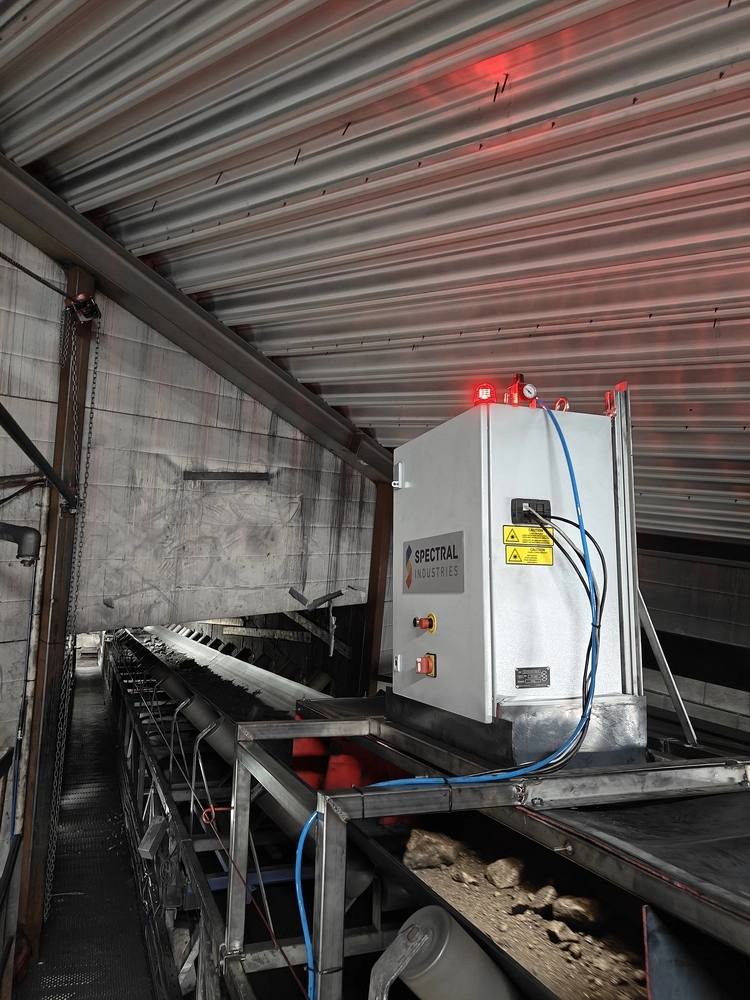
Project partner Spectral Industries developed laser-based chemical sensors which were tested at both project pilot sites. The sensors provide real-time elemental measurements within ore streams, supporting process optimisation, recovery-rate analysis and more efficient resource management during mineral processing.
Modular deployment
The project’s exploitation strategy focuses on transforming its technological modules into deployable industrial products and services. Market analyses conducted within the project identified a significant gap in the European mining software landscape. Although advanced digital mining platforms already exist, many remain too expensive or operationally complex for smaller operators.
DINAMINE’s future commercial products therefore emphasise modular deployment, interoperability and progressive integration. Rather than requiring mines to adopt an entirely new digital ecosystem at once, the project’s technologies are designed to be implemented incrementally. Mines can benefit from tailored modules and progressively expand integration as operational confidence grows.
This approach may ultimately prove to be one of DINAMINE’s strongest competitive advantages. Mining remains a conservative industry where operational reliability, safety and capital expenditure considerations strongly influence technology adoption. By reducing integration barriers and demonstrating technologies directly in operational mine environments, DINAMINE is building industrial credibility alongside technical validation.
Its broader market relevance is reinforced by wider industry trends: increasing ESG focus, rising energy costs, workforce shortages, growing demand for operational efficiency and Europe’s strategic push for more secure critical raw material supply chains.
A new model for European mining
Mining is entering a period of transformation. The industry is being challenged to produce more raw materials while simultaneously reducing emissions, improving safety and increasing operational transparency. DINAMINE suggests that these objectives no longer need to be treated separately.
The project integrates advanced analytics, automation, environmental monitoring and real-time operational management into a connected digital ecosystem. In this way, it demonstrates how future mines could operate as continuously adaptive industrial systems rather than fragmented collections of isolated processes.
The technologies currently being validated in Norway and Portugal are still evolving, but they already point toward a new operational model for mining, one in which productivity, sustainability and safety become interconnected components of the same digital infrastructure.
References
DINAMINE Consortium. (2025). DINAMINE Newsletter – Issue No. 5: Pilot sites and modules ready for demonstration. Issue No. 6: DINAMINE technology demonstration at project pilot sites continues. Retrieved from https://www.dinamine-project.eu/
European Commission. (2023). DINAMINE – Digital and innovative mine of the future. Horizon Europe Project No. 101091541. Retrieved from https://cordis.europa.eu/project/id/101091541
Lokar, N., Ortiz, M. M., Rachah, A., Ahmed, T., Fanavoll, E. V., Ma, X., & Likozar, B. (2026). The role of hydrogen in mining decarbonisation. Renewable and Sustainable Energy Reviews, 226, 116447. https://doi.org/10.1016/j.rser.2025.116447
Stránský, P., & Ahmed, T. (2025). Hybrid real-time life cycle assessment for performance monitoring in mineral extraction and processing facilities. Presented at SETAC Europe 26th LCA Symposium.
Tønnessen, J., Gravdahl, J. T., & Pettersen, K. Y. (2026). A Robotic Control System for a Drill Jumbo with One Articulated Arm: Full-Scale Testing. https://doi.org/10.5281/zenodo.20489139