From sensor to agronomic platform: how Plantvoice transforms sap analysis into operational decisions for irrigation, nutrition and crop protection
According to FAO-AQUASTAT data (2025), agriculture accounts for approximately 72% of global freshwater withdrawals. This is an enormous share that coexists with growing water scarcity. Per capita availability of renewable water has fallen by 7% over the past decade. Yet traditional irrigation systems continue to operate without direct data on the actual water needs of crops, relying instead on standardised thresholds or farmers’ experience. The agricultural sector also contributes significantly to global greenhouse gas emissions. According to FAOSTAT, farm-gate emissions from crops and livestock alone reached 8.1 Gt CO₂eq in 2023. Chemical inputs such as fertilisers and pesticides have cumulative effects on soil, groundwater and human health. We are facing a structural contradiction: a sector called upon to feed a growing population, with less land available, less water, and ever-tightening environmental constraints.
The dominant responses in precision agriculture to date — weather sensors, satellite imagery, drones and soil probes — look at the system from the outside. They measure what surrounds the plant, not what is happening inside it. This limitation led two brothers from Pozzo di Carniglia, in the Apennines near Parma, to ask a deceptively simple question: if we can monitor everything, why can’t we listen directly to the plant?
The problem: making decisions without direct physiological data
The absence of direct physiological data has consequences that go beyond water waste. An over-irrigated orchard produces fruit with diluted sugars, uneven colouring and reduced shelf life. An under-irrigated one, even for just a few critical days during the cell-expansion phase, can compromise the yield of the entire season. The problem is analogous for crop protection. Treatments are applied according to a calendar schedule, regardless of the actual state of the crop. This creates direct costs and environmental impact that are difficult to justify without an objective measure of the plant’s vulnerability at that moment.
The market has responded with a proliferation of digital tools. According to the 2025 research of the Smart AgriFood Observatory at Politecnico di Milano and the University of Brescia, the Italian agriculture 4.0 market reached a value of €2.5 billion in 2025, up 9% on the previous year. But the fragmentation of these tools (one app for weather, one for soil, one for fertigation) creates operational complexity rather than simplifying decisions. All available sensors look outside the plant. None of them asks it directly how it is doing.
The idea: sap as a primary biosignal
Sap is the fluid that flows through a plant’s capillary system, transporting water, mineral salts and macronutrients. It is, quite literally, the plant’s blood. It is here that the first responses to water stress, nutritional deficiencies, and bacterial or fungal infections manifest. As demonstrated in the scientific literature, water stress alters the chemical composition and lymphatic flow, before symptoms become visible externally (Chaves et al., 2003). Measuring its electrochemical composition in real time means accessing physiological information that no external sensor can provide with the same speed and precision. Existing direct monitoring solutions fall into two broad families.
The first includes sap flow and water potential sensors, which enable continuous in situ measurement of plant water status and support irrigation management. However, they focus solely on plant hydraulics and offer limited insight into nutrition or crop protection.
The second includes electrophysiology-based systems, which confirm the value of in vivo monitoring of plant electrical signals, but present significant operational constraints: multiple non-biocompatible metallic electrodes, complex installation requiring specialist technicians, primary applicability to herbaceous crops with reduced performance on woody perennial species, and a substantially higher cost per monitored plant. No available system combines biocompatibility, farmer self-installation, applicability to woody perennial crops, and integration into a multi-parameter decision support system covering irrigation, nutrition and crop protection in a single platform.
From a technological gap to Plantvoice
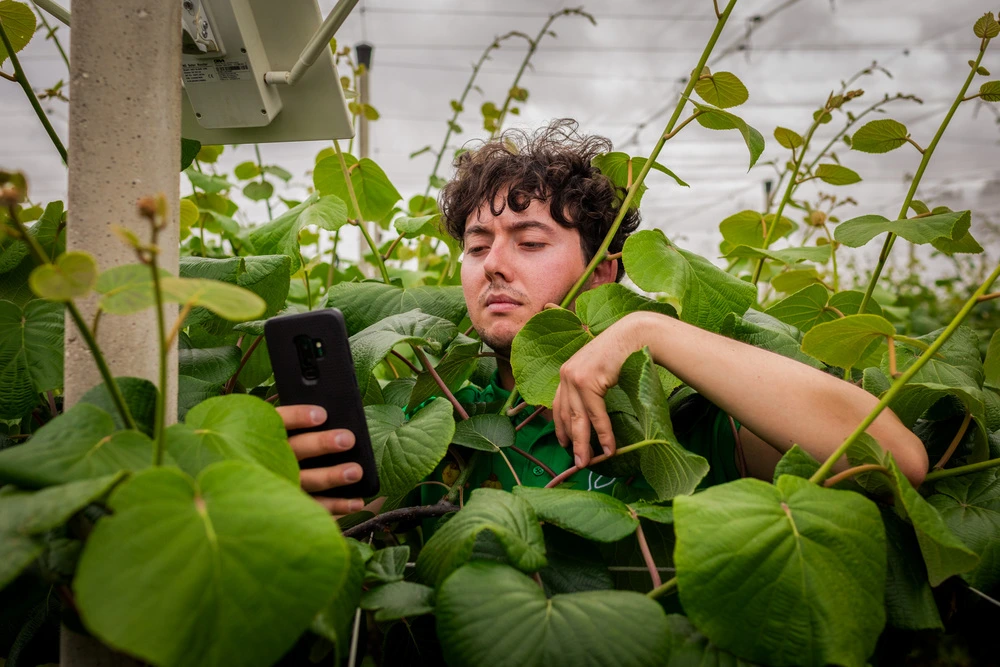
It is from this gap, and from an insight that took shape during the pandemic when Tommaso Beccatelli decided to start tending a small family orchard, that Plantvoice was born. Our startup, founded in Bolzano as a Benefit Company, has developed a biocompatible, non-invasive sensor the size of a toothpick, inserted directly into the stem of the plant, capable of continuously analysing the electrochemical composition of the sap. The patent has received international coverage through the PCT (Patent Cooperation Treaty), with a positive search report at both national and European level, and scientific validation from Eurac Research, Fondazione Bruno Kessler, the University of Milan, the University of Parma and the University of Verona.
The methodology: a sentinel-plant approach
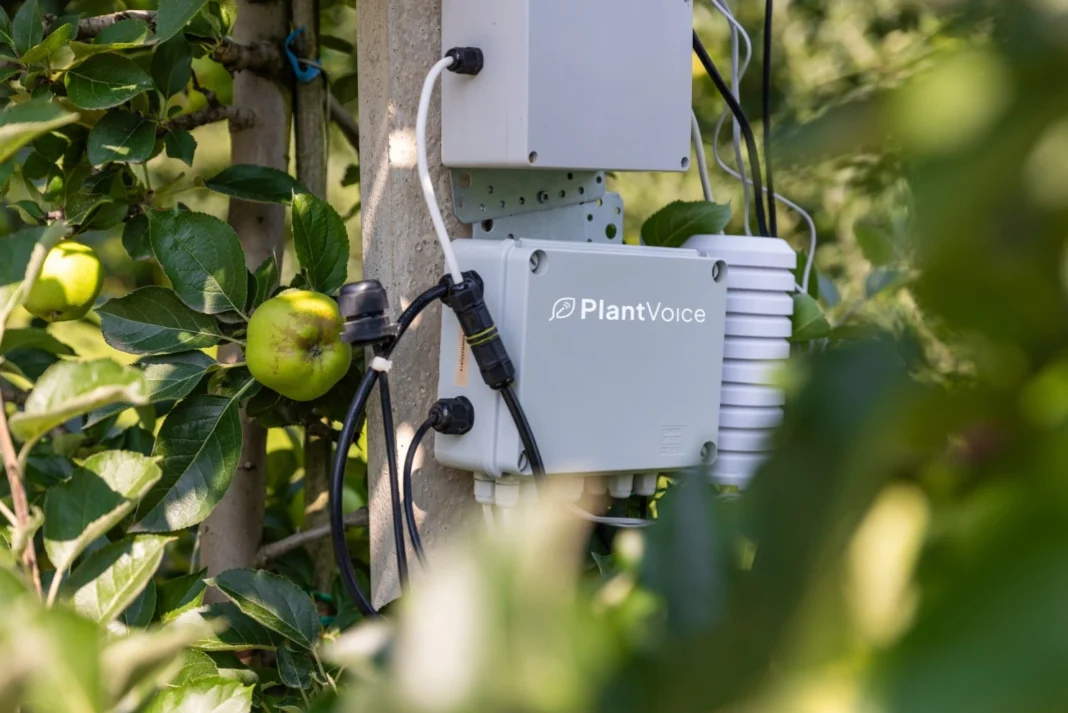
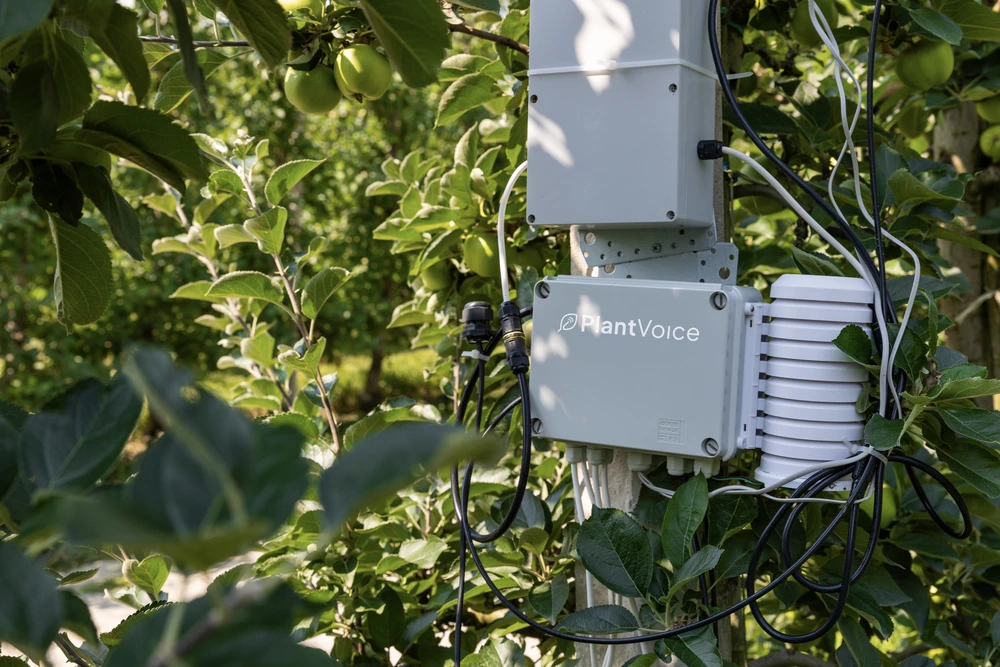
The Plantvoice system adopts a “sentinel plant” approach. A group of four representative plants is fitted with sensors for each homogeneous plot, with an average area of approximately half a hectare. The probe, made from biocompatible materials using low-energy additive manufacturing techniques, is inserted into the stem of the fruit plant and remains there for the entire growing season. The physiological data collected are sent to the cloud and analysed by artificial intelligence algorithms customised for the crop and agronomic context.
The signal produced is what the founders of Plantvoice describe as “the plant’s electrocardiogram”: a continuous electrochemical signal capable of detecting physiological variations that signal a state of stress in the crop, enabling the farmer and agronomist to intervene promptly and investigate the cause. Unlike other agritech platforms that process standardised environmental data, the system starts from what the plant is actually experiencing.
With the technological evolution presented in June 2026, the new version of the probe has been designed to be installed directly by the farmer, with guided support from Plantvoice agronomists. This step reduces operational complexity, lowers the barrier to adoption and makes the model scalable towards new markets.
The platform: from monitoring to decision support
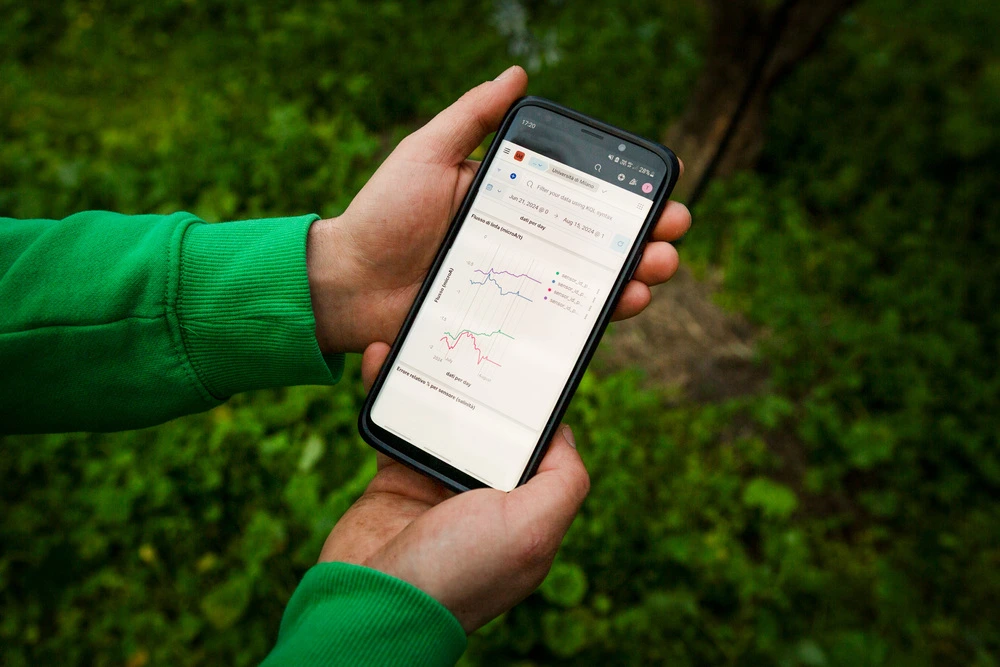
The launch of the new Plantvoice platform, accessible via mobile app and web, marks the evolution from a monitoring tool to an agronomic decision-support system. The platform integrates sap biosignals with environmental data from weather stations, soil sensors, real-time NPK analysis and insect traps. All data converge in a single interface structured around three main agronomic modules.
The irrigation module uses the physiological signal of the plant to intervene only when the water requirement is real, moving beyond the logic of standardised thresholds. Field applications on Italian fruit farms have already documented water savings of up to 40% in some operations, including Gruppo Salvi, without compromising yield or fruit quality. The nutrition module optimises fertilisation based on the physiological response, reducing unnecessary interventions and fertiliser inputs. The crop protection module supports decisions on phytosanitary treatments, favouring more targeted management that is less dependent on precautionary calendars.
Completing the ecosystem are a digital field notebook for structured data collection and an on-demand agronomist service, which integrates specialist expertise at a distance into the operational workflow. Packages include dedicated calls for data interpretation and the definition of practical advice.
Results: from kiwifruit to the historic trees of the Appian Way
Field validation began in 2022 with a group of early-adopter clients spanning soft fruits, cereals and apple and kiwifruit production, operating across several Italian regions.
The G3 yellow kiwifruit case is particularly significant. The crop is strategic for Italian agriculture: over 25,000 hectares under cultivation, average production of around 400,000 tonnes per year and a total supply chain value of approximately €2 billion (CSO Italia). In recent years, production has been hit by the so-called “kiwifruit decline” phenomenon, linked to root stress and water imbalances, with output falling from 570,000 tonnes in 2015 to around 277,000 tonnes in 2024/25, against an estimated productive potential of 600,000 tonnes.
The installation of Plantvoice probes at Salvi’s Latina operations, started in spring 2023 across two plots with different rootstocks, made it possible to correlate physiological data with irrigation events and weather conditions, identifying the plant’s capacity to absorb and use water as the most relevant variable compared to water availability in the soil alone. Monitoring enabled high-quality standards to be maintained through to the end of the season while reducing water use by up to 30%.
A more recent application has taken Plantvoice technology beyond the productive context. On the occasion of the European Day of Parks on 24 May 2026, sap sensors were installed on historic trees in the Bosco Sacro of the Valle della Caffarella, in the Appia Antica Regional Park, a UNESCO World Heritage Site since 2024. The 12-month monitoring project will measure the vigour, CO₂ absorption and carbon footprint of a group of approximately 120 holm oaks, some over 250 years old. The aim is to provide objective physiological data to support the conservation management of historic tree heritage, in a context where many Italian local authorities find themselves making decisions about historic trees without verifiable scientific evidence.
Expected outputs and future developments
Since the start of the commercial phase, Plantvoice has grown its client base from 27 to 105 agricultural businesses, with 840 sensors installed across more than 600 hectares throughout Italy, spanning fruit production, viticulture and cereal crops. A further approximately 200 companies are currently in active negotiations.
On the international front, the primary target markets are France, Spain, Germany, Brazil and Poland, with market tests in preparation in Australia, South Africa, South America and South Korea. In France, an operational agreement has already been signed with Alliance BFC, a union of agricultural cooperatives bringing together Bourgogne du Sud, Dijon Céréales and Terre Comtoise. Globally, Plantvoice was selected among the 33 finalists of the WIPO Global Awards 2026, chosen from more than 1,300 applications from 126 countries.
The declared objective is to build a system of “Plant Intelligence” capable of translating every physiological signal into an operational decision: when to irrigate, how to fertilise, when to intervene. A paradigm shift that, in the founders’ vision, does not replace the farmer’s experience but augments it with a layer of information that has until now been inaccessible.
References
- FAO (2025). AQUASTAT Water Data Snapshot 2025. Food and Agriculture Organization of the United Nations. https://www.fao.org/aquastat/en/
- FAO (2024). Greenhouse gas emissions from agrifood systems. Global, regional and country trends, 2001–2023. FAOSTAT Analytical Brief. https://www.fao.org/statistics/highlights-archive/highlights-detail/greenhouse-gas-emissions-from-agrifood-systems.-global–regional-and-country-trends–2001-2023/en
- Osservatorio Smart AgriFood (2025). Agricoltura 4.0: mercato e trend. Ricerca 2025. Politecnico di Milano e Università degli Studi di Brescia. https://www.osservatori.net/smart-agrifood/
- Chaves, M. M., Maroco, J. P., & Pereira, J. S. (2003). Understanding plant responses to drought — from genes to the whole plant. Functional Plant Biology, 30(3), 239–264. https://doi.org/10.1071/FP02076