Electric kilns and ocean alkalinity could turn one of the most emission-intensive industrial processes into a climate solution
Lime is a material that modern industry cannot readily do without, yet today it cannot be produced at scale without generating carbon dioxide.
Lime is produced by calcining limestone at temperatures above approximately 900 °C:
CaCO₃ → CaO + CO₂
This makes lime a fundamentally hard-to-abate industrial product. Improvements in kiln efficiency, electrification and switching to low-carbon fuels can substantially reduce energy-related emissions, but they cannot eliminate the process CO₂ inherently released when calcium carbonate is converted into calcium oxide. The same chemistry that makes lime difficult to decarbonise, however, also gives it potential as a carbon-removal material.
Limenet was founded around the concept of closing this carbon cycle. This involves producing lime using low-carbon energy, capturing the process CO₂ that is unavoidably released during calcination, and using the resulting alkaline material to convert CO₂ into dissolved bicarbonate for long-duration storage in seawater.
The problem: emission cuts alone will not close the gap
Carbon Dioxide Removal (CDR) is included in virtually all IPCC pathways that limit warming to 2 °C or below. The ocean represents the largest active carbon reservoir in the Earth’s near-surface carbon cycle. Ocean Alkalinity Enhancement (OAE) seeks to increase the ocean’s capacity to store dissolved inorganic carbon by adding alkalinity.
The central bottleneck for OAE is therefore not only oceanographic; it is also industrial. Large-scale deployment requires very large quantities of alkaline material. The carbon footprint of producing that material is critical to the net removal achieved. Conventional lime production can generate around one tonne of CO₂ per tonne of CaO when both calcination and kiln-energy emissions are included.
Why lime matters
Lime is an upstream input to a substantial part of the industrial economy. A modern fossil-fuelled lime kiln can generate approximately 1.05–1.10 tonnes of CO₂ per tonne of CaO produced, depending on kiln efficiency, fuel and product quality. Of this, approximately 0.785 tonnes of CO₂ per tonne of pure CaO arise directly from the calcination of calcium carbonate.
These process emissions are dictated by stoichiometry and therefore cannot be eliminated through improvements in kiln efficiency or by changing the heat source. For a representative natural-gas-fired plant, these energy-related emissions can be around 0.28 tonnes of CO₂ per tonne of lime. This brings total direct emissions to approximately 1.07 tonnes of CO₂ per tonne of CaO.
The idea: indirect electric calcination and storage of the process CO₂
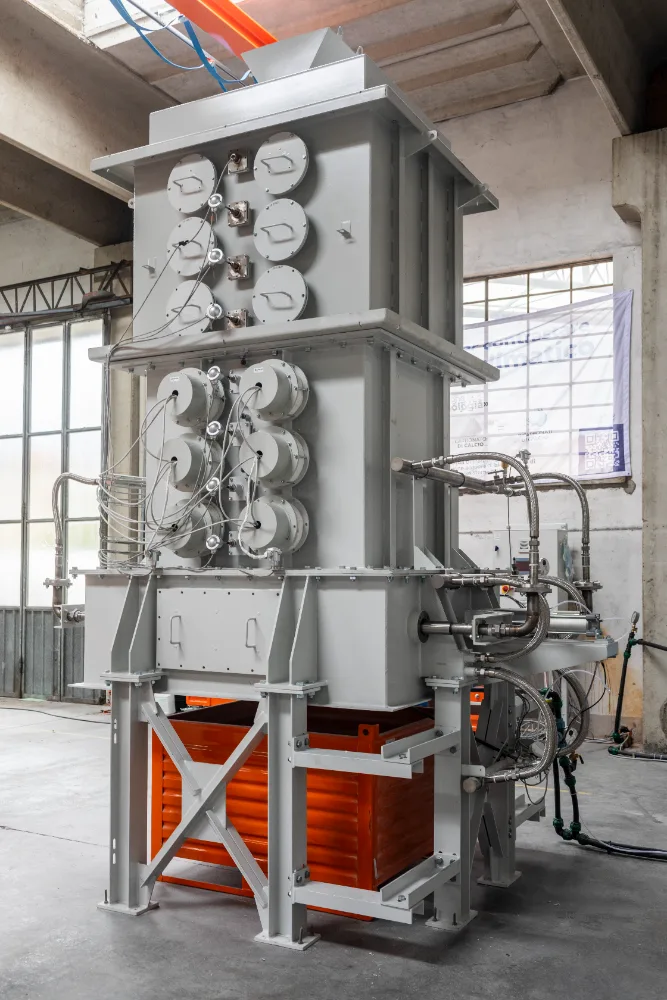
Limenet has patented an indirect calcination unit in which the calcination heat is transferred to the limestone through a physical “wall”, without contact between the heating chamber and the material being calcined.
Why indirect calcination changes the process
First, the gas leaving the reaction chamber is a pure CO₂ stream, rather than CO₂ diluted with nitrogen, excess air and combustion products. In conventional carbon capture applied to a lime or cement kiln, a substantial share of the cost and energy penalty comes from capturing a diluted CO2 separating it from the flue gas.
Second, the absence of direct flame contact on the limestone reduces the risk of over-burning and sintering of the product. The quicklime produced therefore retains low over-burning and high reactivity.
Electrification then addresses the fuel-related fraction of emissions. Replacing methane firing with electricity reduces energy-related emissions from roughly 0.28 to approximately 0.038 tonnes of CO₂ per tonne of lime under Limenet’s life-cycle assessment (LCA), corresponding to a net reduction of about 22% relative to a conventional fossil-fired baseline once the full life cycle is accounted for.
In addition, because the design does not depend on gas percolating through a packed bed, the kiln can process fine limestone particles below 10 mm. It can represent approximately 30% of quarried material. Processing it therefore converts a systematic quarry by-product into useful feedstock.
Integrating calcination with CO₂ storage
Because the kiln delivers a pure CO₂ stream rather than a dilute one, if a geological storage is not present close enough, the kiln can be integrated with Limenet’s own storage unit, the Mixer. The CO₂ is conveyed and reacted with seawater and half of the lime produced on site.
The storage unit is not limited to neutralising the kiln’s own emissions. When supplied with externally sourced CO₂ of biogenic or atmospheric origin, the same equipment can become an active carbon dioxide removal pathway.
The application of lime for carbon removal: how ocean liming works
As a recap, the full cycle to produce lime involves three reactions.
The three reactions behind the process
The first is the calcination where limestone is spitted into lime and Co2:
CaCO₃ → CaO + CO₂
The second is the hydration where lime and water is converted into slaked lime and heat:
CaO + H₂O → Ca(OH)₂
The third is the storage unit. Here the slaked lime reacts with CO₂ in seawater to form dissolved calcium bicarbonate:
Ca(OH)₂ + 2 CO₂ → Ca²⁺ + 2 HCO₃⁻
How stoichiometry enables carbon removal
The stoichiometry is what makes the cycle work. Each mole of CaO can ultimately enable the storage of up to two moles of CO₂, equivalent to approximately 1.57 tonnes of CO₂ per tonne of calcium oxide. This is about twice the amount of CO₂ released by the calcination reaction required to produce that tonne of CaO.
In Limenet’s integrated configuration, however, the two parts of this potential storage capacity serve different functions. Producing one mole of CaO releases one mole of process CO₂. Storing that process CO₂ as dissolved bicarbonate requires approximately half a mole of the Ca(OH)₂ subsequently produced, because each mole of Ca(OH)₂ can react with two moles of CO₂. The remaining half mole of Ca(OH)₂ is then available for carbon removal thought the pathway of Ocean Alkalinity Enhancement.
What distinguishes Limenet’s implementation from other Ocean Alkalinity Enhancement approaches is the way the alkaline material is produced and the way how alkalinity is injected into the ocean.
Once released into seawater, bicarbonate is the dominant form of dissolved inorganic carbon in the marine carbonate system and can retain carbon over very long timescales. Ocean alkalinity enhancement and bicarbonate-based storage are generally associated with storage timescales of thousands to tens of thousands of years, substantially longer than those of biological or terrestrial carbon-storage pathways (Renforth and Henderson, 2017). The Limenet approach builds on an established line of research into accelerated weathering of limestone, from the original proposal by Rau and Caldeira (1999) to the buffered configuration described by Caserini et al. (2021).
Two modes for CO₂ storage and removal
The same storage unit can support two distinct commercial modes:
- In neutralisation mode, the process CO₂ generated by Limenet’s own kiln is routed to the reactor and converted into dissolved bicarbonate, allowing the production of low-carbon lime by preventing the release of the dominant process-emission component.
- In removal mode, CO₂ of biogenic or atmospheric origin supplied from external sources can be stored through the same bicarbonate-production process, generating negative emissions.
Results: pilot validation and industrial scale-up
Deployment was preceded by laboratory and experimental work on the stability of the bicarbonate solution and on the response of marine biota to its discharge.
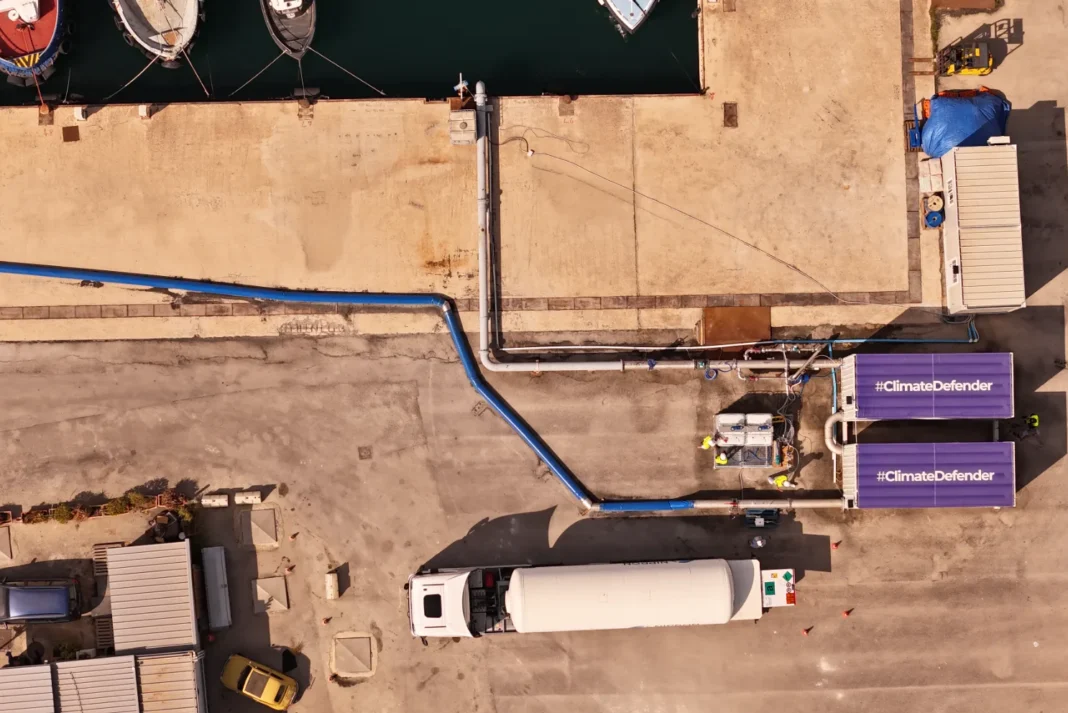
In 2024, following the earlier pilot in La Spezia, Italy, Limenet inaugurated its first pre-commercial storage plant in Augusta, Siracusa, Italy, with a capacity of 800 tonnes of CO₂ per year. The plant represents the first industrial-scale deployment of Limenet’s bicarbonate-based CO₂ storage technology.
Limenet’s methodology has been independently validated by RINA in accordance with ISO 14064-2. Limenet has also entered the Isometric carbon-removal framework.
On the calcination side, a 10 kg/h calciner prototype validated the indirect heat-transfer concept. A pilot unit rated at 150 kg CaO per hour is currently being built in Schio, Vicenza, Italy, and is expected to be fully operational by Q3 2026. It will generate the operating data required to validate performance at larger scale and support the engineering of the first commercial unit, with a capacity of approximately 2 tonnes of CaO per hour.
From pilot validation to industrial scale
The integration roadmap extends to 2030. By 2028, Limenet plans to build and operate an integrated carbon-free lime production plant with a capacity of approximately 1.5 kt per year in Augusta, Siracusa, where the CO₂ storage unit is already installed. This will bring lime production and permanent storage of the associated calcination CO₂ together at a single site, demonstrating the complete Limenet process at pre-commercial scale.
By 2030, the technology is intended to scale to an industrial calciner with a production capacity of approximately 15 kt per year of carbon-free lime, providing the basis for subsequent replication at larger industrial sites. Limenet’s business model is based on retaining ownership of its intellectual property while providing engineering and procurement for the calciner, or for the integrated calciner and storage unit, to lime producers seeking to decarbonise existing production capacity.
Expected outputs and future developments
The near-term objective is to integrate the two halves of the system into a single carbon-negative production unit, in which calcination is electrified, the process CO₂ is captured as a pure stream, and the storage unit converts both this process CO₂ and externally sourced CO₂ into stable dissolved bicarbonate. The remaining low-carbon Ca(OH)₂ can then be used for conventional Ocean Alkalinity Enhancement, enabling additional atmospheric carbon removal or sold into the market as low carbon product.
Geography favours deployment in Italy but energy prices and renewable availability will be the challenge.
Two open questions will influence how rapidly ocean-based carbon removal can scale, and neither is unique to Limenet. The first is the standardisation of monitoring, reporting and verification for marine CDR, where methodologies are developing rapidly but have not yet fully converged. The second is the regulatory treatment of alkalinity and bicarbonate discharge.
Conclusion
The lime sector is usually described as a decarbonisation problem to be solved through end-of-pipe carbon management. The argument presented here is different: an alkaline material produced with low-carbon energy and integrated with its own CO₂ storage pathway can become an instrument for removing carbon from the atmosphere.
What has been missing is an industrial system capable of managing both sides of that carbon balance within an integrated process: producing low-carbon lime, capturing the unavoidable calcination CO₂, storing it durably as dissolved bicarbonate, and using the remaining alkalinity for additional carbon removal through Ocean Alkalinity Enhancement. That is the gap Limenet is building to fill.
References
- Caserini, S., Cappello, G., Righi, D., Raos, G., Campo, F., De Marco, S., Renforth, P., Varliero, S., & Grosso, M. (2021). Buffered accelerated weathering of limestone for storing CO₂: chemical background. International Journal of Greenhouse Gas Control, 112, 103517. https://doi.org/10.1016/j.ijggc.2021.103517
- Isometric. Ocean Alkalinity Enhancement from Coastal Outfalls, Protocol v1.0. https://registry.isometric.com/protocol/ocean-alkalinity-enhancement
- Rau, G. H., & Caldeira, K. (1999). Enhanced carbonate dissolution: a means of sequestering waste CO₂ as ocean bicarbonate. Energy Conversion and Management, 40(17), 1803–1813. https://doi.org/10.1016/S0196-8904(99)00071-0
- Renforth, P., & Henderson, G. (2017). Assessing ocean alkalinity for carbon sequestration. Reviews of Geophysics, 55(3), 636–674. https://doi.org/10.1002/2016RG000533