
Saffron is emerging as a promising ally in ophthalmology, thanks to its ability to act on multiple biological pathways
The retina is one of the most metabolically active tissues in the human body. Constantly exposed to light, high oxygen consumption, and intense metabolic demand, it is particularly vulnerable to oxidative stress and chronic inflammation. These mechanisms play a central role in several retinal neurodegenerative diseases, including age-related macular degeneration (AMD), diabetic retinopathy, and inherited retinal dystrophies such as retinitis pigmentosa.
Despite major advances in ophthalmology, many retinal diseases still lack effective long-term neuroprotective therapies capable of slowing neuronal degeneration. Current treatments are often limited to specific disease stages or molecular targets, leaving a substantial need for complementary approaches able to preserve retinal integrity and function.
For this reason, increasing attention has been directed toward natural bioactive compounds with multitarget protective properties. Among them, saffron (Crocus sativus L.) has emerged as one of the most promising candidates in translational retinal research.
Traditionally known as one of the world’s most valuable spices, saffron is attracting growing scientific interest for its antioxidant, anti-inflammatory, and neuroprotective activities in both neurodegenerative and retinal disorders.
Retina: a highly vulnerable neural tissue
The retina is simply not a light-sensitive tissue. It is a highly specialized neural structure and represents an extension of the central nervous system. Photoreceptors and retinal neurons require substantial energy to sustain visual processing, making them extremely sensitive to oxidative imbalance and mitochondrial dysfunction.
In many retinal diseases, oxidative stress initiates a cascade of damaging events involving inflammation, microglial activation, vascular impairment, and ultimately neuronal cell death. These processes contribute to progressive visual decline and, in severe cases, irreversible blindness.
Because retinal degeneration involves multiple interconnected pathways, there is growing interest in therapeutic strategies that act simultaneously on different molecular and cellular targets an approach that is difficult to achieve with conventional therapies aimed at a single pharmacological target and that may be associated with significant adverse effects when administered chronically. Natural compounds with biological activities are therefore attracting increasing attention in neuroprotection.
Why Saffron?
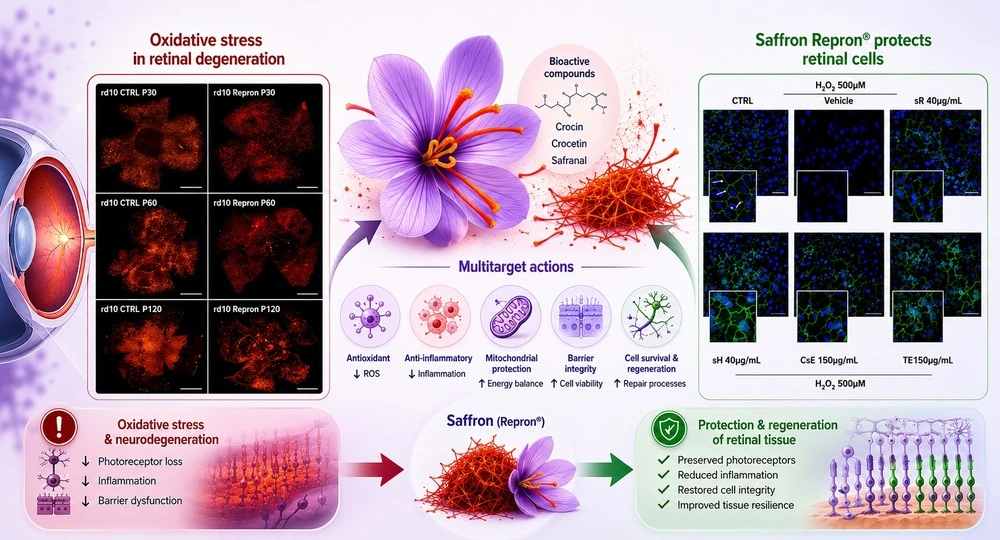
The biological properties of saffron are mainly attributed to several bioactive molecules, including crocins, crocetin, and safranal. These compounds have shown antioxidant and anti-inflammatory activities in experimental models of neurodegeneration and retinal stress.
However, saffron appears to exert more complex biological effects than simple free radical scavenging. Emerging evidence suggests that saffron-derived phytocomplexes may modulate inflammatory pathways, mitochondrial activity, gene expression, and cellular stress responses, contributing to improved tissue resilience.
This multitarget activity is particularly relevant in retinal diseases, where degeneration is driven by multiple overlapping mechanisms rather than by a single pathological process. Our research group has focused on the study of Saffron Repron®, a standardized saffron preparation characterized by controlled phytochemical composition and reproducible biological activity. Standardization represents a crucial step in translational nutraceutical research, since saffron’s biological properties can vary significantly depending on cultivation conditions, extraction methods, and phytochemical profile.
Our research focuses on the potential of Saffron Repron® to protect the retina under neurodegenerative conditions. Using an experimental model of inherited retinal degeneration (rd10 – Retinitis Pigmentosa), we observed promising protective effects on retinal structure and photoreceptor survival. Retinitis Pigmentosa is a progressive inherited retinal disease, without effective cure, with a poor long-term visual prognosis, often leading to severe vision impairment and, in advanced stages, blindness. Our findings suggest that saffron may help counteract oxidative stress and inflammation, two major drivers of retinal degeneration.
Sustainability and the value of Saffron by-products
An additional aspect of our research concerns the valorization of saffron by-products. Traditionally, only a small portion of the saffron flower is used for commercial production, while large amounts of floral material are discarded during processing.
Recent studies from our group demonstrated that saffron waste fractions still retain biologically active compounds capable of exerting protective effects in retinal cell models exposed to oxidative stress, inflammation, and hyperglycemic conditions.
These findings open interesting perspectives from both environmental and biomedical points of view. Recovering bioactive molecules from agricultural by-products aligns with the growing interest in sustainable biotechnology and circular economy approaches within life science research.
Sustainability also extends to cultivation strategies. Recent advances in hydroponic saffron cultivation have highlighted the possibility of improving crop standardization while reducing environmental impact and resource consumption. This aspect is particularly relevant for translational research, where the reproducibility and chemical consistency of natural compounds represent essential requirements.
In this context, saffron research becomes not only a story of retinal neuroprotection but also an example of how sustainability, agricultural innovation, and translational medicine can converge.
Nutraceutical Applications
The growing interest in saffron bioactivity has also led to the development of translational nutraceutical applications. ZAFFIT®, a commercially available supplement developed from Repron® saffron, contains the same standardized phytocomplex used in our experimental studies.
This aspect is particularly relevant in retinal research, where reproducibility and chemical consistency are essential for translating laboratory findings into clinically relevant applications. The convergence of experimental evidence, product standardization, and clinical evaluation highlights the emerging role of saffron-based nutraceuticals in supporting retinal health and neuroprotection.
A complementary approach to retinal protection
The research for effective therapies to protect retinal neurons remains one of the major challenges in modern ophthalmology. Although natural compounds such as saffron are unlikely to replace conventional medical treatments, they may offer valuable support for retinal health thanks to their ability to act on multiple biological pathways at the same time. This characteristic is particularly relevant for people who require long-term drug treatments, either for diseases that can contribute to retinal degeneration, such as diabetic retinopathy, or for other chronic health conditions unrelated to eye disease. In these cases, natural compounds with a favorable safety profile may represent a useful complementary approach to help maintain retinal function and reduce the burden associated with prolonged pharmacological therapy.
Current evidence suggests that saffron-derived phytocomplexes may help reduce oxidative and inflammatory stress while improving retinal resistance to neurodegenerative damage. At the same time, the use of standardized formulations and sustainable production strategies may further strengthen the translational potential of saffron-based research.
Future perspectives for retinal neuroprotection
Beyond its historical and culinary value, saffron is increasingly emerging as a bridge between natural compounds, sustainability, and neuroprotective medicine. As retinal research continues to evolve, multidisciplinary approaches combining neuroscience, nutraceutical science, and translational ophthalmology may open new opportunities for preserving vision and improving quality of life in patients with neurodegenerative retinal diseases.
References:
- Abrol, D.P. (ed.) 2020, Saffron: The Age-Old Panacea in a New Light, Academic Press, London.
- Corsi, F., Galante, A., Maggi, M.A., Mazziotti, R., Bisti, S., Piano, I. et al. (2025) “The efficacy of Saffron Repron® in counteracting the progression of retinitis pigmentosa: neuroprotection and resilience”, Asia-Pacific Journal of Ophthalmology, 14(3), 100192.
- Galante, A., Corsi, F., Maggi, M.A., Mazziotti, R., Bisti, S., Piano, I. et al. (2025) “In Vitro Evaluation of the Protective Efficacy of Crocus sativus Waste Extracts in Retinal Cell Models of Oxidative Stress, Inflammation, and Hyperglycemia”, Molecules, 30(14), 2894.
- Di Paolo, M., Corsi, F., Maggi, M., Nardi, L., Bisti, S., Piano, I. and Gargini, C. (2023) “Efficacy of Hydroponically Cultivated Saffron in the Preservation of Retinal Pigment Epithelium”, Molecules, 28(4), 1699.