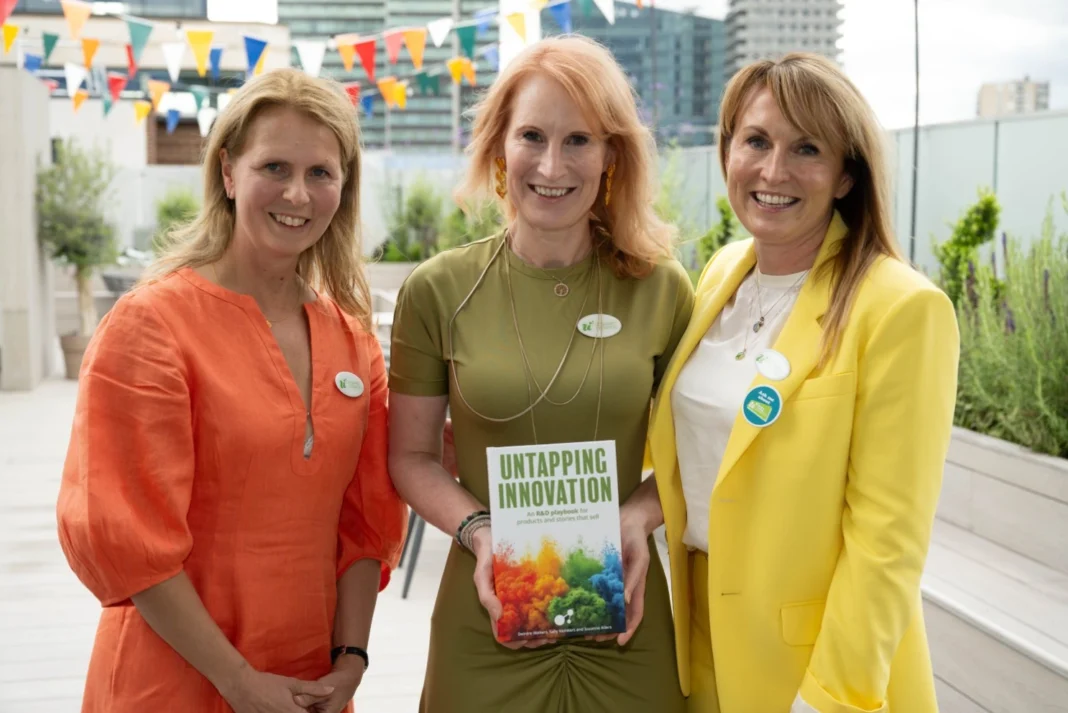
In this extract from the book Untapping Innovation, the authors show R&D teams how to unlock the full value of what they build
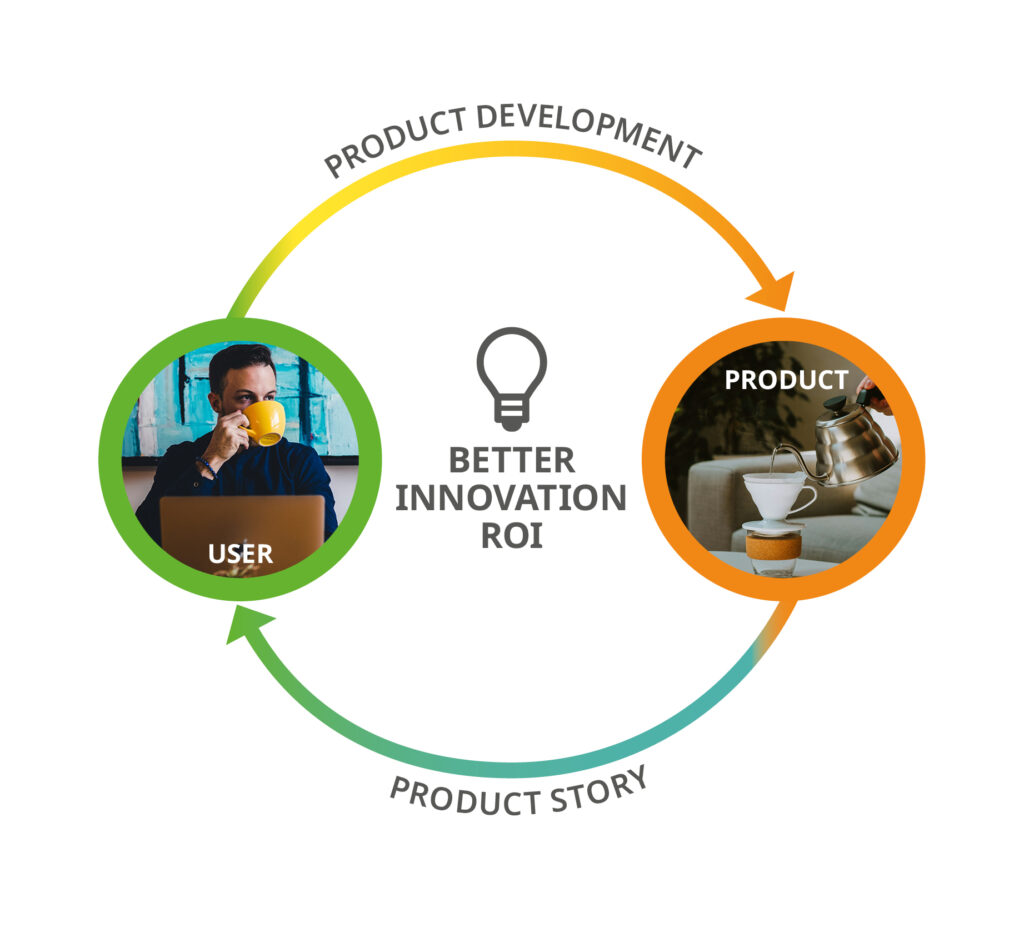
Since receiving our R&D and “Product Research” training at Procter & Gamble in the 1990s, where we learned the importance of linking “what’s needed” with “what’s possible”, our thinking has continued to evolve. Over the years, working with a wide range of clients and industries, we’ve discovered what truly resonates with users and consistently drives success in market. This journey has led to the development of our user-product connection cycle, shown in Figure 1. The critical, and yet simple truth of this cycle is that we often see teams focus on the user, or we see them dive deep into product and technology, but the tools to translate and connect them are often missing.
Connecting the product to the user
Contrary to some beliefs, we maintain that R&D’s role does not stop when the product has been developed and specified. Marketing and advertising will take the lead in creating in-market communication, but to do this effectively, they need to know how the product will truly delight their target user. This is where R&D can add enormous value with Untapped’s “Product Stories”, that can form a bridge between R&D and their commercial counterparts. After all, R&D have spent significant time and budget building a product with appealing, distinctive features. To fully realize the return on this investment, a compelling Product Story can powerfully capture what will make this product different and better in the eyes of the user.
Once again, this is not as easy as it sounds. A practised Product Story writer will be watching out for several pitfalls, of which the main one is, you’ve guessed it, keeping the user at the centre of the story. It’s all too easy to let the product technology take over, with a long list of features that can over-shadow the “happily ever after” benefit in the user’s life. Another temptation is to allow a competitor feature to “randomly” turn up in your Product Story, assuaging the fear of a senior stakeholder, instead of focusing on what your target user values most about the product. Rest assured, with a clear framework and simple guidelines, developing a Product Story is a very manageable and highly enjoyable process that brings innovation functions and teams together, dramatically amplifying the return on R&D time and budget.
Using Product Stories for product communication
Once we have a good Product Story, it can be used as a springboard to develop distinctive product communication such as Claims and Demos for various user touchpoints, e.g. online and in-store retail spaces, social media and other forms of advertising. The strongest claims, once again, keep the user at the centre, with a clear articulation of what is different and better about the product, thereby driving trial and repeat purchase over time. Honing our fluency with tools across the lower half of this innovation cycle can feel new and sometimes uncomfortable for many R&D product developers. Traditionally R&D training has focused on the more logical, analytical side of product development. But if we cannot articulate the magic of our inventions in a meaningful and relevant way, we risk losing the real potential of our ideas when they hit the market.
How the playbook tools fit across this cycle
Untapped Innovation has proven that these eight tools are critical in the development and communication of all new products. Four of these tools should become the life-blood of all R&D innovators. The other four tools are typically shared between R&D and their commercial counterparts. All eight tools are equally important in the innovation process, and if one or more is skipped, it can dramatically affect a product’s ROI.
The first two tools, shown in yellow in Figure 2, generate user insight that is deep and useful for R&D teams when developing new products:
Product User Journey observes user behaviours and maps how people interact with their products today. A strong Product User Journey highlights the drivers of use, along with positives and pain points relative to current alternatives today. It is most powerful when visualized on an x–y axis that plots time against satisfaction, helping to specifically identify emerging windows of opportunity for new product inventions.
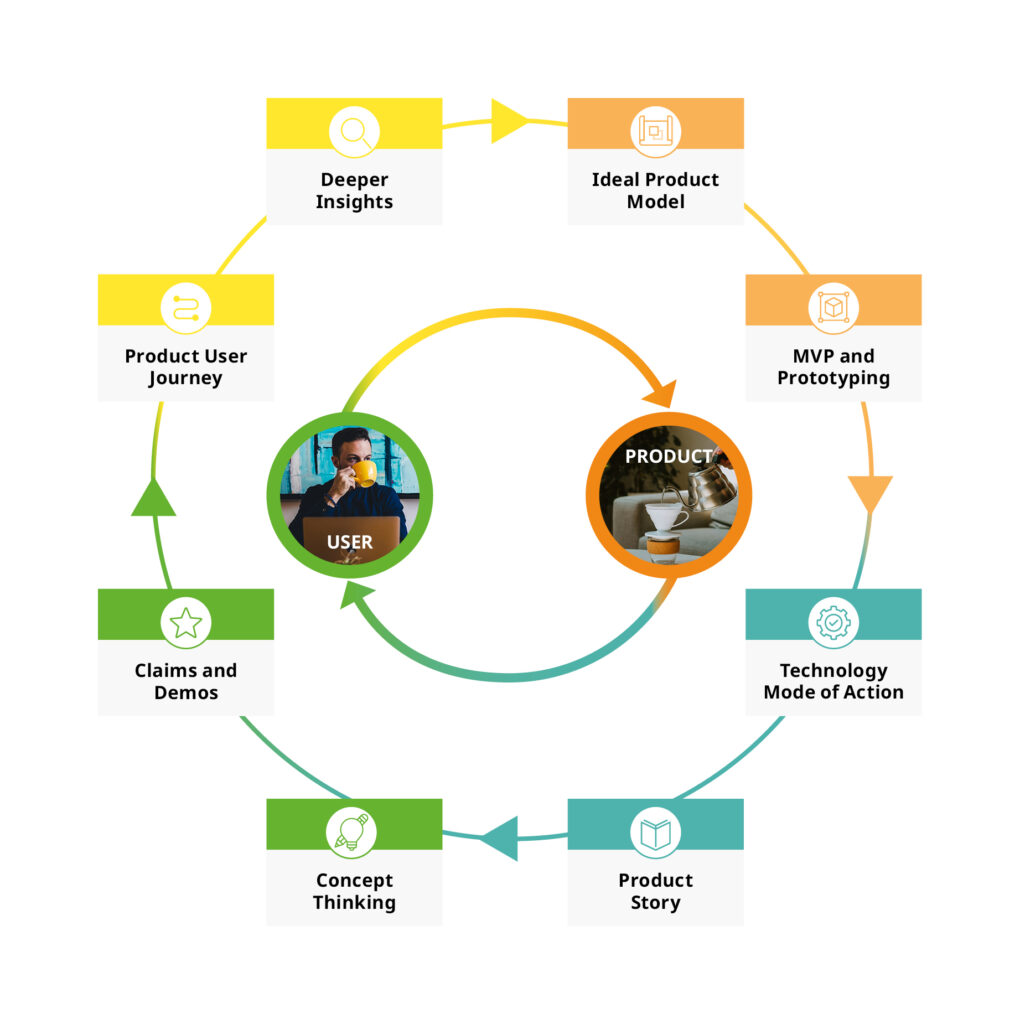
Deeper Insights identify non-obvious user functional and emotional needs, using projective techniques to help explain what the target consumer may find difficult to articulate.
The research budget and leadership of Product User Journey and Deeper Insight studies may be initiated by either the Insight function or R&D, or shared, generating output that is actionable for both. R&D will use these rich user insights to inspire new product specifications, product pipelines and Product Stories. And Insights and marketing may use the same research output to help develop new ideas and concepts, advertising campaigns or in-market activation. This is how well-designed research can generate a significant ROI.
Once the Product User Journey and Deeper Insights are identified, we move onto two cornerstone tools for the R&D product developer, shown in orange in Figure 2.
Ideal Product Model (IPM) Blueprint was created by Untapped to help R&D teams develop breakthrough products with a pipeline of profitable innovation. The IPM Blueprint visually cascades User Needs (Jobs To Be Done; JTBD) into product Attributes (the characteristics of the product user sensory experience), delivery Mechanisms (the specific technology used to
create the sensory experience) and Measures (consumer, sensory, technical or clinical methods or ways of specifically demonstrating the sensory experience). When these are combined, the resulting robust technical brief enables a pipeline of significantly improved product experiences for users.
Minimum Viable Product (MVP) is the simplest version of a product that enables R&D and multi-functional teams to learn about User Needs with minimal development effort and cost. In our approach, the MVP is derived from the IPM Blueprint, where Attributes (the characteristics of the user sensory experience) are prioritized according to the hierarchy of User Needs. This ensures teams move toward an in-market product that remains both lean, and still delightful. This then brings us to the lower half of the cycle. The two tools (shown in teal) are also critical tools for R&D.
Technology Mode of Action is a model that summarizes how a new product uniquely works, in order to solve a technical problem and meet a User Need. As technologists we often describe our inventions in ways that resonate most with other technical experts, but we can only create real impact and value when we frame our products through the lens of what our users want in their world. This Technology Mode of Action model provides a framework for critical R&D thinking, extracting implicit knowledge from scientists and ensuring “articulacy” rigour that then amplifies great Product Stories.
Product Story is a strategic tool that articulates the user experience delivered by the new product, creating a clear and compelling narrative that bridges R&D invention with market communication. Positioned on the lower half of the innovation cycle, it is an invaluable launchpad for concepts, Claims and Demos, and a pipeline of innovation possibilities. It can also add significant value earlier in the innovation process by sparking and shaping new product ideas. When done well, marketeers and creative agencies love working with R&D on Product Story development. The process enables the different functions to fully realize the value of the new product and the impact it can have for the user, making everyone’s role easier and more impactful as the product is brought to the marketplace.
Concept Thinking is a process that develops a concept, essentially a short, structured statement that communicates the essence of a new product idea. A concept must express why the new product should exist, who it’s for and why users would believe in it. Concepts are often used to test ideas with users, guide product development and align key stakeholders. A concept and a Product Story serve different purposes in the innovation process. A concept is a concise, marketing-driven tool, written in consumer language and structured around the classic insight–benefit–RTB format. Its aim is to articulate an idea for a new initiative in a way that can be measurably user-tested to assess project metrics including user appeal, the product’s market potential and its strengths and opportunities. By contrast, a Product Story is deeper. Written in a journalistic style by R&D, it explores “what is going on?” through a four-chapter narrative that captures the user’s current world and the user benefit and category-transformation enabled by the new product.
The roles of marketing and R&D also differ. Marketing typically leads concept development, where R&D’s involvement varies widely between companies, from minimal involvement to highly integrated. However, when R&D develops a robust Product Story before the concept stage, our experience shows that concepts consistently test more effectively and products reach market faster. Last but not least, our eighth tool brings the new product points of difference to life, with deliverables typically initiated by R&D.
Claims and Demos are among the most powerful tools for differentiating a new product in the market. A strong claim sets out a promise to the target user of new performance, while a compelling demo brings that promise to life by showing users exactly what they can expect, and why they should choose it. R&D typically defines what can credibly be claimed or demonstrated, ensuring the science is robust and compliant with regulatory and legal standards. Marketing then leads the execution, sharpening the message and tailoring it across every channel, from pack and point-of-sale to online and social media. While developing Claims and Demos is routine for many in R&D, critical thinking consistently elevates the results, starting with a deeply rigorous understanding of the Technology Mode of Action, and then weaving that into a single-minded Product Story.
This is an edited extract from Untapping Innovation® (Practical Inspiration Publishing, June 2026) by Deirdre Walters, Sally Kemkers and Suzanne Allers, founding partners of Untapped Innovation.
| About the authors Deirdre Walters, Sally Kemkers and Suzanne Allers are founding partners of Untapped Innovation, a global agency helping R&D teams at companies like PepsiCo, P&G, Unilever, and Reckitt create breakthrough products and compelling product stories. Having met at Procter & Gamble, they combine expertise in user psychology, product insight, and commercial strategy. They all have degrees in science with additional diverse experience – Suzanne’s scientific PhD, Sally’s consumer insight background, and Deirdre’s experience in manufacturing and marketing – helping them bridge R&D and business functions. Since launching Untapped Innovation in 2012 and working with CPG clients, they have honed their innovation skills while also co-founding STEM Untapped, a non-profit supporting underrepresented students in STEM. |