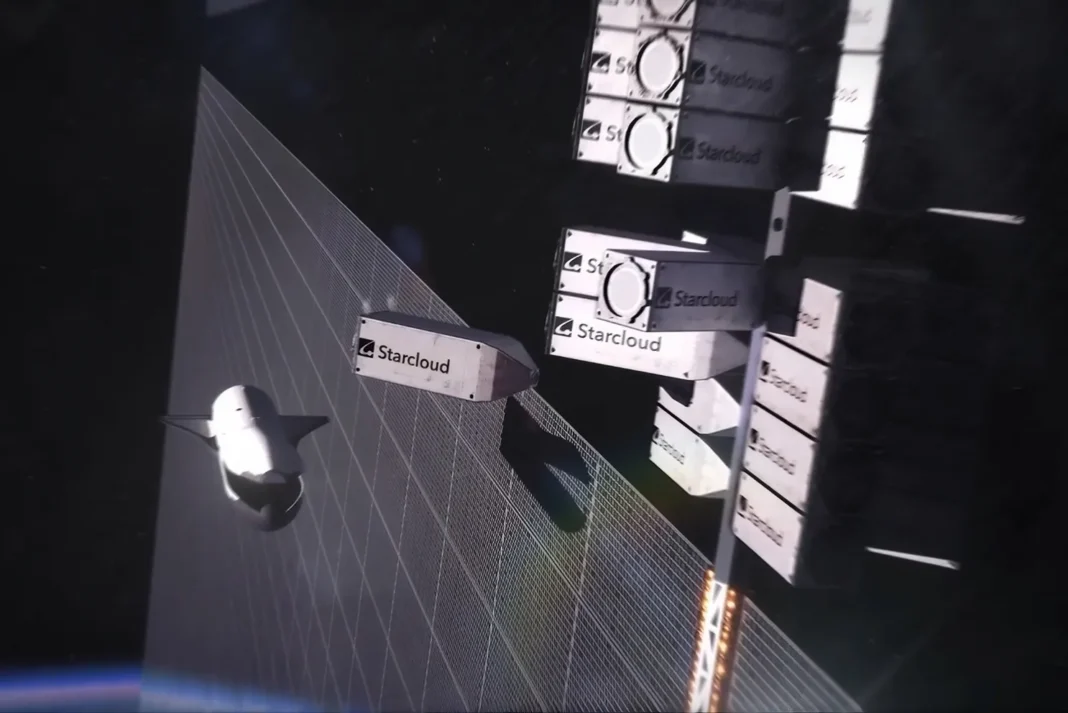
Source: Starcloud, “Why We Should Train AI in Space”, White Paper, September 2024
Space-based data centers save water and power, yet raise new environmental costs
On 2 November 2025, a 60-kilogram satellite roughly the size of a small refrigerator separated from a SpaceX Falcon 9 and began circling the Earth. On board was something no spacecraft had carried before: an NVIDIA H100, the same GPU that powers terrestrial AI data centers. Starcloud-1 (also registered as Lumen-1, from the company’s former name, Lumen Orbit) is powered by solar panels and onboard batteries. Its mission is to test whether data-center-class hardware can work in orbit. So far, it has: the satellite has run Google’s Gemma model and trained a small language model in space.
It is the latest step in a long convergence. The first large electronic computers of the 1940s were room-sized machines with massive ventilation systems; internet data centers spread on an industrial scale in the 1990s; in 1998 the first module of the International Space Station reached orbit as a scientific laboratory. Today these two trajectories meet in the prospect of orbital data centers.
This is no longer science fiction. Tech and aerospace players, including Google, SpaceX and the startup Starcloud, backed by NVIDIA’s Inception program, are actively developing orbital computing architectures. Technical lead times remain long, but the journey has begun.
The concept
An orbital data center is defined as any space-based infrastructure, situated in Earth orbit, dedicated to computing, server hosting, data storage and networking. And more. These facilities are designed to execute operations analogous to the traditional ground-based installations, with current proposals focusing on autonomous, standalone, or modular satellite constellations.
Google is among the most advanced: with Project Suncatcher it is studying how to turn space computing into an operational reality, and in early October 2026 it launched a first prototype satellite carrying four of its Tensor Processing Units (TPUs), built with Planet. SpaceX, for its part, has said it expects to start deploying orbital AI compute satellites as early as 2028.
Cooling and energetical challenge
Terrestrial data centers face intense public and regulatory scrutiny because of their vast energy footprints, driven by power supply demands and continuous cooling requirements. Orbital deployment offers distinct thermodynamic and energy advantages.
For example, being positioned in the Low Earth Orbit (LEO), a satellite can be placed in sun-synchronous orbits to maintain constant exposure to sunlight, maximizing solar panel yield, without any atmospheric interference. Cooling is a different story, and a more complex one. Space has no air or water to carry heat away: the vacuum acts as an insulator, and the only way to get rid of the heat generated by processors is to radiate it into space through dedicated radiators. This removes the need for liquid coolants and, crucially, for terrestrial water. But radiators must be very large to dissipate high power: Starcloud’s plans for a 5 GW facility include solar and radiator arrays several kilometers long. Thermal management, in other words, is not a free bonus of space, but one of its main engineering challenges.
Technical hurdles in space environment
Despite these advantages, the technical hurdles are daunting. Outside the protection of Earth’s atmosphere, semiconductor components are exposed to harsh solar and cosmic radiation. This hostile environment significantly accelerates hardware degradation compared with ground conditions.
To address this, Google exposed its Trillium TPUs to a 67 MeV proton beam simulating the low Earth orbit environment. The chips showed no permanent damage up to doses equivalent to a five-year mission, a result the company described as surprisingly good.
Managing operation from the ground introduces another key bottleneck: latency and bandwidth limits. To reach the bandwidth of a terrestrial data center, Google proposes laser links between satellites flying in very tight formation, a kilometer or less apart and possibly just a few hundred meters, kept stable by modest station-keeping maneuvers. No existing constellation flies this close.
Latency of signals between orbit and the final user remains a primary constraint. For latency-sensitive workloads like AI inference or high-frequency financial trading, signal propagation delay dictated by orbital altitude are critical. Furthermore, managing tens of thousands of orbital assets without collision hazards presents a monumental space traffic management challenge, as said by the European Space Agency (ESA).
Toward an orbital economy
Unlocking optimized power generation via continuous solar harvesting opens the door to a new economic niche. While energy costs become more accessible, the prices are lowering, attracting new users and opening doors to improved services. Always-on, high availability services immune to terrestrial grid failures or localized power outages.
While the ultimate target market is still emerging, the value proposition appeals not only to private enterprise but especially to sovereign and institutional clients. SpaceX’s Starship platform aims to reduce payload launch costs, traditionally hovering around 90 million dollars, because of full vehicle reusability. Under these economics, orbital computing (data processing in Low Earth Orbit) could transition from an experimental niche to a mainstream commercial reality within the next 10 to 15 years.
However, orbital infrastructure introduces novel cost vectors. High initial capital expenditure (CapEx), complex remote operations, and zero-touch maintenance models mean that stakeholders face substantial long-term commitments.
Lower environmental impact or just externalities?
Space-based data centers could ease pressure on critical terrestrial resources such as land, freshwater and local grid capacity. But they risk shifting environmental costs elsewhere. Firstly there is launch emissions. Rocket launches release carbon dioxide and black carbon directly to the upper layer of the atmosphere. The effect is negligible at today’s launch rates, but a dedicated fleet requiring dozens of deployment and resupply launches every year would amplify it significantly.
The second is the supply chain and end-of-life disposal. Computing hardware, high-efficiency photovoltaics, and energy storage rely heavily on rare earth elements and specialized metal alloys. Extracting and refining these materials carries a heavy mining and environmental footprint. Ground-based data centers already pose severe e-waste challenges. For space assets, the operational difficulty of retrieval and recycling amplifies the problem.
This inevitably raises the issue of orbital debris. Without deliberate de-orbiting mechanisms, decommissioned server constellations risk becoming permanent space junk.
The strategic horizon
The debate surrounding orbital data centers extends far beyond engineering and environmental economics. It’s inherently geopolitical. Operating infrastructure outside terrestrial jurisdiction offers strategic insulation from physical sabotage and localized legal interference. As highlighted in industry analyses, space-based infrastructure represents the next frontier of data sovereignty.
The race for computing in space is already underway, featuring active initiatives from ESA alongside national strategies in the US, China and Japan. According to Space Economy insights by Intesa Sanpaolo, this technology will not remain isolated in orbit, it will permeate the broader global economic architecture. Technologically advanced Nations that secure an early presence will inevitably widen the digital divide.
The night sky is fast becoming a shared industrial infrastructure. As our reliance about orbital tech deepens, international policy must adapt quickly, with new clear diplomatic frameworks, legal accountability mechanisms and debris mitigation standards to manage the geopolitical, economic and environmental realities of computing in space.