A detailed breakdown of what the research workbench does, what it leaves to humans, and how it reshapes dry-lab and wet-lab boundaries
On June 30, 2026, Anthropic released Claude Science, an AI workbench for scientists, in beta. My first reaction was not «Anthropic has finally entered scientific research» — it was «How is this different from Claude for Life Sciences (Oct 2025) and Claude for Healthcare (Jan 2026), which I already covered?» Lining up all three, the interesting point turns out to be this: this is not the launch of a new model, but of a new working environment — and that framing changes how you should read it.
3 Key Takeaways
• This is a productization, not a first entry.
Anthropic already stated the “from single tasks to the full research-to-commercialization process” vision back in October 2025 (Life Sciences) and extended it in January 2026 (Healthcare). Claude Science is that same vision turned into a dedicated app, so the “AI that does research” framing is overhyped.
• The bet is workflow, not a smarter model.
Claude Science runs on existing Claude models (including Opus 4.8) and adds 60+ curated skills/connectors (UniProt, PDB, ClinVar, ChEMBL, etc.), compute management, provenance tracking, and a reviewer agent — plus native access to NVIDIA BioNeMo models (Evo 2, Boltz-2, OpenFold3). Just as Claude Code won on “an environment that runs development,” this bets on “an environment that runs research.”
• As the dry-lab barrier collapses, the real question is how much wet-lab work remains.
My provisional answer: wet lab survives, but its scope is being eroded from both ends — in vitro by self-driving labs (Recursion, Arctoris, LUMI-lab), and in vivo (animal testing) by the FDA’s NAM roadmap (organ-on-chip, in silico). The irreducible core narrows to human clinical validation and biology, which we still can’t model.
On June 30, 2026, Anthropic released Claude Science, an AI workbench for researchers, in beta. It ships with 60+ pre-configured skills/connectors for genomics, single-cell, proteomics, structural biology, and cheminformatics, and connects to scientific databases such as UniProt, PDB, Ensembl, ClinVar, and ChEMBL, as well as NVIDIA BioNeMo’s life-science models. It is available to Claude Pro / Max / Team / Enterprise users on macOS and Linux.
When I saw this news, the first thing I recalled was “Claude for Life Sciences,” which I had covered before. And I was fairly sure “Claude for Healthcare” had also been announced back in January this year — so my honest first impression was: how is this new “Claude Science” different from those? So I lined up all three announcements to figure out what is actually new. In short, the interesting part is that this is not the launch of a new model, but of a new working environment. I’ll organize the discussion around that.
It isn’t a “first entry”: the three stages since 2025
First, let me get the timeline straight. Claude Science is not an announcement that stepped into a brand-new field from zero. Anthropic has built up this area in three stages.
October 20, 2025 | Claude for Life Sciences announced a vision to support literature review, hypothesis generation, bioinformatics, lab-protocol understanding, and more. At that point, it already stated the goal of moving «from researchers using Claude for individual tasks, to supporting the entire process from early research through translation and commercialization».
January 11, 2026 | Claude for Healthcare (Life Sciences extension) Extended connections to ClinicalTrials.gov, Medidata, clinical-trial management, regulatory operations, and more, broadening coverage into clinical and regulatory work.
June 30, 2026 | Claude Science turned the above vision into a dedicated application where researchers actually run their analyses.
In other words, the vision itself was laid out more than eight months ago. Framing this as «AI moving from a tool that summarizes papers to an entity that does research» isn’t accurate given this history. The essence this time is that a previously stated vision was implemented as an execution environment.
What’s actually new? — a workbench, not a model
The single most important fact this time is that Claude Science is not a new AI model. It is an “environment” layered on top of existing Claude (including Opus 4.8): research-oriented DB connectors, compute management, provenance tracking, and a fact-checking agent. TechCrunch described it as «betting on workflow, not a new model».
This structure is easiest to understand by recalling Claude Code.
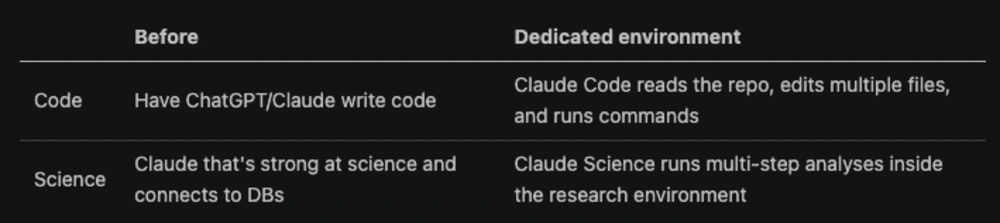
Just as Claude Code was not “a chatbot that can write code” but “an execution environment that runs development work”, Claude Science aims to be not “a chatbot that knows science well” but “an execution environment that runs research work”. The differentiator isn’t intelligence — it’s how much of the work it can carry out for you.
Why can specialist agents span databases?
To answer the heading directly: it’s because Claude Science isn’t structured around a human manually operating a single connector, but around a coordinating agent that routes among 60+ pre-configured skills and connectors.
For example, suppose a researcher asks in natural language, «For this gene variant, look up its known pathogenicity, its impact on protein structure, related pathways, and existing drug candidates». The coordinating agent then spans separate databases such as:
- ClinVar (variant pathogenicity)
- UniProt (protein information)
- PDB (3D structure)
- Reactome (pathways)
- ChEMBL (compounds/drug candidates)
and returns an integrated result. A process that previously required the researcher to open each DB individually and stitch it together by hand now collapses into a single request. This is what “60+ connectors” actually means.
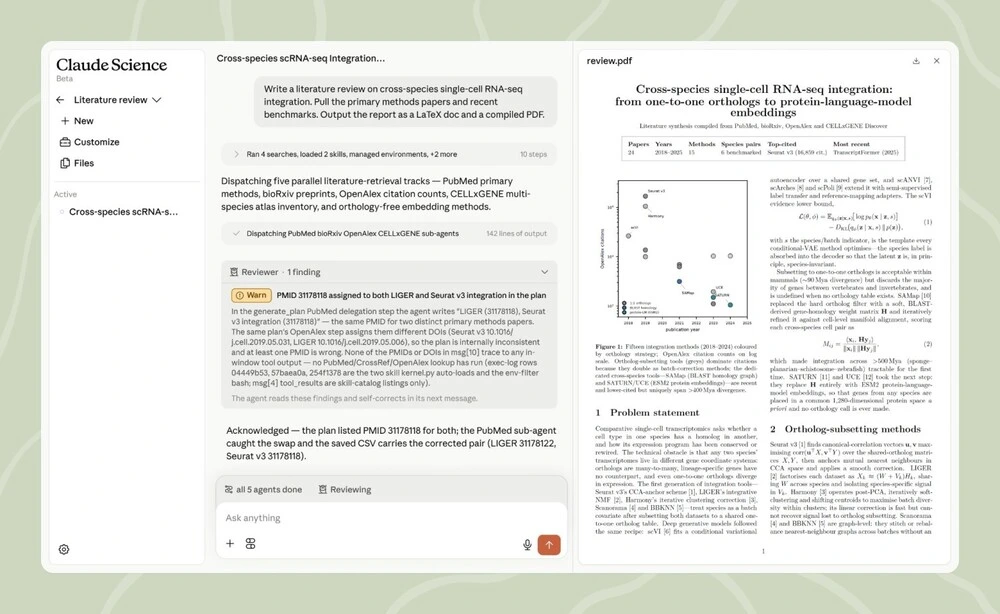
Even bigger is the connection via the NVIDIA BioNeMo Agent Toolkit. Claude Science is said to connect to life-science models such as Evo 2, Boltz-2, and OpenFold3. This is not just an LLM reading papers; it means stepping into a workflow that spans an LLM and specialized models:
literature search → target-candidate extraction → run structure-prediction model → analyze results → select next candidate
It bridges into territory a text-generation model alone can’t reach, by calling out to heterogeneous models.
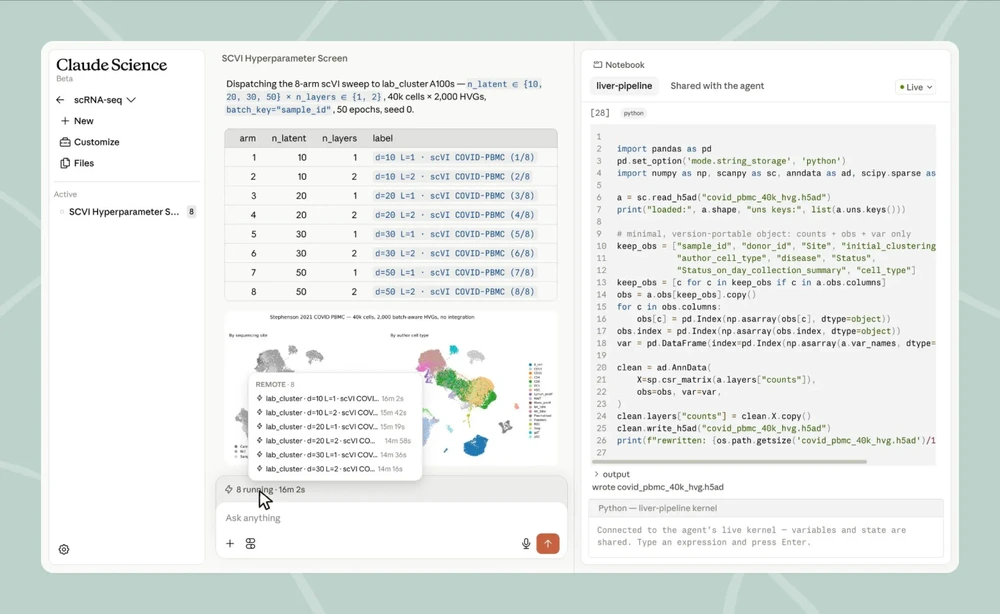
One more thing not to overlook: you can turn your own lab’s pipeline into a reusable skill. You connect your own data, proprietary pipelines, and validated tools, and save them as reusable skills. Once you embed a standard procedure — FASTQ retrieval → QC → alignment → differential expression → pathway analysis → figure creation — you get closer to usage like «run the same pipeline as last time on this new patient cohort».
Why did Anthropic foreground “auditable artifacts”?
In scientific research, «the AI produced an answer» isn’t enough on its own. What data was used, what code was run, what intermediate results were produced, and whether it can be reproduced — these are the questions. This has been the biggest weakness of AI research support.
This time, Anthropic clearly foregrounds that the artifacts Claude Science generates «each carry an auditable history of how they were made». It also embeds a reviewer agent that checks citations and calculations, inspecting for figures that don’t match the code and references that can’t be traced — catching them before a human does.
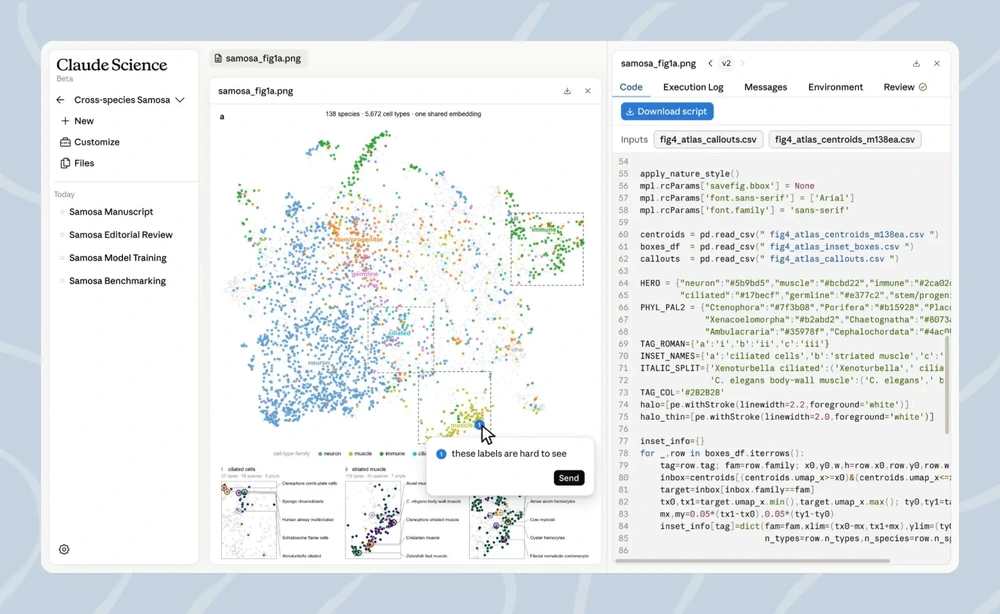
That generative AI fabricates citations and numbers (hallucination) is a known weakness, and in a scientific context it’s fatal. Going after it with a design that has «a separate agent recompute and cross-check sources» struck me as a practical point of focus. UCSF’s Stephen Francis is said to have independently validated Claude Science’s results before stating that it can «produce rapid and robust analyses» — consistent with a «verify, then use» premise.
On compute, too, it is said to manage resources across personal devices, HPC clusters, and Modal’s on-demand resources — turning even «where to run computations you can’t handle locally» into part of the environment.
Three-way strategy comparison: workflow vs. specialized model vs. proprietary IP
This field is not Anthropic’s alone. OpenAI and Google are running alongside with different strategies, and it’s interesting how cleanly the three companies’ bets diverge.
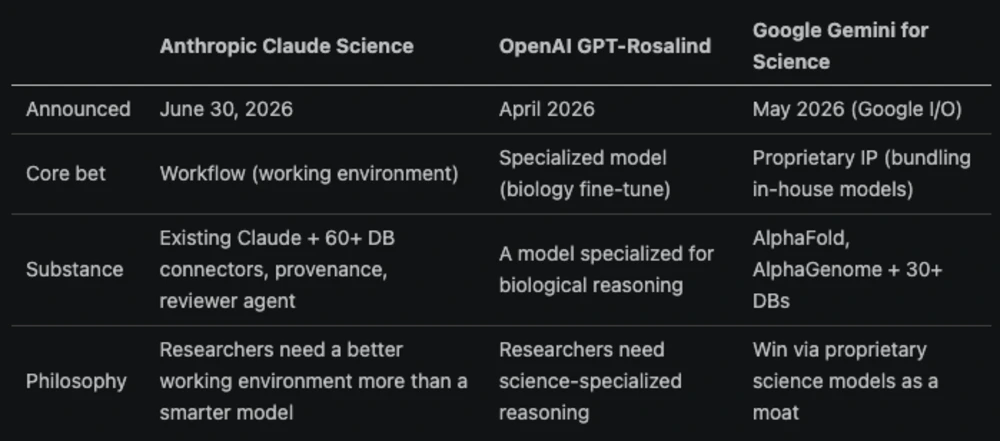
OpenAI’s GPT-Rosalind is reported to score 21.6% on the life-science benchmark BixBench (vs. 20.4% for GPT-5.5) and 63.2% on the wet-lab-practice benchmark LabWorkBench (vs. 55.8%) — the «train the model itself for science» route.
Google, meanwhile, takes the route of bundling AlphaFold and AlphaGenome — assets only it has — into Gemini. Only Anthropic is betting on «keep the model as-is, differentiate on the environment». Which is correct can’t be declared at this point, but the three are likely to compete while carving out different uses. For practitioners, the choice will shift depending on whether you want “a smart one-shot answer” or “to hand off end-to-end work”.
Once the dry-lab barrier disappears, how much wet lab remains?
Having lined up the three announcements, let me first note that this is not an entry into a brand-new field from zero. As of the October 2025 Life Sciences launch, Anthropic had already stated its vision of going from single-task support to supporting the whole research-to-translation-to-commercialization process. January’s Healthcare and this Science release are productizations along that same line. The «AI that does research» framing feels somewhat overhyped to me. That was the setup; what I really want to think about comes next. To dig one level deeper into this news, let me overlay my own hands-on experience of using Claude Code.
From Claude Code to automated research workflows
Before switching to Claude Code, I used Cursor. The experience of writing code while conversing was plenty convenient in itself, but the feeling changed after moving to Claude Code. It connects to external data resources via MCP, and even without detailed programming knowledge, simply conveying my intent — «I want to build something like this» — fills in most of the implementation automatically. Furthermore, with skills, if you backcast from completed work and ask, «register the steps you just did as a skill, and do it automatically next time», a de facto sub-agent assembles itself. We’ve reached a stage where automation runs not for “people who can write the procedure”, but for “people who can say what they want”.
What happens with Claude Science is the science version of this. Run your lab’s standard analysis (FASTQ → QC → … → figure) once, and it remains as a skill; from then on, it’s reproduced just by conveying intent. Even in labs without a dedicated bioinformatician, the barrier to dry-lab analysis drops considerably. I think there’s substantial room for rapid adoption in labs.
That shifts the real question to «once the dry-lab barrier disappears, how much wet lab (actual experiments) remains?» I don’t want to settle this with «wet lab survives, so we’re fine». As you dig in, there are signs that the very scope of what needs to be done in wet lab is shrinking — from above (in silico) and from below (experiment automation). Let me split it into in vitro and in vivo, with some grounding.
Dry lab, in vitro and in vivo
Dry (computation, analysis, literature, hypothesis generation): the layer Claude Science erodes most directly. The barrier drops rapidly.
In vitro (experiments in a dish — cultured cells, molecules, etc.): here, “AI agents + automated experiment facilities (self-driving labs)” that run a closed loop of analysis → candidate selection → experiment execution → re-analysis already exist. Recursion and Arctoris run compound screening on robotized experiment platforms, and closed-loop systems that automate synthesis, formulation, and in vitro screening — such as LUMI-lab, which searches for mRNA-delivery lipids — have been reported. There are reports of collecting 10× the data of conventional methods through automation. In other words, in vitro is shifting from “work humans run by hand” to “work an agent orders and equipment executes”, and the human-run portion is likely to shrink.
In vivo (experiments using animals and humans): at first glance, this layer retains “incompressible constraints” — biological real-time, ethics, regulation, individual variability — and looks hardest to replace. Yet even this scope is starting to be deliberately narrowed from the regulatory side. In April 2025, the FDA announced a plan and a 5-year roadmap to phase out animal-testing requirements for monoclonal antibodies and other drugs, promoting replacement with organ-on-chip, organoids, and in silico models (collectively, NAMs — New Approach Methodologies). In December 2025, draft guidance to reduce primate use in antibody toxicity studies was issued, and as of early 2026, 151 NAM tools are said to be in the qualification pipeline, with 20+ having reached full qualification. “Part of in vivo (animal testing)” is actually being replaced by the combination of AI and organ-on-chip.
What remains at the core of wet-lab research?
Lining this up, my provisional answer to «Does wet lab remain?» is: «It remains, but its scope is eroded from both above and below, and it shrinks». In vitro sheds human labor to automated equipment, and the animal portion of in vivo is partly replaced by computation and organ-on-chip via NAMs. What is hardest to compress is human clinical validation and the complexity of living systems we still can’t adequately model. Conversely, that’s where scarcity and value concentrate. This isn’t the simple story of «dry got faster, so wet’s value rises»; rather, within the wet lab itself, the line is redrawn between “the part that can be replaced” and “the core that remains”.
Strategically, Anthropic taking this dry layer via workflow rather than a model is internally consistent. It’s the same winning path by which Claude Code spread as «an environment that runs development» rather than «a smarter model». But what will really matter after mastering the dry layer is how that environment connects to automated experiments in vitro / in vivo (self-driving labs and organ-on-chip). What I most want to watch is the sequel to «analysis got 10× faster»: «how far can the experiments themselves be compressed?»