From World Bank warnings to European innovation: managing water uncertainty to nourish a flourishing planet
«Man—despite his artistic pretensions, his sophistication and his many accomplishments—owes his existence to a 6-inch layer of topsoil and the fact that it rains». The quote is attributed to an American radio host, but over the years it has become common property, and its meaning is increasingly evident in every part of the world.
The reality, however, is that rain often doesn’t come—or comes too much—and both scenarios are disastrous. Six inches of topsoil can hold precious little water, yet when water arrives in torrents, it is just as likely to wash that same soil away. Within a few decades, one of humanity’s greatest achievements will lie in navigating the existential challenge of feeding ten billion people with barely eleven inches of freshwater to go around—all while sustaining a thriving planet. Adding weight to the urgency of this reflection is the March 2026 report on water solutions from the World Bank Group, titled Nourish and Flourish.
Modest adjustments in water use—this is the conclusion of the analysis—will not be enough to meet current or future food demands, which are projected to grow by as much as 56 percent by 2050. To accelerate inclusive, sustainable, farmer-led irrigation, we must act now to strengthen the enabling environment, lower barriers for farmers, and realign the incentives of governments, the private sector, and financial actors.
A different map
A notable element of the document is methodological in nature. The report indeed presents a new framework for policymakers navigating difficult agricultural water management trade-offs and seeking contextually appropriate solutions. By categorizing countries according to their level of water stress and whether they are net calorie importers or exporters, the water-food nexus framework provides an analytical tool to help policymakers move from generic, one-size-fits-all fixes toward country-specific pathways and actions.
The report recognizes that transforming agricultural water management into a scalable, resilient system requires moving decisively toward service-driven, data-enabled irrigation markets. Evidence from India, Morocco, Peru, and Uganda shows that when risks are shared transparently, revenue streams are predictable, and when regulation supports cost recovery, private capital rapidly enters—from small and medium enterprises providing installation, operation and maintenance, and digital advisory services, to larger firms financing infrastructure through guarantees and blended instruments.
The role of technology
Despite the transformative potential of tools like remote sensing, AI, and machine learning, these innovative technologies have been underused in advancing agricultural water management. Remote sensing, for instance, can provide near-real-time data on crop health, evapotranspiration, crop types and yields, water productivity, and irrigation service delivery performance at a fraction of the time and cost required for conventional census-based data collection. Yet many farmers still rely exclusively on manual methods.
Meanwhile, AI’s predictive capabilities offer powerful tools for anticipating climate variability and its impacts, providing policymakers with early warnings and actionable insights, enabling them to better prepare for and respond to emerging risks. Modernization programs, such as those in India and Spain, have had transformative impacts by leveraging satellite imagery, AI, and advanced data analytics to deliver near-real-time insights into water use, irrigation performance, and overall system efficiency. The use of such technologies has enabled more informed, data-driven decisions for sustainable water management.
Private capital, public gain
The report emphasizes that the vital role of the private sector in scaling agricultural water management—through investment, expertise, and innovation—is increasingly evident. Enterprise innovation is critical to filling data gaps and enabling targeted, productive investment, while expertise drives performance improvements in agricultural water management. To advance private sector engagement, governments and their partners are developing competitive markets for services, including operation and maintenance, delivered by private irrigation operators. Although large-scale private sector players have been successfully engaged in countries including Jordan, Morocco, and Peru, smallholder farmers represent a growing private finance force, particularly through farmer-led irrigation development. Experience with this model demonstrates that when investments are de-risked, access to appropriate finance increases, viable private offtake markets deepen, and small farmers are keen to invest in irrigation. Agricultural water management scales and succeeds when it operates as a service, grounded in cost-recovery principles and accountable operators.
The report provides examples of how countries have achieved agricultural water management transformation, highlighting innovations that have worked and actions that governments have taken. Using this information, along with the water-food nexus framework, policymakers can chart their own journeys toward improved agricultural water management policies and outcomes—sustainably nourishing a flourishing planet.
Time to act
The framework highlights several actions we can no longer afford to delay. First, foster stronger connections across the ecosystem. Ensuring that farmers, suppliers, financial institutions, and agribusinesses are aligned, coordinated, and equipped to respond to one another’s needs is essential. Strengthening these links unlocks technology adoption, expands market access, and opens up financing opportunities.
Second, shift from building infrastructure to delivering sustainable water services. Investments must be guided by governance, incentives, and financing arrangements that support long-term performance, accountability, and financial viability—so that systems deliver reliable services over time, rather than merely creating physical assets. Experience shows that investing in “soft infrastructure”—knowledge exchange, communication and outreach, digital tools, and capacity building—is central to successful development outcomes.
Third, adopt catalytic financing instruments. Tools such as credit guarantees, blended finance, and risk-sharing mechanisms can lower barriers, mobilize private capital, and give farmers the confidence to invest. Redirecting a portion of current agricultural support spending—alongside regulatory reform, blended finance, and public-private partnerships—can crowd in private capital and support financially sustainable, water-efficient service delivery.
Using local water realities to guide policy
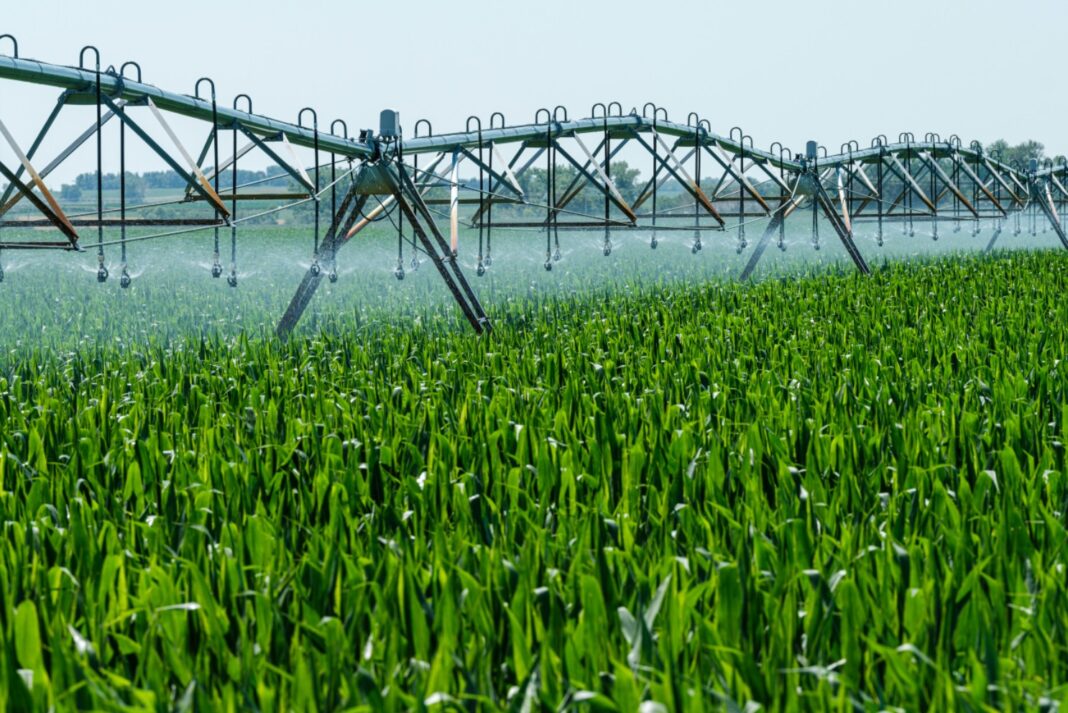
Finally, use water availability and food trade patterns to guide policy choices. As mentioned earlier, governments should move beyond one-size-fits-all approaches and rely on local evidence on water stress, food deficits, and trade exposure to decide where to expand, rebalance, or limit agricultural water use. This means aligning production choices with local water realities and global markets, while making trade-offs explicit and accountable through data. Agricultural water management spans a continuum—from farming that depends entirely on rainfall to systems that use irrigation to supplement it. Strategic, well-timed irrigation can stabilize production, sharply raise yields, and make rainfall more productive.
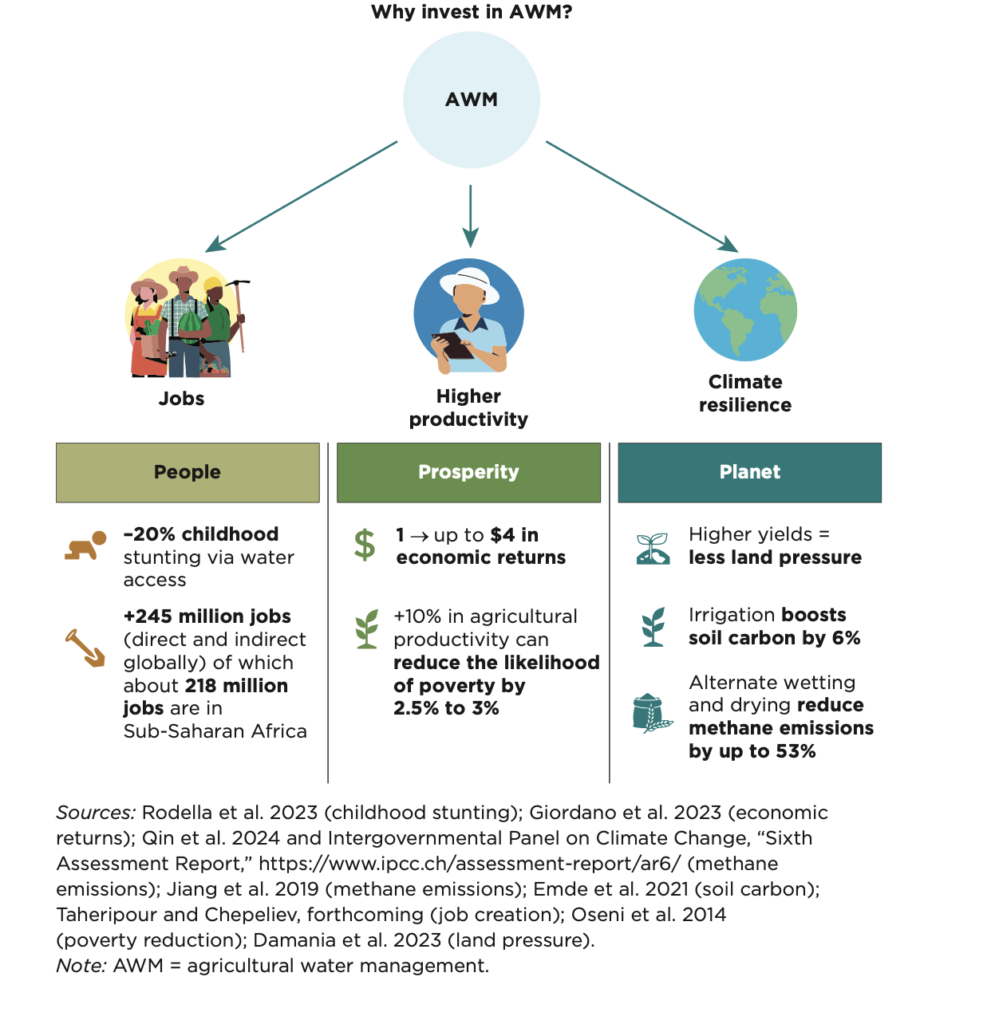
Expanding sustainable irrigation could create at least 245 million jobs, before even accounting for the multiplier effect across storage, processing, transport, and markets. It is clear that investments in this area can generate significant employment gains, and more efficient water systems can ease pressure on land and ecosystems.
10 Technological Solutions
This shift is not limited to emerging economies. Even in Europe, research is driving a structural transformation, moving from “agriculture that uses water” toward integrated water–energy–data–agriculture systems. Among the many examples, the RAINS project—funded under Horizon—stands out. Designed to help European farmers—particularly in southern regions such as Greece and Spain—become more resilient against extreme weather events like drought and torrential rains, RAINS brings together farmers, researchers, businesses, government officials, and community groups in a “quadruple helix” of stakeholders who collaborate, share ideas, test solutions, and discuss how to integrate new techniques into everyday farming.
The overall goal is for the project’s demonstration farms to use water and fertilizers more efficiently and sustainably—saving water, improving crop health, enhancing resilience to extreme weather, while also influencing agricultural policies and farming practices across the EU. These solutions are being showcased on ten farms across Greece and Spain, reflecting a wide variety of agricultural practices.
Alternative water sources and circular resource use
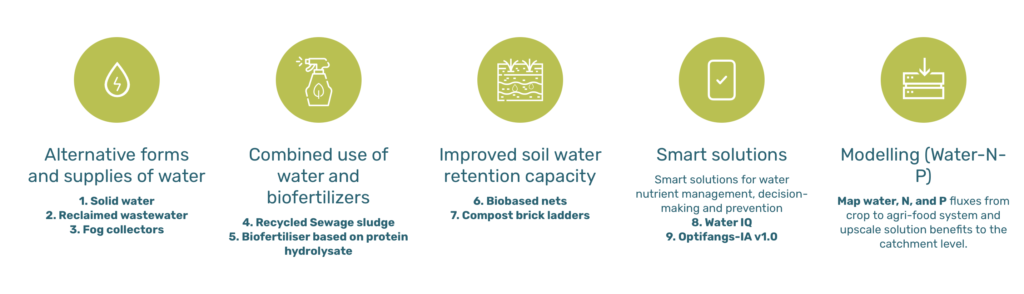
The technological solutions explored by the project can be grouped into ten distinct innovations. On the supply side, alternative water sources include solid water, reclaimed wastewater, which is treated and reused for irrigation; and fog collectors, which capture atmospheric moisture in areas where water is scarce. In the realm of integrated water and nutrient management, the project is advancing the combined use of water with biofertilizers derived from recycled sewage sludge and from protein hydrolysate, both of which enrich soil while reducing dependence on synthetic inputs. To improve soil water retention capacity, two further solutions are being deployed: biobased nets, which reduce evaporation and protect soil structure, and compost brick ladders, which help retain moisture and prevent erosion on sloping terrain.
Alongside these, smart digital solutions are transforming how farmers make decisions. WaterIQ and Optifangs-IA v1.0 are decision-support tools that help farmers determine precisely when and how much to irrigate or fertigate their crops. By leveraging real-time data, artificial intelligence, and predictive modeling, these tools minimize water waste and ensure optimal growing conditions across diverse environments. Completing the suite of innovations is advanced modeling of water, nitrogen, and phosphorus fluxes, which enables researchers to map nutrient flows from crop to agri-food system and upscale the benefits of these solutions to the catchment level.
A broader industrial shift
Taken together, these ten solutions point to a broader industrial shift: the convergence of agriculture, water, and technology sectors, the emergence of new supply chains, plus: a strong public role through funding and regulation.
At the heart of this transformation lies a fundamental insight about cost. The real cost is uncertainty. For a farmer, an insurer, or an investor, the critical question is not “how much does water cost today?” but rather “will I have enough water when I need it?” The enterprises that are emerging and thriving, therefore, are those capable of managing uncertainty across its entire lifecycle. They predict risk through climate models, satellite data, and artificial intelligence. They reduce risk through smart irrigation systems and decision-support software. They transfer risk through agricultural insurance and financial products. And they measure risk through water footprinting and ESG traceability. In this new paradigm, water ceases to be a product to be sold and becomes a risk variable to be modeled.
Water beyond market value
Yet framing water primarily as a risk to be managed, while useful, risks overlooking something more fundamental. Water is not a commodity. To reduce it to mere market logic—to treat it as just another tradable good—would be a profound mistake. Water is the basis of life itself, woven into ecosystems, cultures, and communities in ways that defy simple valuation. Managing risk and building resilient systems are essential, but they must be pursued with humility and respect. Technology, finance, and policy can help us use water more wisely, but they cannot replace the deeper responsibility we all share: to safeguard this precious resource not only for economic stability, but for the health of the planet and for generations to come. The true measure of success will not be efficiency gains alone, but whether we learn to treat water with the care and reverence it deserves.