ENEA trained an LSTM network on thirteen years of simulated data to estimate what thermal prosumers feed into district networks
Heating and cooling account for nearly half of final energy consumption in Europe and remain among the most difficult sectors to decarbonize. Although renewable electricity generation has expanded rapidly, thermal energy production is still largely dependent on fossil fuels. European policies increasingly recognize district heating as a key infrastructure capable of supporting the energy transition by integrating renewable sources, waste heat recovery and low-carbon technologies. Modern district heating systems can aggregate distributed thermal resources and deliver them efficiently to urban areas, improving overall energy performance and reducing greenhouse gas emissions.
Historically, district heating networks have operated according to a centralized and unidirectional paradigm. Heat is produced in a small number of large plants and delivered to users through a distribution network. The evolution of energy systems, however, is leading toward more decentralized architectures. In a way similar to the transformation experienced by electrical grids, thermal networks are becoming more flexible, digitalized and interactive. A growing number of buildings and facilities can now produce thermal energy locally through solar thermal collectors, heat pumps, geothermal systems or industrial waste heat recovery technologies.
Thermal prosumers and the challenge of heat forecasting
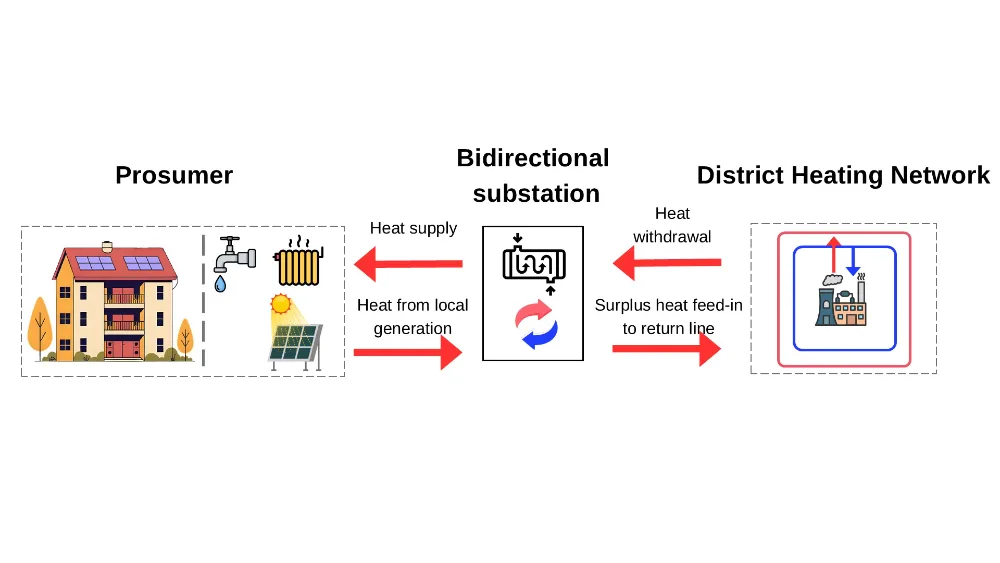
This evolution is creating a new category of users known as thermal prosumers (fig. 1). These actors do not merely consume heat. They can also inject surplus thermal energy into the network when local production exceeds on-site demand. The concept has the potential to unlock significant amounts of renewable and recovered energy that would otherwise remain unused. However, the integration of distributed thermal generation also introduces new operational challenges. Network operators must manage variable and intermittent energy flows while maintaining system reliability and efficiency.
One of the key challenges is the prediction of future heat injections from thermal prosumers. Unlike conventional generation assets, whose output can often be scheduled, renewable-based thermal production strongly depends on weather conditions, storage levels, user behaviour and control strategies. Reliable forecasting tools are therefore becoming essential to support planning and operational decision-making in next-generation district heating systems.
A substation that works both ways
To address these challenges, ENEA has been conducting research activities focused on the evolution of district heating networks toward active and bidirectional configurations. The work has been carried out by researchers from ENEA’s Department of Energy Efficiency within the framework of the Italian Research Fund for the Electrical System (Ricerca di Sistema Elettrico), under the three-year research programme 2025–2027.
The project is developed by the Laboratory for Integrated Solutions for Energy Efficiency and focuses on innovative solutions capable of accelerating the decarbonization of thermal energy systems. Research activities combine numerical modelling, experimental validation, artificial intelligence techniques and system-level analyses. These aim to evaluate the technical and operational impacts of thermal prosumer integration.
A central component of the project is the development of an innovative bidirectional district heating substation prototype (fig. 2). Unlike traditional substations that only allow heat withdrawal from the network, the proposed solution enables buildings to both consume and inject thermal energy. This approach allows distributed renewable heat generation to actively contribute to the network energy balance. It also represents a fundamental enabling technology for active district heating systems.
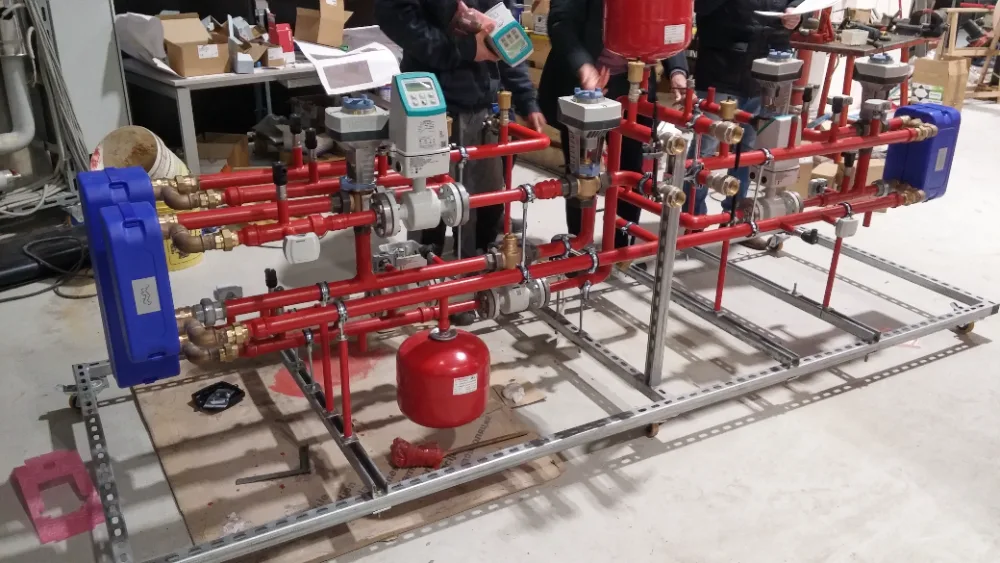
The project builds upon several years of research activities conducted by ENEA on district heating innovation, renewable energy integration and advanced control strategies. The developed solutions have been assessed through both numerical simulations and experimental investigations. These assessments provide a solid basis for the subsequent development of artificial intelligence applications.
Forecasting distributed heat
The primary objective of the project is to develop predictive models capable of estimating, with sufficient accuracy, the amount of thermal energy that prosumers will inject into district heating networks over the short term. While considerable research has been devoted to forecasting thermal demand, relatively limited attention has been given to the prediction of distributed thermal generation. Yet this information is critical for optimizing network operation and maximizing the exploitation of renewable energy.
The study considers a district heating network serving residential buildings in Northern Italy . A retrofit intervention has been designed for one building in order to let it operate as a thermal prosumer. It integrates solar thermal collectors and a dedicated heat exchanger, allowing surplus solar heat to be exported to the network. The retrofit approach was deliberately designed to be minimally invasive. It preserves the existing control logic and avoids modifications to the primary network infrastructure.
To analyse the behaviour of the system, researchers developed a detailed dynamic numerical model of the bidirectional substation. They used the Modelica/Dymola simulation environment. The model reproduces the interactions among space heating demand, domestic hot water production, solar thermal generation, thermal storage operation, control systems and energy exchange with the district heating network.
A large simulation campaign was carried out using hourly meteorological data from the ERA5 climate database. Thirteen consecutive years of operation were simulated with an hourly time step. This generated a comprehensive dataset capturing seasonal variability and changing operating conditions. This dataset provided the foundation for training advanced machine-learning algorithms.
Training the LSTM forecaster
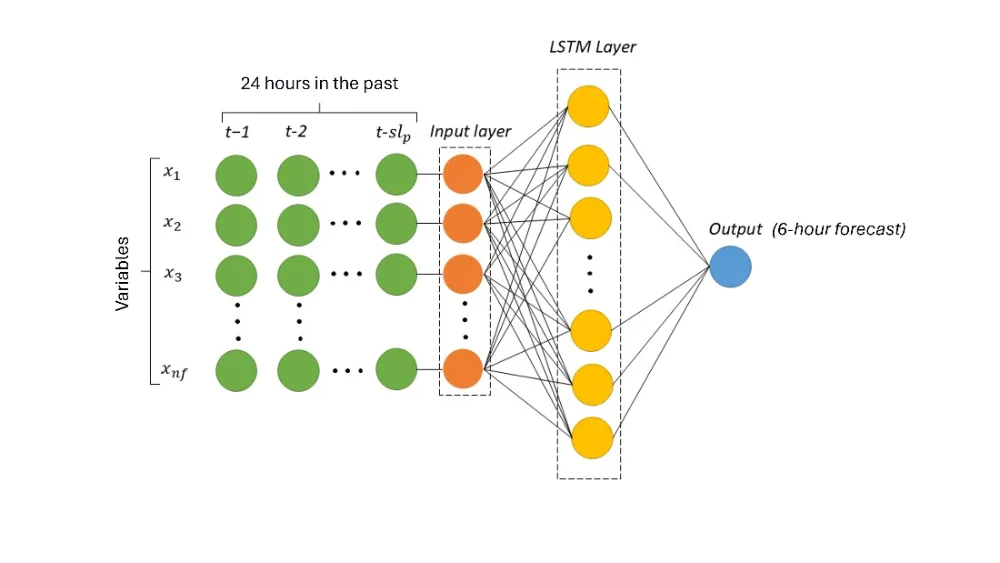
The selected artificial intelligence approach is based on a Long Short-Term Memory neural network (fig. 3). LSTM architectures are particularly well suited for time-series forecasting because they can identify and learn temporal dependencies across long periods. The model was configured to predict thermal power injection into the network up to six hours ahead. It uses information from the previous twenty-four hours.
Input variables include historical feed-in values, outdoor temperature, solar radiation, heating system status indicators and temporal variables describing daily and seasonal cycles. Ten years of simulated data were used for training and validation, while the remaining years were reserved for independent testing. This methodology enabled researchers to assess the robustness and generalization capability of the forecasting model under different climatic conditions.
Best results under the summer sun
The initial results obtained during the project demonstrate the effectiveness of artificial intelligence for forecasting thermal prosumer contributions. The LSTM neural network proved capable of predicting with a satisfactory accuracy heat injection into the district heating network several hours in advance.
Performance analysis showed particularly good results during spring and summer months, when solar thermal production is more abundant and the contribution of thermal prosumers becomes increasingly significant (fig.4). During these periods, the model was able to identify the relationship between weather conditions, thermal storage behaviour and future energy exports with a significant reliability.
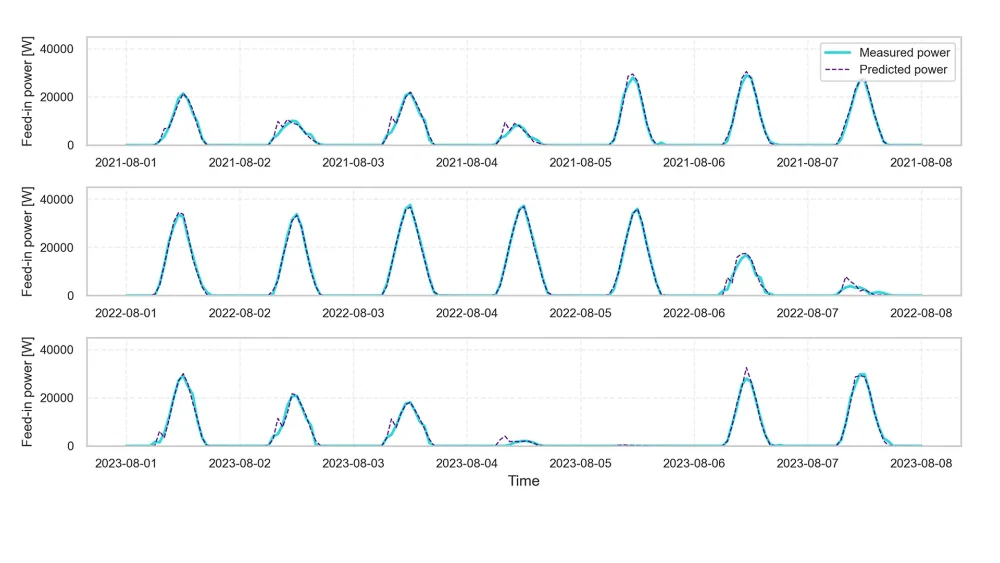
Somewhat larger deviations were observed during winter periods. This behaviour is largely attributable to the lower quantities of excess thermal energy available for export. When thermal feed-in values are very small, even limited absolute forecasting errors may translate into larger relative deviations. Nevertheless, prediction accuracy remained sufficient to support operational decision-making.
Beating persistence forecasts
The proposed artificial intelligence model was also compared against a conventional persistence-based forecasting method. The comparison clearly highlighted the superiority of the neural-network approach. Predictions generated by the LSTM model exhibited lower forecasting errors, reduced dispersion. They also demonstrated a better capability to reproduce the dynamic behaviour of the system. The results confirm that machine-learning techniques can capture complex nonlinear relationships that are difficult to represent using traditional forecasting approaches.
Towards intelligent heat networks
The research confirms that predictive artificial intelligence can become a key enabling technology for the future evolution of district heating systems. As thermal prosumers become more widespread, network operators will require increasingly sophisticated tools capable of predicting distributed renewable heat generation and supporting real-time operational decisions.
Accurate forecasting provides several benefits. It enables more efficient scheduling of centralized generation assets, reduces the need for fossil-fuel-based backup production, improves network flexibility and facilitates the integration of renewable energy sources. In addition, better knowledge of future heat availability can contribute to reducing operating costs and enhancing overall system efficiency.
In the medium term, the integration of forecasting algorithms within advanced supervisory control systems could transform district heating networks into intelligent thermal infrastructures characterized by a higher degree of automation and adaptability. Such systems would be capable of coordinating centralized production, distributed renewable resources, thermal storage units. They would also coordinate prosumer contributions in an optimized manner.
Next steps: longer horizons
Future activities will focus on extending forecasting horizons beyond six hours, incorporating experimental measurements from real installations and integrating predictive models into digital platforms for operational support.
Additional research will investigate the combined use of forecasting algorithms and advanced control strategies. The aim is to maximize renewable energy utilization while maintaining network reliability.
Beyond the purely technical dimension, the project contributes to a broader vision of active district heating networks in which consumers become active participants in energy exchanges. By enabling the valorisation of surplus renewable heat and waste heat that would otherwise remain unused, thermal prosumers can play a significant role in accelerating decarbonization.
The convergence of digital technologies, artificial intelligence and advanced district heating infrastructures represents one of the most promising pathways. This pathway leads toward sustainable urban energy systems.
The work carried out by ENEA demonstrates that the forecasting of thermal prosumer contributions is both technically feasible and operationally valuable. As Europe continues its transition toward climate neutrality, these solutions can support the development of more resilient, efficient and renewable-based heating networks capable of meeting future energy and environmental challenges.
References
- Progetto di Ricerca di Sistema Elettrico Nazionale, Piano Triennale di Realizzazione 2025-2027, Progetto 1.5 “Edifici ad alta efficienza per la transizione energetica”, Work Package 3 “Tecnologie e componenti innovativi per l’incremento della prestazione energetica degli edifici”.
- M. Ricci, F. Gianaroli, M. Artioli, S. Beozzo, P. Sdringola, “Multi-step Artificial Neural Networks for predicting thermal prosumer energy feed-in into District Heating Networks”, Energies, 2025, 18(24), 6608, https://doi.org/10.3390/en18246608.
- ERA5 Hourly Data on Single Levels from 1940 to Present. Available online: https://cds.climate.copernicus.eu/datasets/reanalysis-era5-single-levels?tab=overview (ultimo accesso: 19 novembre 2025).