Sixty years after a visionary essay on zero-gravity manufacturing, orbital industry quietly takes shape
In September 1974, Princeton physicist Gerard K. O’Neill published an essay in Physics Today that would change the way people thought about space exploration for good. “The Colonization of Space” was about something radical: the possibility of permanently relocating humanity’s industrial activity into space. O’Neill’s starting point was to treat space not as a void, but as «a culture medium, rich in matter and energy». Two years later, those same ideas would flow into the book that made them famous worldwide, The High Frontier: Human Colonies in Space (1976).
Seven years earlier, in October 1967, a NASA engineer had put a seemingly naive question to colleagues gathered in Huntsville, Alabama: how does a candle burn inside a pressurised space station? Hans F. Wuenscher, then Assistant Director for Advanced Projects at the Marshall Space Flight Center, noted that almost none of those present had ever wondered. Manufacturing, for the aerospace industry of the day, was an earthbound affair; space was for observing, communicating, demonstrating national prestige. The idea that it might also become a place of industrial production was, in 1967, almost unthinkable.
Sixty years on, O’Neill’s vision and Wuenscher’s question have converged in a technical acronym: ISAM, In-Space Servicing, Assembly, and Manufacturing. The sector now has an institutional architecture spanning eight countries, hundreds of organisations worldwide, and a market whose estimates, though still uncertain, point to double-digit growth by 2030.
Repair, assemble, and manufacture in orbit
The ISAM acronym encapsulates three distinct but interdependent capabilities. Servicing covers extending the life of assets already in orbit through repair, refuelling, component replacement or software transfer: any activity requiring two spacecraft to rendezvous and, in some cases, dock. Assembly refers to the direct construction in orbit of large physical structures from pre-manufactured materials — structures that could never fit inside a rocket fairing as a single unit. Manufacturing covers the creation of new materials, objects and structures in orbit, using resources extracted in space or raw materials launched from Earth.
Taken together, these three pillars represent something more profound than a set of engineering techniques: a restructuring of space logistics. It is useful to view ISAM through the lens of supply chains, since the concept fundamentally involves relocating those chains from Earth to space, moving them closer to the point of use and thereby breaking the traditional dependence on costly, infrequent launches from the ground. The traditional model — design everything on Earth, compress it into the smallest possible volume, launch it, deploy it, and abandon it when it fails — is giving way to a model in which space itself becomes an industrial environment.
Monolithic, disposable spacecraft are giving way to systems that can be built, maintained, upgraded and eventually recycled without ever returning to Earth. This is the paradigm of the “orbital satellite factory”, where satellites could one day be built directly in orbit, doing away entirely with the dimensional constraints imposed by the launch environment.
The production pillar: three strands, one still-immature market
The first demonstration of parts manufacturing in space dates back to 2014, with a Fused Deposition Modelling (FDM) 3D printer developed by Made In Space — now part of Redwire — and operated aboard the International Space Station. Made In Space went on to develop the Additive Manufacturing Facility, sent to the ISS in 2016 and still operating today; both printers work with plastic materials. Redwire is now developing the Multimaterial Fabrication Laboratory, intended to demonstrate the production of electronic components directly on the ISS. Other recent demonstrations concern the in-orbit production of pharmaceuticals, optical fibres and semiconductors, made advantageous by the unique environmental conditions of vacuum and microgravity.
Of these three pillars that give the ISAM acronym its name — Servicing, Assembly, Manufacturing — manufacturing remains, however, the furthest from real commercial viability. The Saudi Arabian Centre for Space Futures made this point clearly in its factsheet Pioneering the Future: Space Technologies Poised to Revolutionize Exploration and Economy by 2035 (June 2026): life-extension and inspection services are the most mature near-term applications, while refuelling, modular upgrades, large-scale assembly and in-space manufacturing still require further validation, standardisation and repeated demonstrations.
In-Situ Resource Utilisation
The Manufacturing pillar itself branches into three application strands, each with its own technological logic and commercial trajectory. The first is In-Situ Resource Utilisation (ISRU): extracting and processing raw materials from planetary bodies, moons or asteroids, to enable a self-sufficient human presence beyond Earth and reduce dependence on Earth-supplied resources. This capability requires a set of enabling technologies: sorting and classifying materials, extracting resources from their native environment, precision robotic handling, welding and bonding of materials, power generation beyond the limits of traditional solar arrays, organised storage, and waste management.
Products for Earth
The second strand, Products for Earth, exploits the unique conditions of space — microgravity, vacuum, extreme thermal cycling — to manufacture goods that are difficult or impossible to produce on our planet: high-performance semiconductors, advanced alloys, ZBLAN optical fibres that outperform their terrestrial equivalents, and pharmaceuticals whose crystal structures can only form in the absence of gravity. These products return to Earth aboard dedicated re-entry vehicles, a rapidly expanding market: numerous US and European start-ups are emerging from stealth, many with demonstration missions scheduled for the coming years, while established players such as Varda and Orbital Paradigm are planning larger vehicles and higher launch cadences to guarantee commercial-grade supply.
Products for Space
The third strand, Products for Space, covers components and systems built for use beyond Earth’s atmosphere: large antennas, solar arrays, space station modules. These are the applications that benefit most directly from in-orbit assembly, which removes the physical constraint of the rocket fairing and allows structures far larger and more capable than any deployed today.
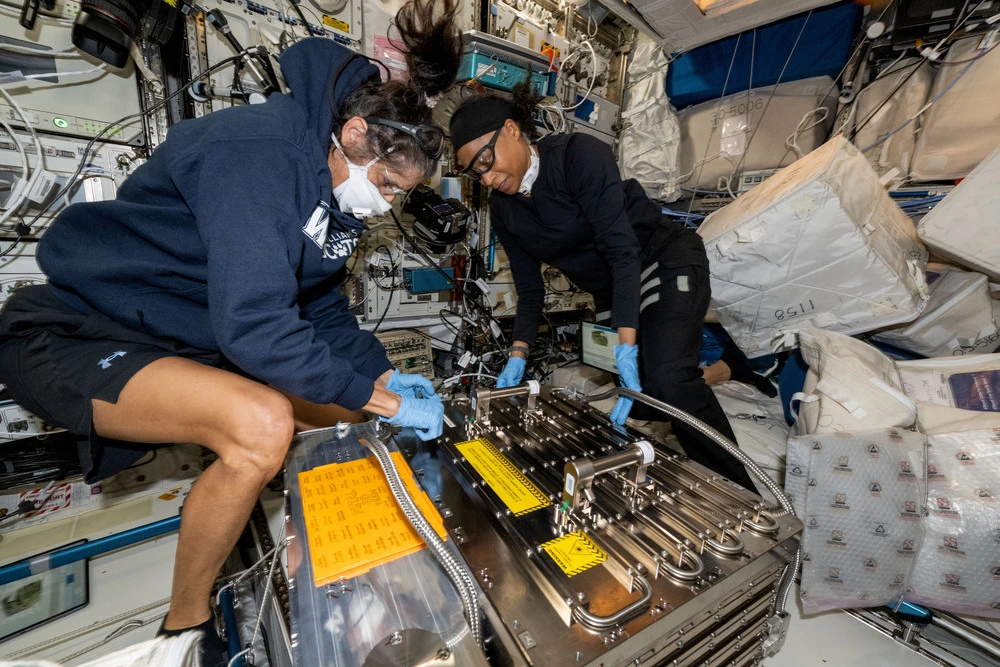
ght Engincer, configure the Metal 3D printer inside the Columbus laboratory module. They retrieved an experimental sample
printed with stainless steel, replaced a substrate in the advanced manufacturing hardware, then reinstalled the 3D printer back
in Columbus’ European Drawer Rack-2. (Image credit NASAUSC)
A global industry takes shape
The scale of global activity is documented by the searchable online database maintained by Growbotics, a specialist space-sector analytics firm, built as part of a project commissioned by the UK Space Agency: 358 organisations catalogued worldwide, filterable by type — public, defence, research, private, non-profit — and by country, from the United States and China to Italy, Japan, Australia and more than twenty other nations. There is no single certified market figure — each analyst covers only one segment — but adding up the estimates gives a usable order of magnitude: servicing converges on 4–9 billion dollars by 2030, manufacturing swings between 3.5 and over 11 billion. Combined, the ISAM market by 2030 sits between 8 and 13 billion — compatible with the £14 billion cited in UK parliamentary evidence, but as a sum of disparate segments.
Daniel Porras, a space lawyer, observed in a 2025 policy brief for the Centre for International Governance Innovation that Western governments remain the principal source of ISAM funding, and companies must meet institutional demand to approach profitability: for now, the path to a fully commercial economy runs through procurement and defence.
ISAM’s foundations are global, but its build-out is not evenly distributed. In the second part of this piece, we go country by country — from America’s COSMIC alliance to the UK’s sovereign ambitions, India’s twin-track approach, and the roadmaps of Japan, the EU and China.
Want to explore this topic further? Read also: Who’s Building the Space Economy? A Country-by-Country Race for ISAM Dominance