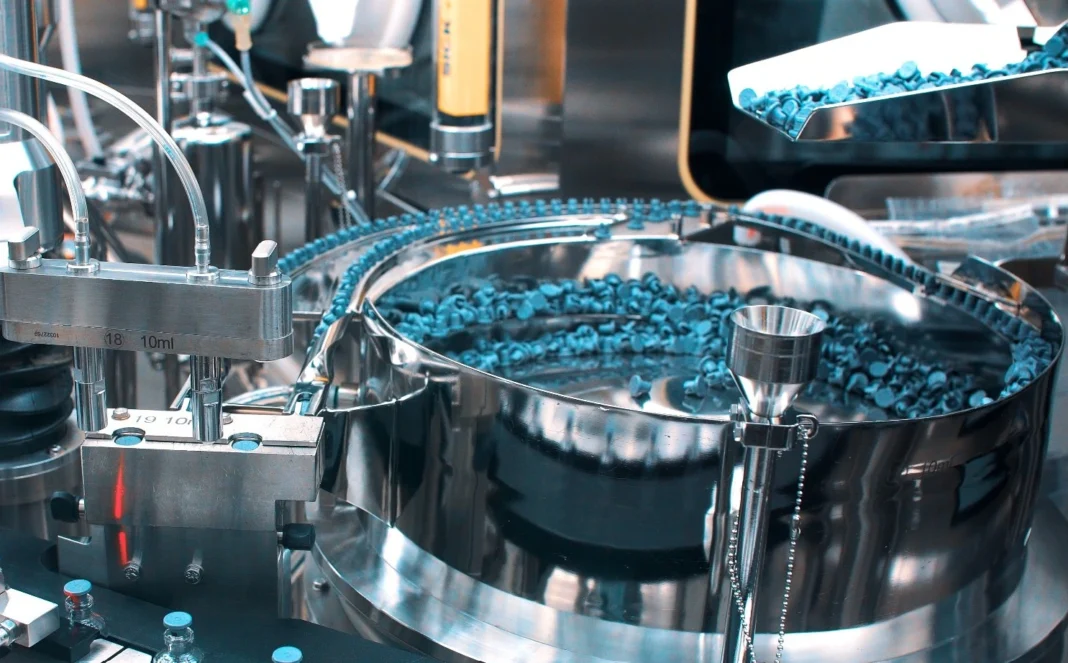
DIGISYSTEM’s mission is to make vibration control simple in electromagnetic vibrating conveyors.
For almost 50 years we have been designing and manufacturing drivers, supporting our clients in choosing the solution that best suits their needs as well as in defining the optimal working parameters.
We complement this application expertise with readiness to develop customised versions and a flexible production structure, designed to react quickly to specific and urgent needs.
Fixed or variable frequency?
The first step when choosing a driver for vibratory conveyors is between fixed or variable frequency.
A fixed frequency driver allows the adjustment of the vibration amplitude. A variable frequency one, on the other hand, makes it possible to intervene both on amplitude and frequency.
To understand the difference, it’s useful to clarify how a vibration is defined.
There are two main variables:
- amplitude, meaning the displacement generated during each cycle
- frequency, namely the number of cycles per time unit
Amplitude is the most immediate parameter: the greater it is, the greater the movement of the material in each cycle. This has a direct impact on the feed rate. It is regulated by the current that flows through the coil.
Frequency, however, is the most critical performance parameter.
Every system — composed of a vibratory conveyor, mechanical components and material — has its own resonance frequency, at which the energy transfer is the highest. Close to this condition it’s possible to achieve high performance, even with low current levels.
The resonance frequency
Every vibratory conveyor has its own resonance frequency: the condition at which the system oscillates at maximum amplitude with minimum energy input.
This depends on different factors, among others:
- total mass of the system
- stiffness of the structure and the springs
- characteristics and amount of material conveyed
Working close to resonance has many concrete benefits:
- higher energy efficiency, due to the system amplifying naturally the vibration
- less component wear, by virtue of reduced mechanical demands
- more stable and continuous material flow
The actual resonance frequency doesn’t always match the rated frequency declared by the manufacturer: it can vary based on working conditions, especially of the handled product.
In the systems with fixed frequency drivers, the operating frequency is tied to the power grid. This means that potential discrepancies from the optimal condition need to be compensated by adjusting the mechanical setup (for example springs or leaf springs).
This aspect becomes particularly relevant in the transition between power grids at 50 Hz and 60 Hz, where it may be necessary to readjust the system.
Benefits of variable frequency drivers
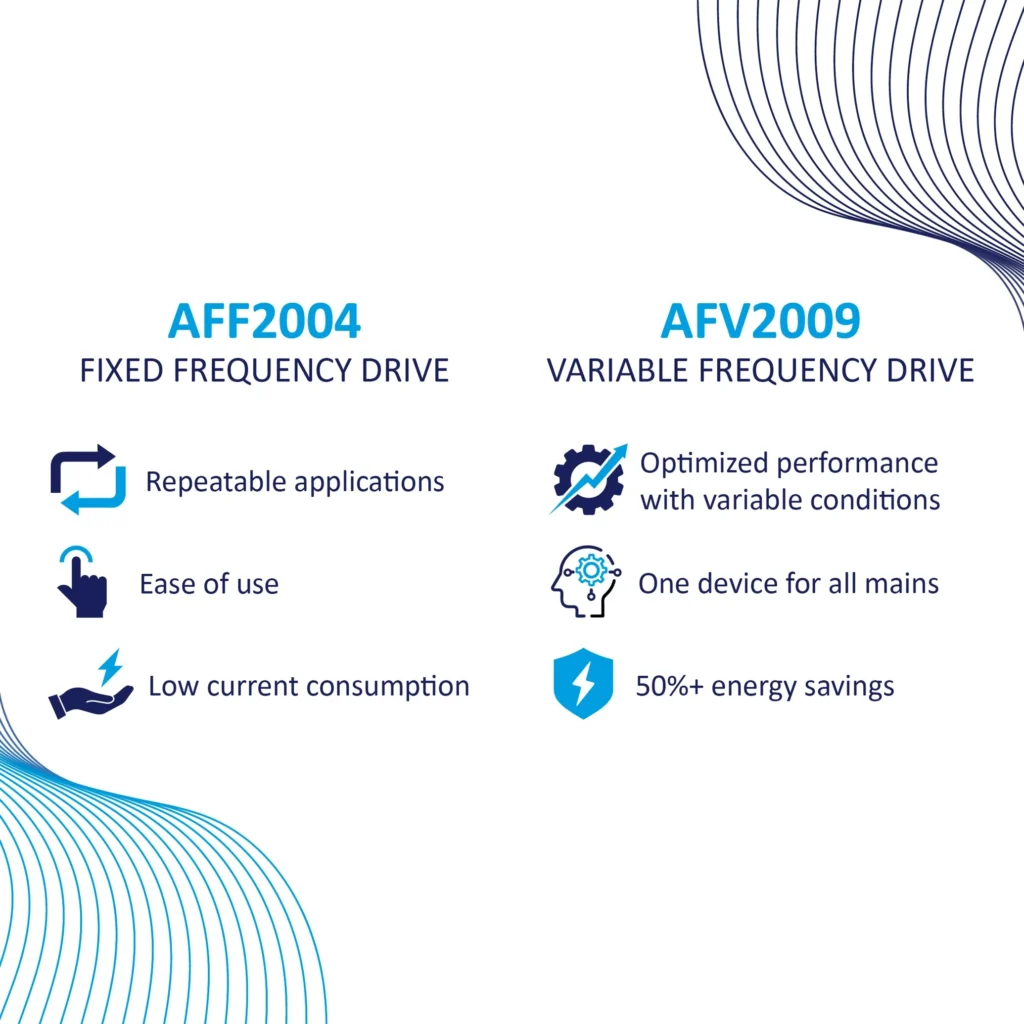
Variable frequency drivers allow independent regulation of amplitude and frequency of the vibration.
This makes it possible to adapt with precision the behaviour of the system to the specific application: even variations of a few hertz can significantly affect the performance.
Once the ideal operating frequency is determined (usually in proximity of resonance), it’s possible to intervene with fine adjustments to modify the material’s behaviour.
In particular:
- above-resonance operation (supercritical)
The material moves more smoothly and with less jolting but, to achieve the same throughput, more energy is needed: suitable when a more linear movement is necessary or when the jolting can create issues (e.g. pieces that risk falling out of the track) - under-resonance operation (subcritical)
The material tends to bounce slightly: useful for non-fragile products or to facilitate the flow of materials prone to compacting or bridging.
Therefore, variable frequency drivers offer higher regulation flexibility and make it possible to optimise the performance according to the product and the process. Since they’re based on inverter technology they also ensure:
- Increased efficiency, with energy savings of over 50%
- Maximum management flexibility, given that they adapt to different grid conditions (50/60 Hz) without needing mechanical adjustments
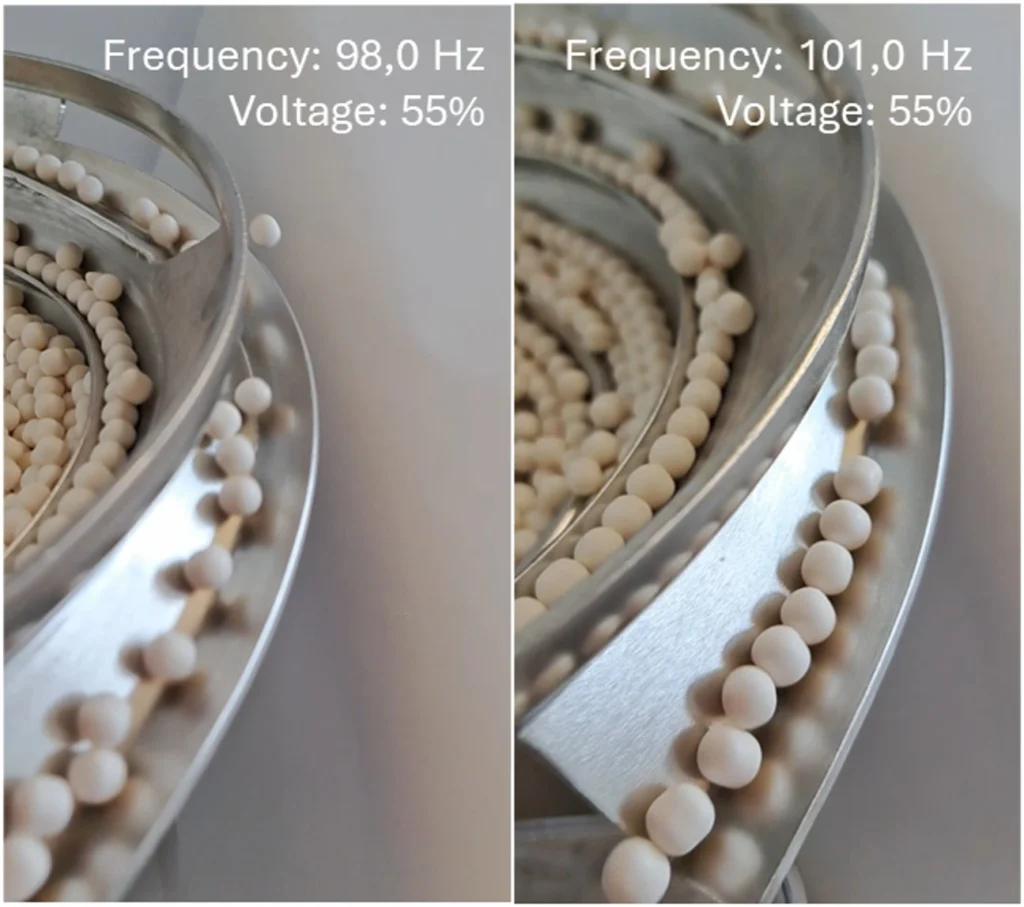
Sometimes just a few hertz can change the behaviour of the product. In this application:
– At 98 Hz, the candy moves in an unstable way and may fall out of the conveying track;
– At 101 Hz, the movement becomes smooth, linear and controlled.
Fixed frequency drivers
In view of the advantages of variable frequency, it may seem natural to consider it the best overall choice. This, however, is not always the case.
Fixed frequency drivers represent a simpler and more economical choice, particularly suited to stable applications, where regulating the behaviour of the system is not necessary. In these cases, being able to regulate the amplitude is enough to grant the result needed, with a more simpler operation.
From a technical point of view, they are based on phase-angle control: the frequency of the vibration remains tied to the one of the power grid. This means that the system needs to be mechanically compatible with the available frequency (for instance 50 or 60 Hz), without the possibility of independent regulation.
The situation is different regarding supply voltage, which can change over time. In variable frequency drivers, based on inverter technology, input voltage is first rectified and then regenerated into a new output waveform, reducing the impact of mains fluctuations.. In phase-angle triggered controllers, the output follows directly from the input waveform: potential variations thus directly affect the performance of the vibration.
For this reason, the ability to efficiently compensate voltage variations is a fundamental element to guarantee stability and consistency in the performance.
In AFF2004 Digisystem drivers, this function is designed to keep the output stable even in case of significant mains voltage fluctuations: even with input deviations of up to 20%, output variation remains under 1%.
Working parameters: the key to an optimal performance
Vibratory conveyors never work in isolation – they’re part of more complex systems, where multiple devices need to operate in sync. In this environment, regulation of working parameters becomes crucial for the overall performance.
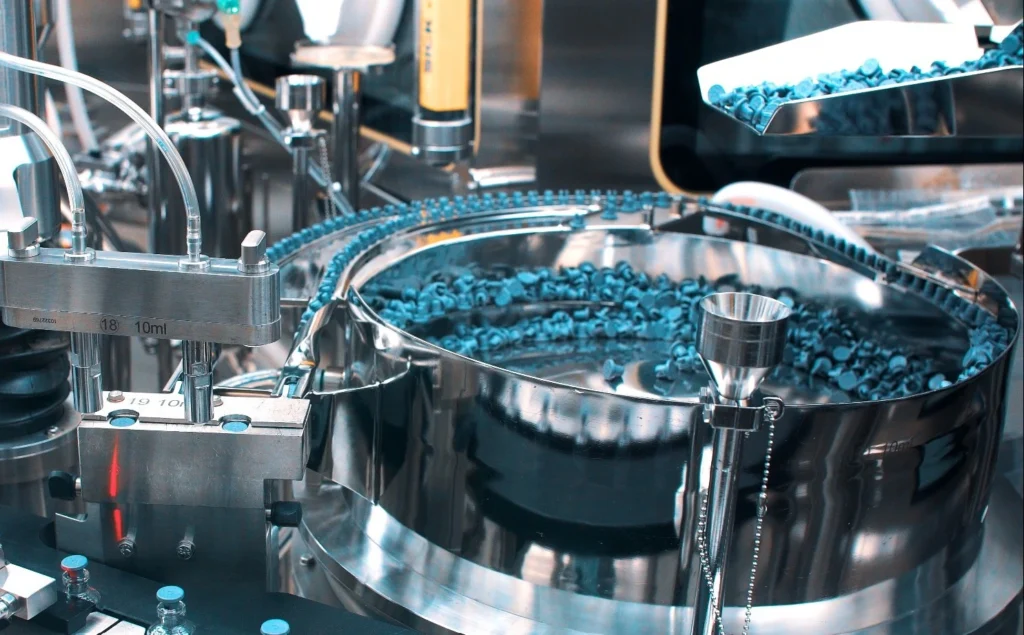
Often, inside an automatic machine, different vibratory conveyors work together to prepare components for the next production phase. For instance, a vibratory hopper can feed loose products into a vibratory bowl feeder, which orients the parts and transfers them to a linear vibrator, so that they are correctly positioned for final use.
For this reason, the most up-to-date drivers are not limited to vibration management, they also play an active role in the integration with the overall system. The most advanced solutions make it possible to manage external signals (for example overflow/overempty sensors or accumulation management) as well as to adapt the operation to working conditions.
From the monitoring point of view, in simpler configurations the main controls (start/stop, regulation of the amplitude) are handled by PLCs. On the other hand, some settings defined during the set-up, like start/stop ramps or delays, can be adjusted on the driver itself.
With drivers equipped with serial communication it is possible to manage all the parameters remotely and access diagnostics information, for instance the output power delivered to the feeder.
The selection of the ideal parameters is not always immediate: in this situation application support makes a huge difference.
Towards smarter diagnostics
The evolution of drivers doesn’t just concern vibration control, but also the possibility to access in a simple and immediate way the information on the system’s performance.
For this reason, DIGISYSTEM is working to develop a new control architecture for its own variable frequency drivers, aimed at a greater integration and connectivity.
The goal is, through a web interface, to provide the following functions:
- configuration and parameterisation
- backup and restore of settings
- real-time monitoring of the main operating data
An evolutionary step designed to further simplify system management and support increasingly effective diagnostic and assistance activities.