EU-funded Project shows that SUNPOWER® matches the efficacy of conventional methods while increasing environmental performance
Pesticides have long been central tools for controlling harmful plant disease, but their intensive use has caused soil and water contamination and risks for non‑target species such as pollinators. European policies, including the Farm to Fork strategy and the Nature Restoration Law, require a 50% reduction in chemical pesticides by 2030 to protect ecosystems and human health. As a result, the herbicide sector is shifting toward safer, bio‑based alternatives. These constraints highlight the need for non‑hazardous, environmentally compatible weed‑control solutions.
Pelargonic acid: a naturally occurring fatty acid for more sustainable weed control
Pelargonic acid, a naturally occurring saturated fatty acid, offers a more sustainable option. Acting as a non‑selective contact herbicide confined to green tissues, it rapidly biodegrades in the environment, leaving no toxic residues on treated plants, in the soil or in the surrounding area.
Its safety has been confirmed by the European Food Safety Authority (EFSA), making it suitable for use in public areas where minimizing chemical exposure is essential. Used for plant protection, it has demonstrated its high efficiency while at the same time being readily biodegradable in water. It has a half-life of 1.6 days in soil leaving no toxic residues on treated plants, in the soil or in the surrounding area. The amount that would be released into the environment through its use as an active substance in plant protection products would, however, be far lower than the amount to which living organisms are already exposed through their diet.
NATURAL POWER LIFE: three products from renewable sources
Pelargonic acid‑based formulations are central to the NATURAL POWER LIFE Project, that aims at sustainably replacing hazardous herbicides and biocides with pelargonic acid-based products. NATURAL POWER LIFE received funding from the European Union under Grant Agreement No. 101114110. The project consortium includes Versalis, the coordinator, Agri2000, Novamont, RE‑CORD and Teraglobus. The project aims to introduce three renewable‑source products: two broad‑spectrum herbicides, one for urban amenities, one for agriculture, and a new bio‑based biocide. Production follows a standardized, sustainable process avoiding ozone‑based oxidative cleavage of vegetable oils, reducing environmental impacts throughout the supply chain.
Demonstration activities evaluate product performance in real operational contexts. SUNPOWER® (Novamont product), an herbicide for non‑crop applications, has been tested extensively within the NATURAL POWER LIFE Project. RE‑CORD, a non‑profit research center in Florence (Italy), carried out optimization trials during 2024–2025 across diverse urban sites in the Mugello area (Northern Florence, Italy). The selected sites, three cemeteries and two public parking areas in Scarperia and San Piero a Sieve and Dicomano, presented high operational complexity due to gravel surfaces, monumental structures, constant weed growth, and strict safety requirements.
The experimental strategy targeted the peak vegetative growth phase in spring. A protocol of three consecutive applications was adopted to evaluate SUNPOWER®’s ability to limit regrowth and progressively reduce weed pressure. Dosages were dynamically adjusted to vegetation stage and local climatic conditions. Treatments covered the following contexts:
• Parking areas: large, paved surfaces, borders, and stalls. A manual lance ensured uniform coverage.
• Cemeteries: weed growth among gravel and monuments required precise, low‑drift application using professional backpack pumps with anti‑drift bells.
Dosages, water volumes and timing
The dosage program began with higher concentrations (5–10%) between late March and early April to manage dense post‑winter vegetation, followed by medium‑low concentrations (3–5%) for subsequent applications. Water volumes were adjusted to site needs: approx. 400 L/ha in cemeteries, where vegetation is localized, and 600–700 L/ha in parking lots, where surfaces are more uniform. Intervals of 25–35 days between applications allowed assessment of regrowth dynamics. Control plots included mechanical mowing in parking areas. In cemeteries, brush cutters were avoided to prevent gravel displacement and potential damage to monuments.
High efficacy with optimal performance in full sun
Monitoring conducted days and weeks after each treatment demonstrated high efficacy. SUNPOWER® achieved rapid desiccation of 70–85% within 48–72 hours, with optimal performance in full sun. Efficacy slightly decreased (to 50–60%) in shaded or cooler microclimates, consistent with the thermophilic and photo‑activated behaviour of pelargonic acid. The use of anti‑drift bells improved precision and minimized off‑target effects. This was particularly valuable in cemetery environments where localised weeding is essential.
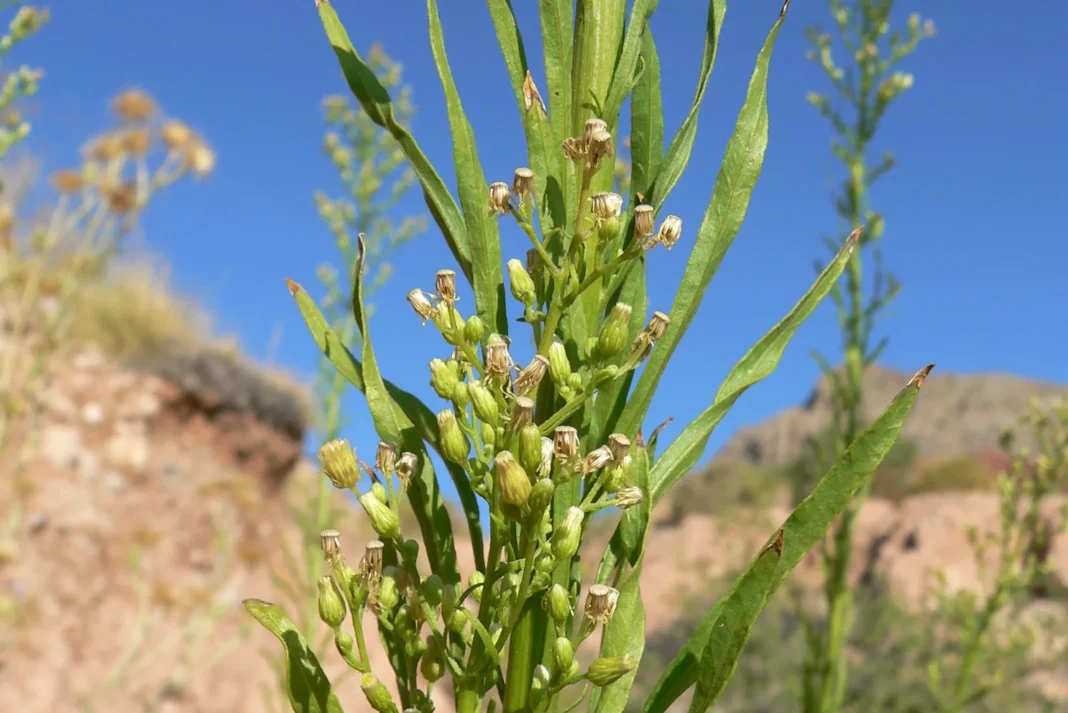
Botanical observations confirmed rapid burn‑down of broadleaf weeds (dicots). Particularly noteworthy was the high effectiveness against Conyza spp. This invasive species that poses major challenges in urban vegetation management due to its prolific seed dispersal. For monocots such as Cynodon dactylon, complete desiccation was not always achieved due to the plant’s morphological resilience. However, growth was significantly slowed, demonstrating the protocol’s capacity to limit vegetative vigor.
Resilience under variable environmental conditions
In public parking areas, three applications produced weed control comparable to mechanical mowing. A key observation emerged in July 2024: treated areas exhibited extremely limited regrowth for more than three months, ensuring sustained cleanliness without additional interventions. Operationally, SUNPOWER® provided substantial benefits: a single operator could treat over 600 m² quickly, while mechanical weeding required more time, multiple workers, and disposal of biomass.
In 2025, exceptional rainfall (180–210 mm) between the first and second treatments stimulated new seed germination, yet areas treated with SUNPOWER® maintained markedly lower weed pressure than mechanically managed plots. This confirmed the robustness of the treatment protocol under adverse weather conditions.
Guidelines for a more sustainable urban vegetation management
The outcomes from the Mugello trials offer clear guidelines for sustainable urban vegetation management. In parking areas, SUNPOWER® proves a highly effective alternative to mechanical methods, reducing labour, time, and operational costs. In cemeteries, its precision and safety make it ideal for delicate environments where mechanical disturbance is inadvisable. Future research will focus on optimizing water volumes to improve efficiency and further streamline application practices.
One of the most promising developments is the adoption of early‑intervention strategies, treating weeds at the earliest phenological stages. Targeting young, less vigorous plants can reduce required active‑ingredient concentrations and prevent biomass accumulation, improving economic and environmental performance.
In conclusion, the Mugello trials demonstrate that bio‑based herbicides SUNPOWER® can match the efficacy of conventional methods while offering superior environmental compatibility and operational advantages. The optimized protocols developed through LIFE NATURAL POWER provide municipalities with scalable solutions aligned with the European Green Deal’s zero‑pollution objectives, supporting biodiversity, public health, and urban landscape quality.
Contributors: RE-CORD, Novamont, Versalis
References
- Pesticides have negative effects on non-target organisms. Wan, NF., Fu, L., Dainese, M. et al. Nat Commun 16, 1360 (2025).
- Regulation (EU) 2024/1991 of the European Parliament and of the Council of 24 June 2024 on nature restoration and amending Regulation (EU) 2022/869.
- Pelargonic Acid: From Historical Uses to Future Perspectives in Sustainable Agriculture. Preisler, A. C., Campos E. V. R., Takeshita V., et al. Journal of Agricultural and Food Chemistry, March 2026.
- Updated peer review of the pesticide risk assessment of the active substance pelargonic acid (nonanoic acid). EFSA Journal, 2025
- European Commission. (2021). EU Action Plan: Towards Zero Pollution for Air, Water and Soil (COM/2021/400 final).