While scientific talent is not an issue, there is still an evident disparity among genders in senior positions in the industry and academia
Gender equality still looks like a distant goal in the world of Research and Innovation (R&I), judging by the latest data published in March 2026 by the European Patent Office (EPO).
The Women Inventor Rate (WIR) – that is, the proportion of women among all inventors listed in the European patent applications since the late 1970s – stood at just 13.8% in 2022. Slightly better is the number of patent applications featuring at least one woman among the inventors (24.1%). Looking at data from the SheFigures 2024 report by the European Commission, women make up 37% of all graduates with a doctoral degree in scientific and technological disciplines (STEM: Science, Technology, Engineering, and Mathematics). An apparent paradox that requires us to better understand the reasons why women still face difficulties in establishing themselves as inventors and entrepreneurs.
The gap with international competitors
Looking at the main competitor countries, the number of women inventors in Europe was higher than in Japan in 2022 (WIR 10.9%), while the United States positioned slightly ahead. Furthermore, the proportion of female inventors in China and South Korea was more than double that in Europe. However, the EPO report warns that these figures should be interpreted with caution due to a lack of precise attribution data for these countries.
The situation among individual European countries is highly fragmented. At the top of the ranking, Portugal recorded the highest WIR index (29.3%) among countries with at least a thousand inventors for the 2018-2022 period, followed by Spain and Turkey. Italy is just above the European mean value, while Austria closes the ranking.
This situation appears to reflect the persistent cultural differences in approaches to the labour market that characterise different European countries, favouring those that have invested more effectively in supporting women to balance work and private life, including through family policies or flexible academic pathways. Contrary to what one might expect, the Iberian countries seem much further ahead from this perspective than those in the Germanic-Nordic area. Between 2000 and 2020, the proportion of women among new inventors increased by only 0,33% per year. At this growth rate, it would take over 275 years to achieve gender parity in patent applications, according to Mercedes Delgado (Copenhagen Business School and Massachusetts Institute of Technology) speaking at the 2025 Women and IP Symposium for Intellectual Property (IP) and Innovation Offices.
The research “leaky pipeline”
The proportion of women inventors is significantly higher in technological sectors related to the life sciences. For example, WIR index values were higher than 30% in the pharmaceuticals, biotechnology and food chemistry sectors in the period 2018-2022. While these values closely reflect the number of women holding doctorates, they quickly drop when looking at the career progression.
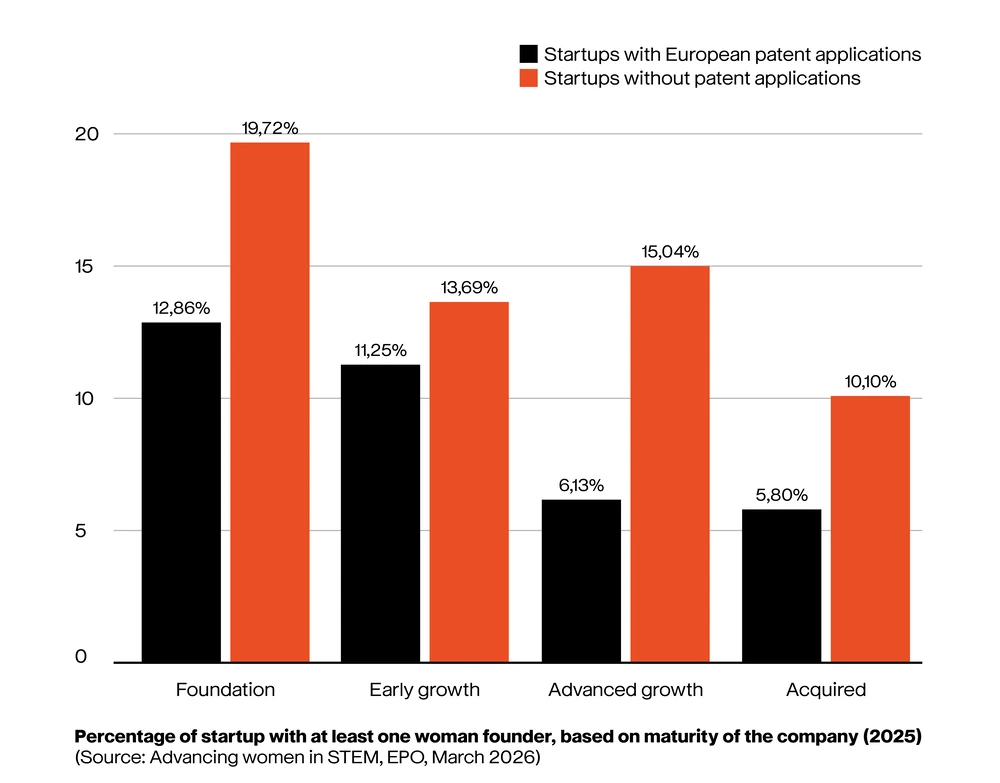
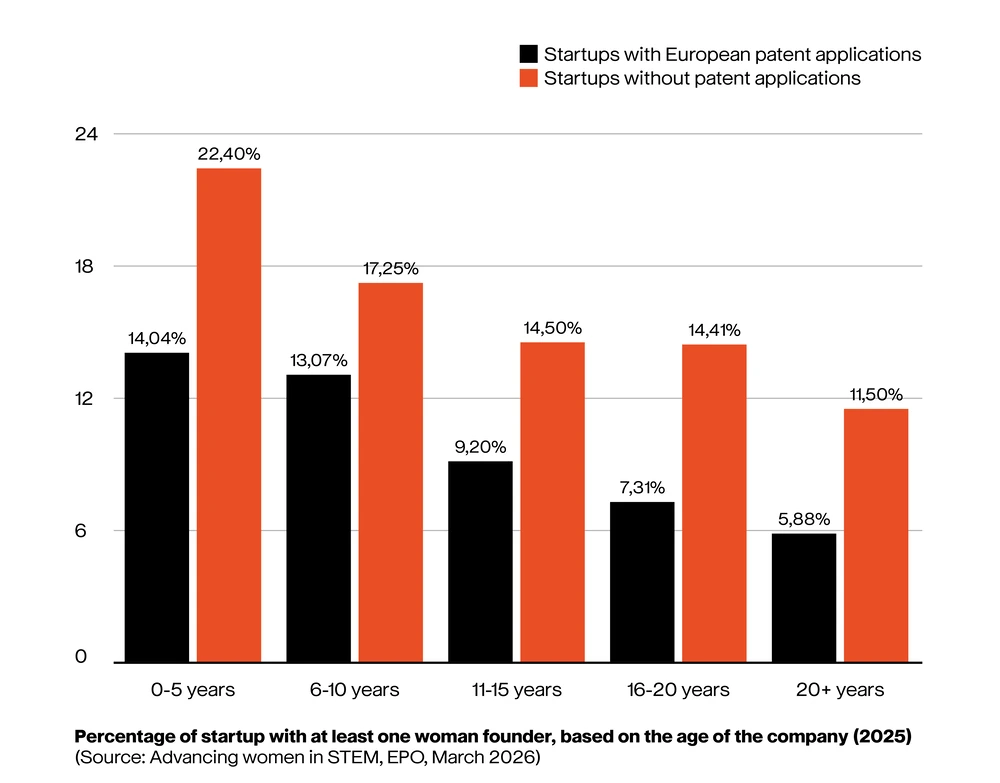
The SheFigures 2024 report indicates that, despite the higher WIR index values characterising universities, only 26% of senior institutional roles in academia are held by women. The gender gap is even more pronounced among women founders of technology startups with European patent applications, accounting for approx. 10% of the total. Just approx. two thirds of innovative startups have been founded by all-female teams, while another 6.2% have been founded by mixed teams.
The picture here is consistent with that for women inventors and shows the difficulty of the European entrepreneurial ecosystem in moving away from a traditional vision centred predominantly on male roles. This bias is not caused by a lack of technical or scientific competence among women, but rather by factors such as the selection process, family responsibilities, promotion criteria, and an organisational culture that is still anchored in traditional norms.
The importance of policies that support women in the innovation supply chain is demonstrated once again by Spain and Portugal, which are at the top of the ranking for the number of female startup founders. Meanwhile, Germany, Austria and the Netherlands are at the bottom, with Italy in fourth place. The most representative sectors for women remain chemistry, agri-food and health technologies.
Difficulties in accessing the capital markets
Another critical issue impacting the number of women entrepreneurs is the difficulty of accessing capital markets, particularly in Europe. According to PitchBook’s data for 2025, in the US, VC-backed companies founded by women raised $73.6 billion, representing around a third of total VC deals value. In Europe, female-founded companies collectively raised €9.5 billion in 2025 (16.5%), down from 2024. PitchBook’s data also show that last year, 203 transactions involving women-founded biopharma companies occurred in the US, with a total value of $4.8 billion. This is significantly less than the amount raised in 2021, a record year ($12.7 billion). The majority of the 2025 deals were in the United States; major transactions in Europe included Germany’s BioNTech and the UK’s Verdiva Bio.
PitchBook’s report also indicates that women-founded life sciences and biotech companies in Europe have maintained a steady pace of deals since 2020, at around €1 billion/year. Two relevant exit operations occurred in 2025: the acquisition of Araris Biotech (oncology) and that of Beckley Psytech (mental health).
According to the EPO report, the gap in access to venture capital increases from the early to the more advanced stages of funding. This further highlights Europe’s structural difficulties in supporting talented female researchers in advancing their careers, given that the proportion of women with STEM doctorates in the US is essentially the same (36%).
The new European Action Plan
According to the SheFigures 2024 report, almost all of the European-funded research still fails to consider the gender dimension. The European Commission is addressing this issue with a new European Action Plan for Women in Research, Innovation and Startups. The initiative aims to establish Europe as the preferred location for women working in R&I by 2030, by creating more inclusive R&I ecosystems, improving career pathways, and increasing financial support for talented women researchers, innovators and startup founders.
The public consultation on the call for evidence closed on 23 February 2026, and adoption of the Action Plan by the EU Commission is currently scheduled for Q3 2026. That said, we can only wait and see how the European institutions will concretely promote women’s participation in research and innovation. «There is an obvious gain for Europe in boosting women’s participation in innovation», said EPO President António Campinos, presenting the report. «Diversity is not a nice-to-have, it is fuel for breakthrough innovation».