By 2030, the EU aims to transform its research into solutions that reach people, support industry, and strengthen competitiveness
Europe’s future competitiveness increasingly depends on how it manages the intersection between health, technology, and sustainability. At that crossroads lies the life sciences, a vast ecosystem that connects medical research, biotechnology, agri-food systems and clean energy. Together, they are redefining how Europe prevents disease, produces food, and manages natural resources to sustain both prosperity and the planet. Historically, the continent has been a global leader in this field, backed by a deep research base, world-class universities, and a culture of scientific excellence.
Today, however, demographic aging, pressure on health systems, and the urgency of the green transition are exposing the limits of fragmented innovation models. Europe continues to excel in discovery, yet struggles to transform that strength into scalable, market-ready solutions. Complex regulation, dispersed R&I ecosystems, and insufficient investment in commercialisation slow the path from lab to market.
To address this, the European Commission has launched a new strategy to make the EU the most attractive environment for life sciences by 2030. It’s a coordinated effort to accelerate innovation and enable faster market access. But also to build public trust in technologies that serve both people and the planet.
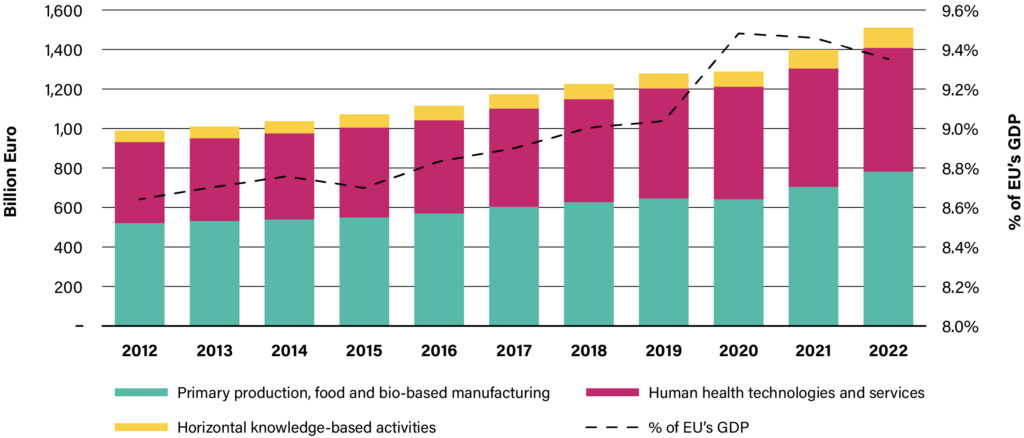
A €1.5 trillion sector driving jobs and growth
In 2022, life sciences contributed €1.5 trillion in value added, nearly 10% of the EU’s GDP. They supported close to 29 million jobs, representing over 13% of total employment across the Union. Over the past decade, these sectors have grown steadily at a rate of 4% to 7% per year, demonstrating remarkable resilience and long-term potential.
Within this broad field, biotechnology has emerged as a key driver of innovation and competitiveness. Its productivity surpasses the EU average, and employment is growing six times faster than the rest of the economy. Europe is home to 15% of the world’s top research-investing health companies. It ranks second globally for high-value biotech patents, just behind the US. However, China is rapidly closing the gap, a signal that global leadership is far from guaranteed.
Yet Europe’s strategic weight in life sciences is undermined by persistent structural challenges. An aging population and rising healthcare costs are placing unprecedented pressure on public systems. The COVID-19 pandemic exposed vulnerabilities in supply chains and Europe’s dependence on third countries for critical technologies. Despite world-class research institutions and high levels of scientific output, the EU still struggles to bring innovation to market, scale up startups, and attract the level of private capital seen in the US or Asia.
This innovation deficit is exacerbated by fragmented governance and complex regulatory frameworks. Companies must often navigate overlapping EU and national rules that are not fully adapted to fast-evolving technologies, leading to long approval times and market uncertainty. In areas like clinical research, medical devices, and advanced therapies, this poses a real risk of Europe falling behind.
Governance and implementation
Recent strategic reflections on the future of the European Union. From the report on the Single Market by Enrico Letta to Mario Draghi’s analysis on competitiveness, they have identified life sciences as a priority sector for advancing the EU’s economic and strategic autonomy. Both contributions call for a stronger capacity to convert scientific excellence into industrial and technological leadership.
Choose Europe for Life Sciences responds to this call. As one of the first sector-specific initiatives under the new Competitiveness Compass, it brings together major EU programmes, such as Horizon Europe, Digital Europe, EU4Health, and InvestEU, into a more integrated and mission-driven policy framework.
To ensure coordination and avoid fragmentation, the Commission will enhance its internal governance structure. It will bring together key Directorates-General under a common implementation framework. At the same time, Member States are called to align their national strategies with the EU-level vision. That is a challenge that the new Life Sciences Coordination Group is designed to address.
«Europe has long been a global leader in life sciences. Today we are renewing that ambition with a clearer focus on simplification, investment, and a stronger single market», stated Stéphane Séjourné, Executive Vice-President for Prosperity and Industrial Strategy.

Three strategic pillars
To achieve its 2030 leadership goal, the European life sciences strategy builds on three interconnected pillars. Pillars that form a comprehensive innovation pathway supported by targeted policies and strategic investment.
1. The first pillar: optimising the R&I ecosystem to achieve a globally competitive life science sector
The first pillar focuses on optimising Europe’s research and innovation ecosystem to build a globally competitive life science sector. It aims to strengthen cooperation across disciplines, make better use of data and AI, and ensure the right skills are in place. It also seeks to support a sustainable industrial base that can turn scientific progress into real impact.
Clinical research remains one of the most strategic yet constrained parts of Europe’s life science ecosystem. The new EU Clinical Trials Investment Plan will make multi-country studies faster and more efficient by reducing administrative delays. It will also align ethical and regulatory standards across Member States. The initiative will also support shared research infrastructures and simplify trial procedures, improving both data comparability and cost-effectiveness.
In parallel, a network of Centres of Excellence for Advanced Therapy Medicinal Products (ATMPs) will strengthen Europe’s position in complex biotechnologies such as gene and cell therapy. These hubs link hospitals, universities, startups, and manufacturers, setting common standards and accelerating technology transfer. The growth of cross-border bioclusters will complement this effort. It will help SMEs and regional ecosystems scale innovation and reinforce industrial value chains in biotechnology and biomanufacturing.
A holistic One Health approach
In parallel, the strategy promotes a holistic One Health approach that recognises the interdependence of human, animal, and environmental health. The EU will invest around €100 million in One Health microbiome-based solutions to transform microbiome science into tangible applications. This investments will support progress in prevention, nutrition, and sustainable agriculture. Another €170 million will support a new strategic research and innovation agenda on health and climate change. It will improve resilience to climate-related health risks and foster the development of low-carbon medical technologies. A complementary agenda on food systems will align research in agriculture, forestry, and rural innovation, encouraging cross-sector partnerships between agri-food, biotech, and environmental industries.
An interoperable framework for sharing health data
Digital infrastructure is becoming a key driver of Europe’s life science capacity. The European Health Data Space (EHDS) will create a secure and interoperable framework for sharing health data, supporting advanced research while safeguarding privacy. New AI Factories and AI Gigafactories will provide the computational power for genomics, drug discovery, and precision medicine. That will ensure that artificial intelligence develops on European data and standards. The Commission is also investing in generative AI for biomedical research and in stronger genomic data infrastructures. These efforts are supported by a digital navigator that helps researchers and companies meet regulatory requirements and access EU-wide digital services.
Finally, strengthening the foundations also means investing in people. The EU is advancing the European framework for research careers and the forthcoming ERA Act 2026 to make scientific careers more attractive and mobile. Initiatives like the Union of Skills and the STEM Education Strategic Plan will bridge talent gaps. Meanwhile, a foresight study on life-science competencies will identify new skill needs in AI, biomanufacturing, and biotechnology.
2. The second pillar: ensuring smooth and rapid market access for life science innovations
Turning scientific excellence into market value has long been Europe’s weak point. The second pillar of the strategy addresses this by building a regulatory and investment environment for biotechnology, advanced therapies, and data-driven health solutions. It aims to help these innovations move faster from the lab to commercial deployment. It redefines the interface between innovation and regulation, aiming to make Europe a first-choice location for testing, scaling, and producing next-generation life science technologies.
At its core stands the forthcoming EU Biotech Act, the first legislative initiative designed to simplify and harmonise biotechnology rules across Member States. Today, innovators face inconsistent procedures, long approval times, and complex administrative layers that delay the uptake of new products. The Biotech Act seeks to reverse this pattern. It will align regulatory pathways, clarify authorisation requirements, and reduce uncertainty for both entrepreneurs and investors.
The use of regulatory sandboxes
The strategy also encourages the use of regulatory sandboxes, which are controlled settings where companies and regulators can test emerging technologies together. These include areas such as synthetic biology, advanced biomanufacturing, and digital therapeutics. These environments make it possible to experiment safely and help authorities understand the effects of innovation before new solutions reach the market.
The strategy also introduces a new generation of digital tools for regulatory guidance. A forthcoming AI-based navigator, linked to the Biotech and Biomanufacturing Hub, will give innovators early support across sectors and jurisdictions. The system will use EU data and natural language processing to help researchers and startups find the relevant regulations and understand what information is required.
It will also help them design their products in line with compliance standards from the very beginning.
A modern intellectual property system completes this framework. The Unitary Patent and the proposed unitary Supplementary Protection Certificate (SPC) will strengthen patent protection across the EU and reduce administrative costs. They will also increase the bankability of IP assets, a critical factor for deep tech and biotech investors.
«This strategy places Europe at the forefront of life sciences innovation, ensuring that cutting-edge therapies reach patients faster while strengthening our industrial competitiveness and resilience», said Olivér Várhelyi, Commissioner for Health and Animal Welfare.

3. The third pillar: boosting the uptake and use of life science innovation
As one of Europe’s largest buyers, the public sector can drive demand for advanced technologies and accelerate their adoption. To make the most of this opportunity, the Commission will mobilise around €300 million under Horizon Europe and EU4Health. These funds will support the procurement of innovative life science solutions in areas such as climate adaptation, next-generation vaccines, and affordable cancer care. The forthcoming European Innovation Act and the revision of EU procurement rules will further simplify access to public tenders and open new pathways for innovative firms to scale across Europe.

© European Union, 2025
Ultimately, to foster public trust and the acceptance of technologies, people must understand how life sciences work and how technologies may improve people’s well-being. This is increasingly tested by misinformation, fragmented communication, and uncertainty about how new technologies influence personal and societal choices.
The Commission recognises that effective communication is part of competitiveness. Under Horizon Europe (2026–2027), around €2 million will be invested in practical tools and guidance to strengthen public engagement, science communication, and responsible research practices. The initiative aims to help researchers, policymakers, and companies engage with citizens more openly. But it also aims to anticipate social expectations, especially among younger generations.
«Science changes lives, but only if we support the people behind it. With this strategy, we’re funding innovation from lab to market and making sure that bold ideas improve lives right here in Europe», affirmed Ekaterina Zaharieva, Commissioner for Startups, Research and Innovation.