New research in personalised medicine based on Artificial Intelligence to better define tailor-made rehabilitation paths
Cerebral Palsy (CP) affects an estimated 17 million people worldwide. It represents the consequence of a brain damage which can occur during intrauterine life, at the time of birth or shortly thereafter. Although this condition often presents a wide variety of symptoms affecting sensorial, perceptual, cognitive, and communicative skills, it can also include associated disorders that impact sleep, pain, learning abilities, and overall daily functioning. Despite this variety, the most noticeable feature of the condition is motor impairment.
The impact on motor functioning defines the clinical form of CP. It can be described as: spastic form (stiffness), which represents the most diffused one; dyskinetic form (involuntary movements) or ataxic form (impaired coordination).
Challenges in CP management: late diagnosis and socio-economic impact
The motor impairment can interest different body parts and each situation defines a different form of spastic form of CP. It can be hemiplegia / unilateral cerebral palsy (main involvement of one side the body), diplegia (main involvement of the lower limbs) or tetraplegia (involvement of all limbs).
In addition to the complexity of its manifestations, the diagnosis of CP often comes late. Children with CP need a personalized and intensive rehabilitation program, to be started early based on a detailed assessment of their functional abilities. This scenario is not always realistic. This condition can have a significant economic impact, typical of permanent disabilities. With exception of other complications, people with CP have a similar life expectancy to that of the general population. A part of them can have a job and be financially independent. On the other hand, many people with CP require a high level of assistance. But assistive technologies can partially support them in overcoming the disabling barriers of their living environment.
The AINCP project
The European Union funds the AINCP project as the largest research initiative under the HORIZON-HLTH-2021-DISEASE-04 program, focusing on personalized medicine for people with unilateral cerebral palsy. The duration of the project is five years overall from June 2022 to May 2027.
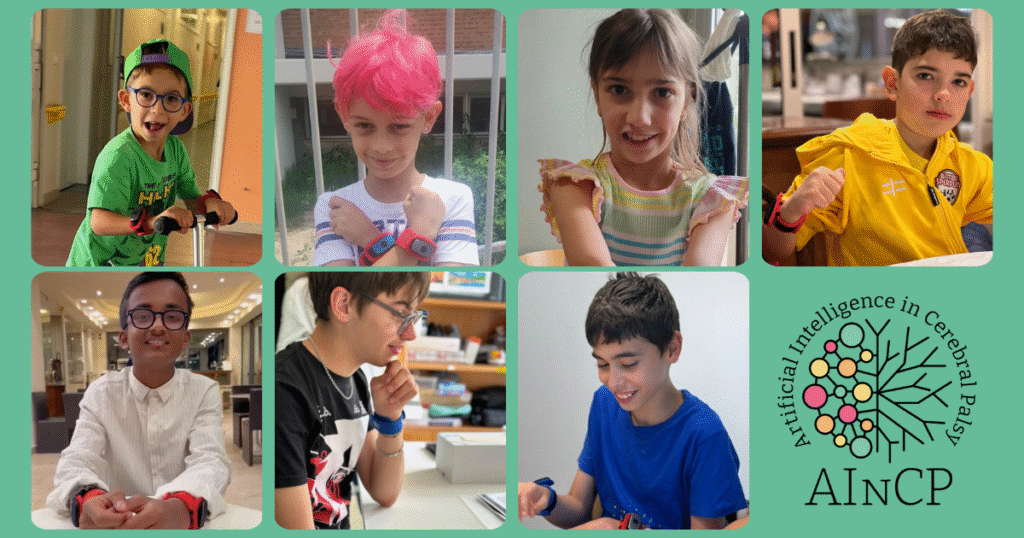
The project aims to validate new artificial intelligence algorithms for functional diagnosis. It also focuses on personalized tele-rehabilitation for children with unilateral cerebral palsy. The goal is to create more advanced tools to understand children’s daily difficulties. But also to better define tailor-made rehabilitation paths, with a sustainable approach from both ethical and economic point of views. For this goal, AINCP is validating new functional assessment tools. These tools are more advanced than the scales currently in use. These tools will allow doctors to gain a more comprehensive view of children’s limitations in daily life. They will also help personalize rehabilitation programs based on each child’s individual needs.
A wide range of professionals from seven countries form the AINCP project team, with the University of Pisa leading twelve multidisciplinary partner organizations.
Actions and methodology
The Principal Investigator of the AINCP project is Prof. Giuseppina Sgandurra of the Department of Clinical and Experimental Medicine of the University of Pisa. Co-PI is Prof. Giuseppe Prencipe, from the Computer Science Department of the University of Pisa, Italy.
The AINCP research project is a distinctive example of participatory research. In fact, patients and families have been actively involved in the design phase since the beginning of the project. Parents participate thanks to the support of FightTheStroke Foundation, a point of reference in Italy for families with children affected by Cerebral Palsy. The Foundation also helped enroll new researchers who could make a valuable contribution to the project. One of them, a philosophy graduate, is now a PhD student working on the co-design framework, himself a patient with cerebral palsy.


AINCP global network: clinical studies and LMIC validation
The study in Georgia involved more than 200 children and adolescents with unilateral cerebral palsy. It also included control groups of the same size composed of children and adolescents with typical development. These studies are run in Italy by the IRCCS Stella Maris Foundation of Calambrone, Pisa, coordinated by prof. Giovanni Cioni. In Spain are run by the Universidad De Castilla La Mancha, Toledo, led by prof. Rocío Palomo. In Belgium by the Katholieke Univesiteit Leuven, Leuven, led by prof. Hilde Feys. And in Georgia by the David Tvildiani Medical University, Tbilisi, led by prof. Nana Tatishvili.
The Georgian team joined the project to support the validation of AINCP for low and middle-income country (“LMIC”). They do so that the solution will be viable in countries with less resources. The associated partner University of Queensland, Australia, works with the consortium to develop artificial intelligence algorithms for magnetic resonance and integrate them into the model.
Developing the AINCP tele-rehabilitation platform
The technological partners work side by side with the clinical partners to build the AINCP framework. Artificial Intelligence will allow for personalized medicine by acquiring all available data, even outside clinical settings. This will provide valuable insights into functional movement patterns beyond traditional therapy sessions, both for diagnosis and treatment. The Institute of Biorobotics at the Scuola Superiore Sant’Anna University in Italy, coordinated by Prof. Matteo Cianchetti, is developing new sensorized objects that can monitor how children interact with them during therapy exercises. It is also working on a hand-tracking system to capture hand kinematics. This system does not require the child to wear any device on their hands during therapy.
Similarly, the Dutch company Noldus is contributing to the AINCP tele-rehabilitation platform with a tool that provides clinicians with insights into children’s eye-tracking during rehabilitation exercises. This includes both quantitative measurements (such as the area of the screen they are looking at) and qualitative indicators, like their level of attention. The Austrian company Tyromotion provides wrist-worn movement trackers that collect data on children’s daily activities and make it available to healthcare professionals. The Italian company Khymeia is developing the integrated software and the tele-health AINCP architecture. It is also responsible for developing the project’s business model and business plan.
Ensuring viability: economic model, ethical AI, and sissemination strategy
The Institute of Management, Scuola Superiore Sant’Anna University, Italy, coordinated by prof. Giuseppe Turchetti, works to ensure the economic sustainability of the AINCP solution in the context of European health systems and LMIC countries. The University of Salento, Italy, coordinated by prof. Fiorella Battaglia, is working on the ethical aspects of the use of artificial intelligence in the developmental age. The company FTS, Italy, implements and coordinates the communication and dissemination strategy of the AINCP project led by Dr. Francesca Fedeli, providing a bridge between citizens and science, with the goal to reach the whole civil society.

Achieved and future results
The AINCP Project has transitioned from foundational preparation to the pre-deployment of its core telerehabilitation platform. This phase involved multidisciplinary collaboration to co-design and integrate clinical and technological requirements. The first Observational studies and data collection are ongoing, now nearing completion in Italy and Spain. The database used to secure Observational study data collection will be used also for the upcoming Rehabilitative study.
The prototyping and integration of the main components of the technological platform have been completed. The eye-tracking, hand-tracking, and smart sensorized objects have been finalized and tested for safety and usability. The full telerehabilitation software architecture features GDPR-compliant data handling, secure telemonitoring, role-based access control, and multilingual support. The implementation of the AI-based decision support tools for the clinicians is ongoing. It involves the development of machine learning models for sensor data. The team introduced an upper-limb activity biomarker and preliminarily validated it for daily-life monitoring.
The research results obtained in the first half of the project have been discussed in dedicated scientific articles. They refer to multiple dimensions of the solution like co-design, technology, medicine. The list of articles that are published is regularly updated and linked on the project website.
The future phases of the project will focus on the development of decision support tools, clinical validation, and the regulatory process. They will also address the RCT protocol and all necessary certification and compliance work. At the same time, the team will update and finalize the Health Technology Assessment, the economic evaluation, and the Ethical Framework, taking into account all the implications of evolving AI regulations.
The AINCP Booklet
The AINCP project received appreciation from the scientific community at a wide range of academic events. During these events, the different perspectives of the project and its co-design approach were discussed (see ). In parallel, the AINCP communication activities also engaged non-academic stakeholders, including patients and civil society. This was achieved through a wide range of initiatives for the press and public events, such as festivals and TV interviews.
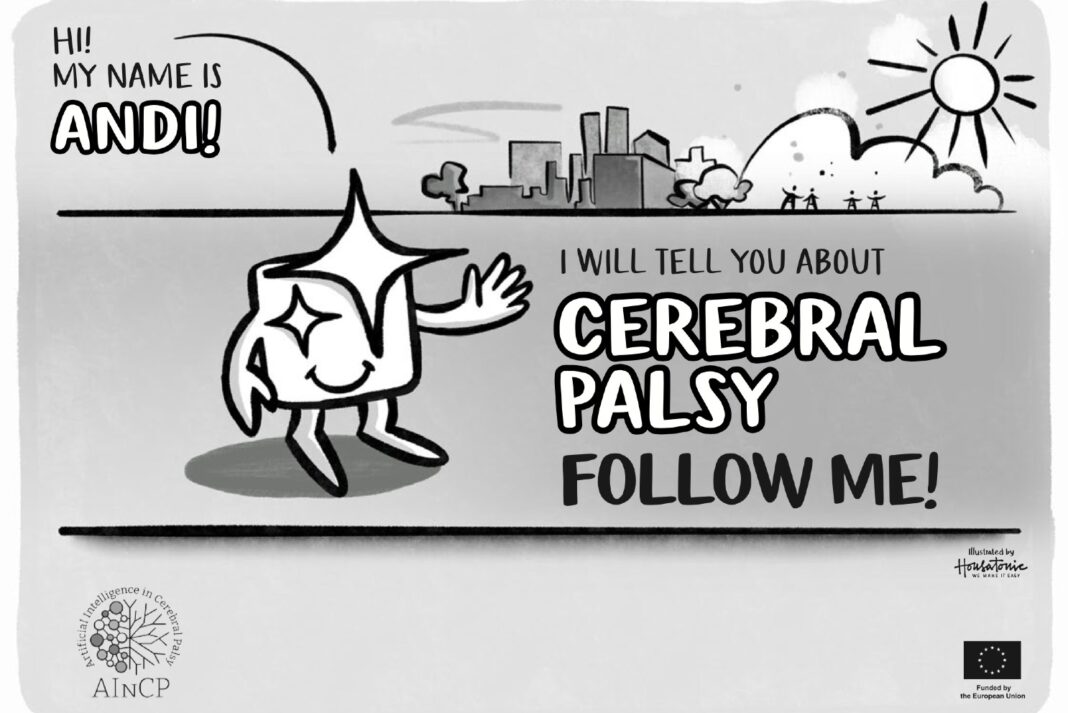
In this respect, a distinctive tool realized by the AINCP project was the AINCP Booklet, an illustrated publication. Anyone can download it for free from the project website. This material, designed to be printed and colored, is the first-ever comic aimed at children to raise awareness about Cerebral Palsy. It primarily targets children between 5 and 15 years old. The initiative was designed to inform, in an easy and accessible way, about: 1) What Cerebral Palsy is, 2) What the AINCP Project does, 3) Why Scientific Research is important.
The AINCP booklet publication included the launch of “Andi”, the project mascot. It’s a friendly character with a body like a wearable screen and magic eyes that come to life. It accompanies children on a journey of discovery through stories and images that can be colored. The character also offers practical examples and games to share with friends or, for the little ones, to do with the help of their parents.
References
- De Luca, G., Kalkantzi, A., Mailleux, L., Palomo-Carrión, R., Feys, H., Boyd, R. N., Beani, E., Cianchetti, M., Filogna, S., Prencipe, G., Sgandurra, G., & Maselli, M. (2025). A holistic approach towards evaluating upper limb function in children with unilateral cerebral palsy: A narrative review of clinical tools and promising technologies for comprehensive assessment. Journal of Clinical Medicine, 14(18), 6539.
- Filogna, S., Arras, G., Turchi, T., Prencipe, G., Beani, E., Bombonato, C., Fedeli, F., D’Alessandro, G., Scrocco, A., & Sgandurra, G. (2025). Pathways to family-centered healthcare: Co-designing AI solutions with families in pediatric rehabilitation. Frontiers in Robotics and AI. Advance online publication.
- Beani, E., Franchi de ’Cavalieri, M., Filogna, S., Barzacchi, V., Cianchetti, M., Maselli, M., Martini, G., Menici, V., Prencipe, G., Sicola, E., Cioni, G., & Sgandurra, G. (2025). Wearable sensors for measuring spontaneous upper limb use in children with unilateral cerebral palsy and typical development. Journal of NeuroEngineering and Rehabilitation, 22(1), 71
- The updated full list of scientific publications is available at: https://www.aincp.eu/about. AINCP Booklet for children can be downloaded from: www.aincp.eu/kids