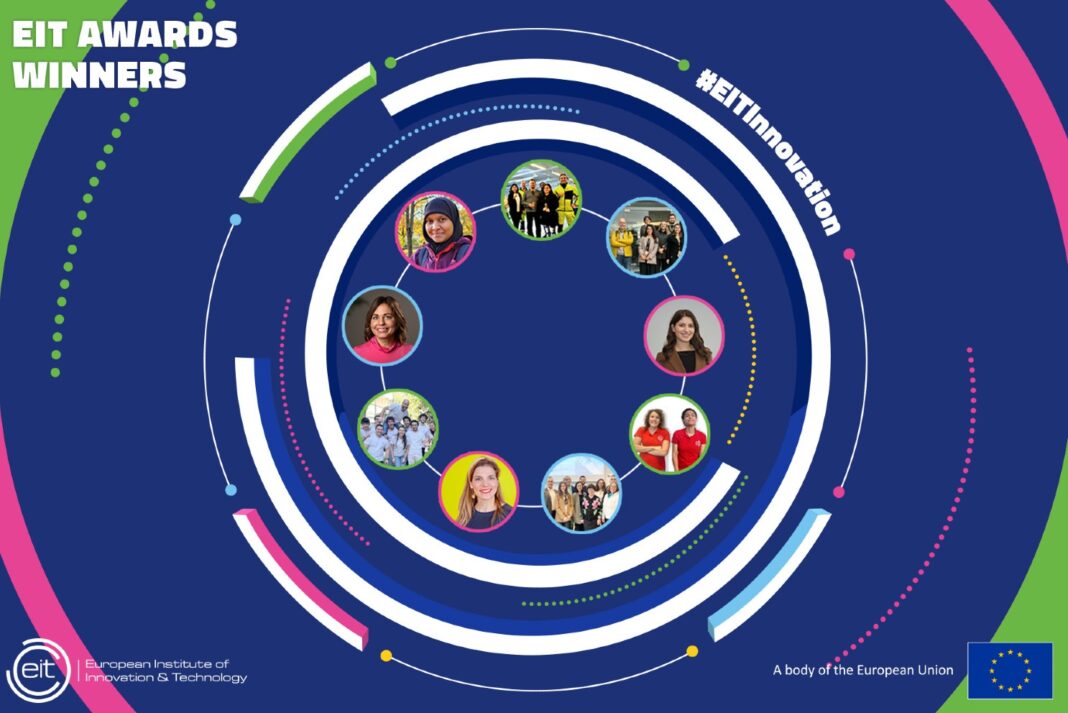
The 2025 winners demonstrate how blending research, business, and education creates real-world solutions that matter
From AI that empowers factory workers to exoskeletons that restore movement, and software that optimizes lithium batteries. This year’s visionaries of the EIT Awards 2025 have once again hit the mark. Transforming industrial floors with human-centric AI and restoring independence through affordable robotics – these are the breakthroughs championed by this year’s winners of the European Institute of Innovation and Technology (EIT) Awards.
Announced at a vibrant ceremony in Budapest on November 25, 2025, these prestigious prizes celebrate the most impactful innovators emerging from Europe’s largest collaborative network.
The EIT Awards distinguish excellence across four pivotal categories:
- the EIT Venture Award for high-potential startups;
- the EIT Innovation Team Award for transformative collaborative projects;
- the EIT Changemaker Award for influential individual leaders;
- the EIT Public Award, selected by popular online vote.
Finalists in each of the three main prize categories competed for the top spot on the podium, with monetary prizes of €50.000 for first place, €30.000 for second, and €20.000 for third.
The winners
EIT Venture Award & EIT Public Award – ABLE Human Motion (Spain)
The standout story of the evening was the Spanish startup ABLE Human Motion, which achieved an exceptional double win. It secured both the EIT Venture Award and the EIT Public Award, triumphing in a competitive field of 43 finalists from 17 countries. Founded by Alfons Carnicero, Alex Garcia, and Josep M. Font at the Universitat Politècnica de Catalunya, ABLE Human Motion addresses a critical societal challenge: mobility for people with spinal cord injuries.
Their innovation lies in a motorised exoskeleton that is as revolutionary in its economics as it is in its engineering. By utilising advanced yet cost-effective materials and a modular design, the team has slashed production costs. This makes personal mobility assistance financially accessible.
Beyond affordability, their core technological achievement is a sophisticated gait algorithm and intuitive control system that allows for a remarkably natural walking motion. This focus on user experience and dignity, combined with accessibility, redefines the potential of rehabilitation technology. In fact, it offers not just movement, but a true restoration of autonomy.
EIT Innovation Team Award – AI Automated Industrial Analytics (Italy)
Winning the coveted EIT Innovation Team Award, the AI Automated Industrial Analytics team from Italy, nominated by EIT Manufacturing, presented a compelling vision for the future of work.
Led by Ann LoCicero, CEO of smartFAB, the team confronted the common fear of AI as a job-replacer. They created a platform that positions it as an essential collaborator.
Their human-centric AI integrates seamlessly with existing factory machinery and workflows. It provides real-time analytics in an intuitive visual format for floor operators. Moreover, it detects microscopic anomalies in production lines, such as vibrations, thermal shifts, or pressure drops. This signals would normally escape human perception, enabling pre-emptive maintenance and drastically reducing downtime.
This project puts the EIT’s “knowledge triangle” into practice by merging university research in machine learning with industrial expertise. Together, they have created a tool that enhances both productivity and job satisfaction. This innovation ultimately strengthens the global competitiveness of European manufacturing.
EIT Venture Award – Runner-up: SofiAlchemist (Finland)
The runner-up for the Venture Award, SofiAlchemist from Finland, tackles sustainability in one of the most resource-intensive industries: mining.
As a specialised division of Sofi Filtration, this team developed a novel filtration technology capable of capturing ultrafine mineral particles- such as gold, cobalt, or lithium – from mining process water. Traditionally, these valuable micron-sized particles were lost as waste, representing both economic loss and environmental contamination. Their ceramic membrane system, developed in close partnership with industrial leader Endomines, recovers over 95% of these materials.
This innovation creates a powerful circular economy model within mining, turning a waste stream into a revenue stream while dramatically reducing the toxic sediment released into waterways, showcasing how environmental stewardship can align perfectly with economic gain.
EIT Venture Award – Third place: Digiclean Solutions AB (Sweden)
Securing third place in the Venture Award was Sweden’s Digiclean Solutions AB, founded by chemical engineer Charlotte Stigen Låstberg.
The company addresses the rampant overuse and waste of industrial chemicals, a silent contributor to pollution and operational cost. Their patented in-line sensor technology provides constant, precise monitoring of chemical concentrations in fluid systems. These systems are common in everything from pharmaceutical manufacturing to food processing.
By maintaining optimal levels automatically, their in-line sensor technology eliminates the industry-standard practice of “over-dosing” for safety margins.
The result is a proven reduction in chemical use by up to 60%, significant cost savings for manufacturers, and a substantial decrease in hazardous effluent, proving that operational efficiency and ecological responsibility are intrinsically linked.
EIT Changemaker Award – Individual innovators driving impact
The EIT Changemaker Award honoured individual visionaries.
The winner, Laura Laringe of Germany. She was recognised for her work with reLi Energy, a startup developing AI-driven software that optimises the charging cycles of lithium-ion batteries. This technology can extend battery lifespans by up to 30%, a crucial innovation for electric vehicles and grid storage, directly combating electronic waste and resource depletion.
Second place went to Laurie Lancee (Netherlands) for her community-driven platform connecting sustainable material suppliers with designers, and third to Farnaz Baksh (Estonia) for her project Robot[ic] Study Companion (rsc.ee), that takes aim at inclusive next-gen edtech.
The awards ceremony
The awards ceremony was more than a celebration. It was a strategic gathering that underscored the EIT’s role as a policy shaper.
The event included the signing of a landmark Memorandum of Understanding with the Government of Malta to boost regional innovation capacity and high-level panels on leveraging deep-tech for place-based growth.
In her address, Antoaneta Angelova Krasteva, Director at the European Commission’s Directorate-General for Education, Youth, Sport and Culture, emphasised:
«The EIT Awards highlight why Europe needs strong innovation ecosystems connecting education, research and business in an innovation ecosystem. These innovators show how entrepreneurship and collaboration can address real challenges that matter to citizens. We are committed to supporting this work and helping more talented Europeans turn their fledgling ideas into marketable solutions».
EIT Director Martin Kern added:
«The innovators we celebrate today are outstanding examples of how European talent can turn strong ideas into impact. In Europe, we need more of that: solutions that improve our lives and help us to regain our ability to compete globally. I warmly congratulate the winners and all finalists for their achievements.».
The EIT ecosystem and its impact across Europe
The European Institute of Innovation and Technology, established by the EU in 2008 and headquartered in Budapest, is a cornerstone of Europe’s innovation strategy. It operates through nine thematic Knowledge and Innovation Communities (KICs) that bridge the “knowledge triangle” of business, research, and higher education.
This unique model is designed to accelerate the transition from idea to impact, directly supporting the goals of the Horizon Europe programme.
The EIT Community has grown into an unparalleled network of over 2,420 partners, including corporations, universities, and research labs.
Its tangible impact is monumental. It has fostered the creation of more than 9,900 startups, launched over 2,400 new products and services. In addition, it has upskilled more than 1.3 million students and professionals. Companies emerging from this ecosystem have attracted €9.5 billion in external investment, achieving a collective valuation of €71 billion. This solidifies the EIT’s status as the engine of transformative, sustainable innovation for Europe.