As AI finds new crystals, Politecnico di Torino reveals how to select them
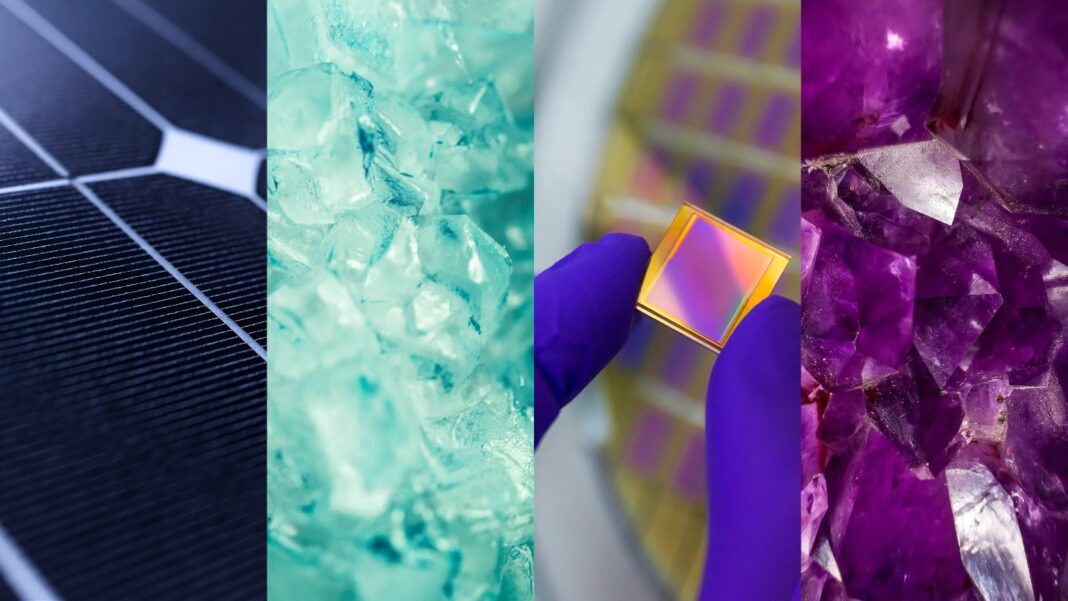
There exists a new continent, not made of land, but of unprecedented atomic structures. It is a vast world, unlocked by AI, but so enormous that no one truly knew how to explore it. Until now. Politecnico di Torino has forged the compass. A research group, through the Energy-GNoME project, has developed an innovative methodological protocol based on a strategic combination of Machine Learning (ML) and Deep Learning (DL) techniques. The purpose is to efficiently and granularly analyze the enormous volume of data derived from GNoME (DeepMind Google), a database of materials generated by AI.
The project aims to classify and direct these materials toward the applications for which they are best suited, a critical factor in a sector such as energy. However, it goes beyond material analysis. In fact, it establish a cross-disciplinary research paradigm applicable to many other sectors, while also promoting the democratization of the study’s results. Moreover, the materials, once processed and tested in the energy application for which they are deemed most suitable, can be produced on a large scale by anyone. This challenges the hegemony held by a few large producers and alters the course of the race for “rare earths”. These raw materials are currently indispensable but represent an unresolved environmental, ethical, and geopolitical problem.
From GNoME to Energy-GNoME
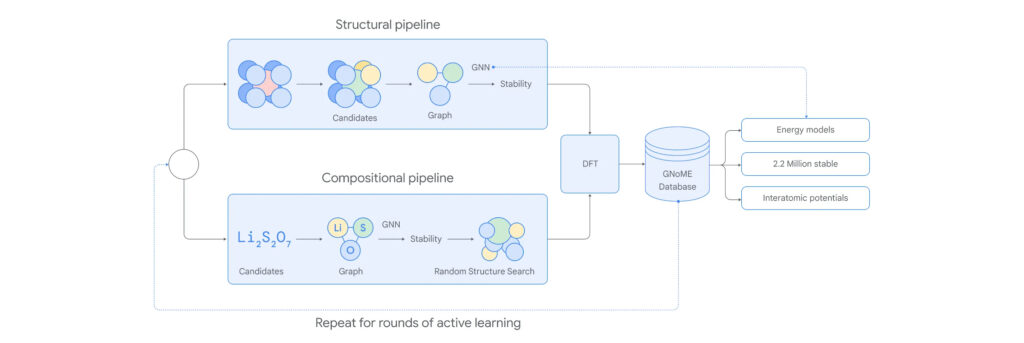
To fully understand Energy-GNoME, it is necessary to first analyze the monumental work on which it builds: the GNoME (Graph Networks for Materials Exploration) project by Google DeepMind. At GNoME’s foundation is an AI architecture specifically designed for the domain of solid-state physical and chemical properties. The primary tools employed are Graph Neural Networks (GNNs) and an Active Learning methodology. What is that? Graph Neural Networks (GNNs) are a class of deep learning models (multi-layered artificial neural networks capable of analyzing complex data systems) particularly suited for extracting graphical representations from data, such as those of crystalline systems that describe the geometry of solid substances.
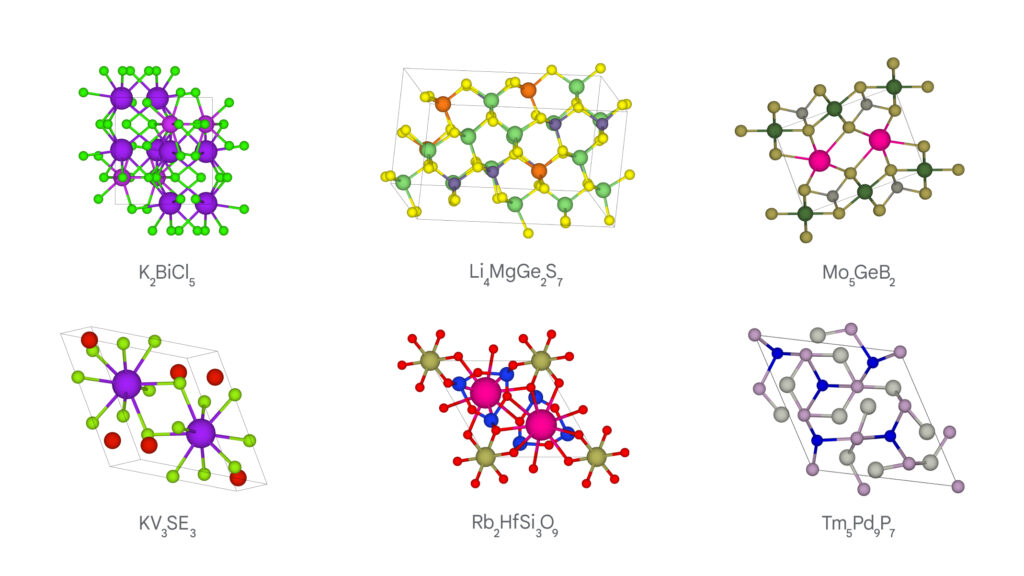
In materials science, a crystal structure can be represented as a graph where the nodes correspond to atoms and the edges (or arcs) represent chemical bonds or, more generally, the connections and distances between atoms. Unlike previous methods that relied on manually engineered descriptors (feature engineering), GNNs autonomously learn from the atomic topology and geometry, capturing complex information about the physical and chemical characteristics that the specific arrangement imparts to the material.
Regarding Active Learning, the process is based on four phases. The first one is prediction, that is generating new, potentially stable crystalline material configurations. This is followed by computational verification, where structures are tested to evaluate their thermodynamic stability. The third phase is refinement. The final step is iteration, which integrates new information into the model and restarts the generative process with greater precision.
An 800-year leap forward in research
This active learning approach, combined with the functional structure of GNNs, allowed GNoME to explore the vast “chemical space” of possible elemental combinations exponentially more efficiently than exhaustive or random screening, concentrating computational resources on the most promising regions of the search space.
In this way, Google DeepMind’s GNoME system led to the discovery of 2.2 million new crystal structures, an undertaking that, according to estimates, would require approximately 800 years of research using traditional approaches. However, the most significant result is not the quantity of structures generated, but the number of materials predicted to be thermodynamically stable. Stability represents a fundamental prerequisite for a material to exist and for researchers to synthesize it in a laboratory.
From this vast trove of data, GNoME successfully identified 380,000 stable potential materials with technological applications. However, a complete characterization of these materials was not performed. Consequently, information on their functional properties and subsequent technological applications was not disclosed. This limitation is understandable, as the database is too vast to allow experimental analysis or in-depth computational simulations for every possible application. The focus of the research has thus shifted. It is no longer about generating new candidates, but about their interpretation, selection, and targeted characterization. This is precisely where the work of Politecnico di Torino comes into play.
To systematically filter and leverage a massive dataset
The Energy-GNoME project aims to bridge this gap by providing an “essential bridge between the generation of new materials and their practical use”. The goal is to develop a fixed methodological protocol to sift through the vast amount of structural data more rapidly and functionally, enabling the high-precision identification of the most promising materials. In this case, with a strong focus on the energy sector.
However, the innovation of Energy-GNoME lies in its shift of the fundamental computational paradigm, enabling functional and application-oriented screening in drastically shorter timeframes compared to traditional approaches or even classical computational simulation. It is no longer simply about “discovering” new materials – that is a traditionally long and uncertain process – but about systematically filtering, connecting, and exploiting an already large and growing dataset of candidate materials.
In the past, the primary goal was to find, to discover a functional material. Today, that same material enters a living digital ecosystem, consisting of an updatable database that constantly integrates new measurements, simulations, and applications. In other words, what was once the final result now becomes an intermediate step. An identified material can be immediately tested, optimized, and applied in a rapid cycle, allowing a process that once took years or decades to be completed in months, or even weeks.
An interdisciplinary and open-science research framework
Energy-GNoME is one of the first interdisciplinary projects to address this new paradigm: transforming the “raw material” provided by AI and computational models into usable and applicable forms of knowledge. The researchers, coordinated by Professor Eliodoro Chiavazzo, are affiliated with the SMaLL (multi-Scale ModeLing Laboratory), located at the “Galileo Ferraris” Department of Energy (DENERG), a center of excellence for research in energy and thermodynamics. In line with the principles of open science, the team has made the Energy-GNoME database a publicly accessible resource for the scientific community, encouraging its adoption and use for further research.
Implications in the Energy Sector
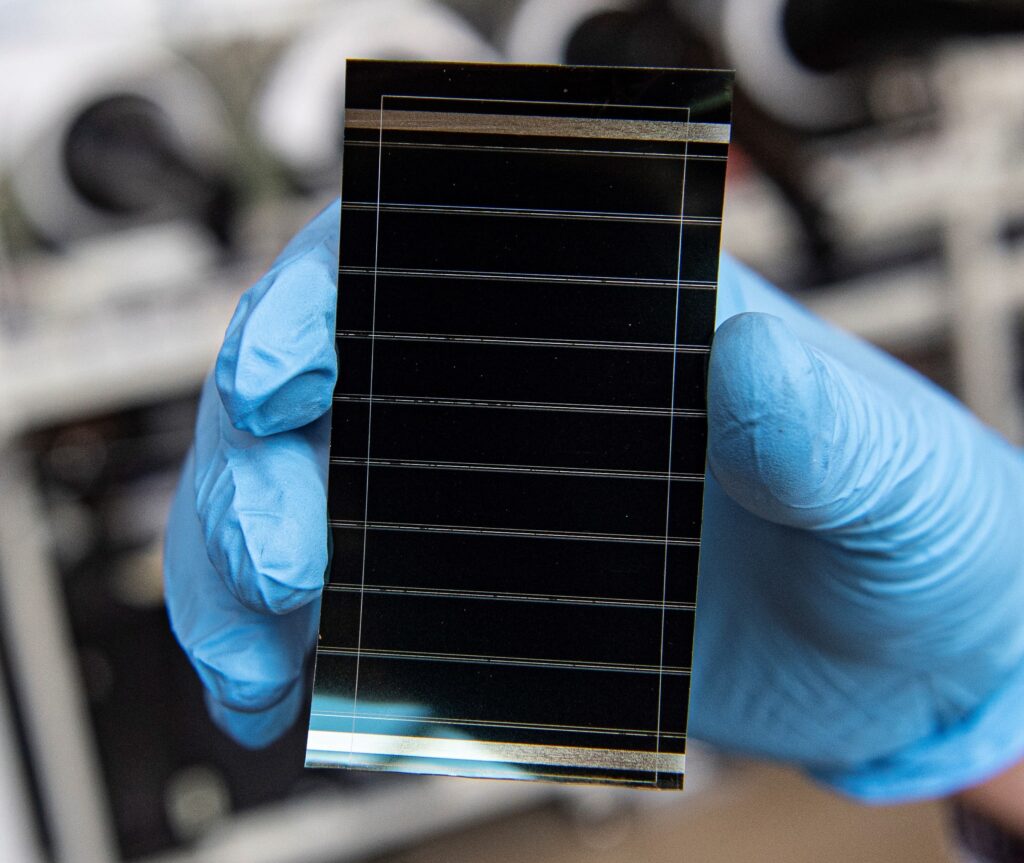
The application of the Energy-GNoME protocol to the vast GNoME database has produced an unprecedented catalog of new candidate materials, specifically selected for their potential in energy generation and conversion. The results focus on three technological areas of strategic importance for the energy transition. The first is perovskite photovoltaics (approx. 4,300 candidate materials). The second is thermoelectric materials for heat recovery (approx. 7,500 candidates). The third concerns cathodes for high-performance batteries (approx. 21,000 possible candidates).
Perovskite photovoltaics
Energy storage is the pillar supporting the transition to an energy system based on intermittent renewable sources like solar and wind, as well as being the key technology for the electrification of transport.
Perovskite-based solar cells have emerged in recent years as one of the most promising photovoltaic technologies. They potentially offer energy conversion efficiency superior to that of silicon (the traditional material for solar cells) but with the advantageous characteristic of being easier to produce.
However, limited durability – especially under conditions of humidity and heat – and the presence of toxic lead still hinder their large-scale commercialization. For these reasons, the Energy-GNoME protocol screened the GNoME database and identified 4,259 new materials with a perovskite structure. Each one possesses the key electronic property for absorbing the most efficient portion of the solar spectrum and converting it into electricity. An optimal band gap is crucial for maximizing a solar cell’s efficiency. The exploration of such a vast number of new chemical compositions, within such an accelerated process, significantly increases the probability of identifying perovskites that are intrinsically more stable or lead-free.
Cathode materials for high-performance batteries
Regarding batteries, lithium-ion batteries currently dominate the market, but there is a need to develop batteries with higher energy density, greater safety, and a longer lifespan.
The cathode material (the positive electrode) plays a predominant role in determining these performance metrics. The cathode material families currently in use are the result of decades of research. Each presents a specific trade-off between its characteristic properties, with different energy densities, costs, and durability. The goal is to create a new cathode material that surpasses these trade-offs and reduces the supply dependency on expensive and geopolitically critical elements, such as “rare earths”.
In this domain, Energy-GNoME produced its most impressive result. It produced a number of identifications several orders of magnitude greater than any previous screening effort – totaling 21,243 new candidate materials for use as cathodes in lithium-ion batteries and beyond (sodium, potassium, etc.). The key properties for this application are voltage and stability. Voltage acts as a power multiplier. For the same capacity, a material that operates at a higher voltage produces a battery with a higher energy density. The direct result is greater range for devices and vehicles.
Stability, on the other hand, is the key to longevity. It determines the material’s ability to withstand hundreds or thousands of charge-discharge cycles without degrading, ensuring performance does not plummet over time.
Democratizing method and materials
It is essential to emphasize that the results presented by Energy-GNoME are, at present, computational predictions. The next crucial and indispensable steps are the experimental synthesis and validation in the laboratory of the most promising candidates identified by the protocol. The publication of this vast catalog of potential cathode materials – complete with predictions of their operating voltage – enables far more targeted and efficient research compared to traditional, slower, more expensive, intuitive, and trial-and-error-based exploration. There is a second fundamental contribution of Energy-GNoME to science: the interdisciplinarity of its methodological paradigm. The two-phase process (classification of a vast data repertoire + regression based on characteristic functions) is domain-agnostic. Therefore, it can be extended to other fields beyond those addressed by the project, offering a potential methodological pipeline that can be used as a standard in other sectors.
The openness and accessibility of the Energy-GNoME database have the potential to democratize battery material discovery. Currently, large corporations and national laboratories equipped with immense computational and experimental resources often dominate research in this field. By providing a pre-filtered database of thousands of high-potential candidates, the Politecnico di Torino team significantly lowers the barrier to entry for smaller university labs or research groups worldwide. These groups can now focus their available resources on the crucial phase of synthesis and validation of the most viable candidates, rather than on high-risk, high-cost initial screening. This act of making knowledge freely accessible and more democratic is not an end in itself or a political stance, but a potential catalyst for more distributed, collaborative, and accelerated innovation in the field of energy storage.
References
- Zheng, Y. (2024). Artificial Intelligence and Machine Learning for Materials. Current Opinion in Solid State & Materials Science, 34, 101202.
- Energy-GNoME: A living database of selected materials for energy applications. https://paolodeangelis.github.io/Energy-GNoME/#
- De Angelis, P., Barletta, G., Trezza, G., Asinari, P., & Chiavazzo, E. (2025). Energy-GNoME: A living database of selected materials for energy applications. Energy and AI, 22, 100605.